<g id=”cross”>
<line class=”cls-1″ x1=”7″ x2=”25″ y1=”7″ y2=”25″ />
<line class=”cls-1″ x1=”7″ x2=”25″ y1=”25″ y2=”7″ />
</g>
Madagascar’s Unfinished Revolution: Can a Youth Uprising Break the Country’s Political Curse?
<circle cx=”10.5″ cy=”10.5″ r=”7.5″ />
<line x1=”21″ x2=”15.8″ y1=”21″ y2=”15.8″ />
<nav class=”fo-navigation pos-r” itemscope itemtype=”http://schema.org/Navigation”>
Login
Sections <circle cx=”10.5″ cy=”10.5″ r=”7.5″ />
<line x1=”21″ x2=”15.8″ y1=”21″ y2=”15.8″ />
Search
<circle cx=”10.5″ cy=”10.5″ r=”7.5″ />
<line x1=”21″ x2=”15.8″ y1=”21″ y2=”15.8″ />
Search


PUBLICATION
Support Fair Observer
We rely on your support for our independence, diversity and quality.
</nav>
</header>

<main id=”main” class=”site-main” role=”main”> 



Friday, December 26, 2025
<header class=”entry-header”>
Madagascar’s Unfinished Revolution: Can a Youth Uprising Break the Country’s Political Curse?
In Madagascar, a youth-led revolt has toppled a president and ushered in a military-led transition. Sparked by protests over collapsing public services and shrinking freedoms, the uprising drew in the armed forces and fractured state institutions. Whether this moment becomes a democratic turning point — or another loop in Madagascar’s long cycle of crises — remains uncertain.
By
Friday, December 26, 2025
</header>

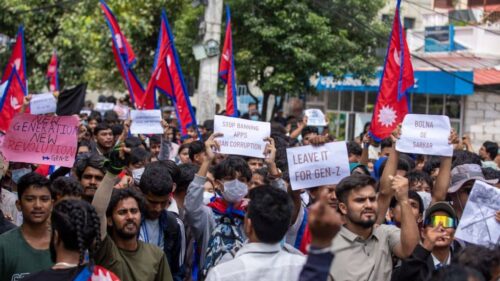
September 30, 2025: Protesters march on the streets of Antananarivo, Madagascar. Via Shutterstock.

December 26, 2025 07:52 EDT

Check out our comment feature!
Saved Successfully.
This article saved into your bookmarks. Click here to view your bookmarks.


Since September, Madagascar has been in the throes of a fast-moving political crisis that toppled President Andry Rajoelina and brought a military-led transitional regime to power. What began as small demonstrations by Generation Z activists in the capital Antananarivo — protesting severe water and electricity shortages — quickly grew into a nationwide movement amplified by influencers and opposition voices.
Protests spread to other cities such as Toamasina, Antsiranana and Toliara, and violent clashes with security forces left several injured and at least 22 people dead, according to the UN High Commissioner for Human Rights — figures the government denies.
Within days, frustration with daily hardships and a lack of freedom of expression escalated into an open demand that Rajoelina resign.
A decisive military defection
The turning point came on October 11, when the Corps d’administration des personnels et des services administratifs et techniques (CAPSAT) unit of the armed forces unexpectedly joined protesters at Antananarivo’s symbolic Place du 13 Mai — a square historically tied to several protests that ultimately led to the downfall of multiple governments since 1972. The move evoked memories of the 2009 crisis, when the military also sided with opposition-led protests.
One day later, President Rajoelina abruptly left the country. While the presidency insisted he was on an overseas mission, foreign media reported he had been evacuated from Sainte Marie island aboard a French military aircraft. Speaking via social media from an undisclosed “secure location,” Rajoelina claimed he had received death threats.
Constitutional showdown
October 14 marked a chaotic escalation. The National Assembly announced it would convene to remove Rajoelina from office. In response, the presidency issued a decree dissolving the Assembly. Lawmakers — across opposition, independents and even the ruling party — ignored the decree and voted to remove him anyway.
Hours later, CAPSAT forces led by Colonel Michaël Randrianirina declared they were “taking responsibility” for the country. Rajoelina’s allies called it a coup; the military insisted it was a necessary intervention. The High Constitutional Court quickly validated the takeover, declaring the presidency vacant due to Rajoelina’s “passive abandonment of power.”
With the Senate presidency itself in disarray, the court chose an unprecedented path: endorsing a military-led transition and effectively “inviting” Randrianirina to power, thereby giving his takeover a semblance of legality.
The “refoundation” begins
On October 17, Colonel Randrianirina was sworn in as President of the “Refoundation of the Republic of Madagascar,” launching a two-year transitional period. Among other reform measures outlined in a six-step plan, the new leadership pledged to conduct a national consultation, organize a constitutional referendum and hold presidential elections.
The concept of “refoundation” has become a rallying cry for breaking with decades of corruption, patronage and institutional fragility. Gen Z activists have demanded entirely new leaders across all institutions. But controversy erupted quickly. The appointment of Prime Minister Herintsalama Rajaonarivelo — criticized for alleged ties to figures close to the former regime — raised doubts about how deep the renewal will truly go. By October 28, a new cabinet of 29 nonmilitary members had been installed.
Justice or political score-settling?
A wave of arrests and searches targeting figures close to the former ruling circle has fueled growing unease. While the new authorities portray the moves as a fight against impunity, critics see echoes of past governments that weaponized the justice system against opponents. Once again, the line between accountability and political revenge is blurred.
This latest turmoil marks Madagascar’s sixth major political crisis since independence — following those of 1972, 1991, 2002, 2009 and 2018. Unlike its predecessors, however, the 2025 revolt was driven not by political elites but by young citizens demanding dignity, opportunity and responsive governance — a development that has been driven by anger over the steady erosion of public services and civil rights.
The stakes are enormous in a country already struggling with severe social and economic fragility. As evidenced by the Bertelsmann Transformation Index (BTI), Madagascar has witnessed a stark decline in the political and social realm over the past 20 years, with indicators such as freedom of expression (from 8 to 3) and commitment to democratic institutions (from 9 to 3) dropping drastically. Similarly, economic indicators such as market organization and liberalization of trade have stagnated at relatively low levels.
An uncertain international embrace
With regard to the current political situation, the international community appears divided. Although foreign diplomats attended Randrianirina’s swearing-in, the African Union suspended Madagascar while simultaneously dispatching envoys to mediate. This ambiguity threatens the new regime’s access to international financing, making international recognition a top priority.
Diplomatically, the transition government has signaled openness to all partners but has notably leaned toward Russia: The Russian ambassador was the first foreign official to meet Randrianirina after his inauguration, and the new National Assembly president, Siteny Randrianasoloniaiko, traveled to Moscow soon after.
A crossroads: renewal or repetition?
All eyes now turn to the national consultation, expected to be convened by Madagascar’s influential Ecumenical Council of Christian Churches. The process is meant to chart the transition’s long-term political future, including the drafting of a new constitution. Yet skepticism is warranted.
Recent events — echoing findings from a recent Afrobarometer survey show that while most Malagasy citizens support democracy and reject military rule, many are willing to tolerate military involvement when civilian leaders abuse their power. It’s a stance that, paradoxically, weakens democracy itself.
Still, forward-looking debates are already emerging: Should Madagascar remain a unitary state or move toward federalism? Should decentralization finally be strengthened? And when will a constitutional referendum be held before the return to elected leadership?
We are a nonprofit, truly independent media organization committed to delivering diverse, fact-based global analysis. If you like what you are reading, sign up for our free newsletters now.
<label for=”Your email will be shared with fairobserver and subject to its Privacy Policy”>I agree to receive emails and other content from Fair Observer. I understand that I may repeal my consent at any time. You can review our Privacy Policy and Terms of Use for further information…</label>
The answers will determine whether Madagascar can finally escape its cycle of instability — or whether this moment, like so many before, will slip into the familiar pattern of hope, upheaval and disappointment.
[African Arguments first published this piece.]
[Kaitlyn Diana edited this piece.]
The views expressed in this article are the author’s own and do not necessarily reflect Fair Observer’s editorial policy.
Comment
0 Comments
Newest
Oldest
Most Voted
Most Voted
Inline Feedbacks
View all comments
Commenting Guidelines
Please read our commenting guidelines before commenting.
1. Be Respectful: Please be polite to the author. Avoid hostility. The whole point of Fair Observer is openness to different perspectives from perspectives from around the world.
2. Comment Thoughtfully: Please be relevant and constructive. We do not allow personal attacks, disinformation or trolling. We will remove hate speech or incitement.
3. Contribute Usefully: Add something of value — a point of view, an argument, a personal experience or a relevant link if you are citing statistics and key facts.
<label style=”font-size: 18px;”>
I have read and agree to the above commenting guidelines.
</label>
Please agree to the guidelines before proceeding.
I
Agree, Proceed to Login
Cancel
Related Reading
FO° Exclusive: Global Lightning Roundup of October 2025
In this section of the October 2025 episode of FO° Exclusive, Atul Singh and Glenn Carle reflect on a world…
by
Glenn Carle & Atul Singh,
November 9, 2025
The Unseriousness of Young Revolutionaries
Young protesters across the world use humor, memes and pop culture to confront failing governments and rigid institutions. Their decentralized…
by
Tara Yarwais,
November 8, 2025
Harvesting Happiness in Poverty: Impressions of Madagascar
by
Felix Haas,
November 26, 2012
Support Fair Observer
We rely on your support for our independence, diversity and quality.
For more than 10 years, Fair Observer has been free, fair and independent. No billionaire
owns us, no advertisers control us. We are a reader-supported nonprofit. Unlike many other
publications, we keep our content free for readers regardless of where they live or whether
they can afford to pay. We have no paywalls and no ads.
In the post-truth era of fake news, echo chambers and filter bubbles, we publish a plurality
of perspectives from around the world. Anyone can publish with us, but everyone goes through
a rigorous editorial process. So, you get fact-checked, well-reasoned content instead of
noise.
We publish 3,000+ voices from 90+ countries. We also conduct education and training programs
on subjects ranging from digital media and journalism to writing and critical thinking. This
doesn’t come cheap. Servers, editors, trainers and web developers cost
money.
Please consider supporting us on a regular basis as a recurring donor or a
sustaining member.
Will you support FO’s journalism?
We rely on your support for our independence, diversity and quality.
Donation Cycle
<label for=”donation_cycle_one_time”>One Time</label>
<label for=”donation_cycle_monthly”>Monthly</label>
<label for=”donation_cycle_yearly”>Yearly</label>
Donation Amount
<label for=”amount_11″>$11</label>
<label for=”amount_111″>$111</label>
<label for=”other”>Other</label>
$
The IRS recognizes Fair Observer as a section 501(c)(3) registered public charity
(EIN: 46-4070943), enabling you to claim a tax deduction.
Make Sense of the World
Unique Insights from 3,000+ Contributors in 90+ Countries
<label
for=”Your email will be shared with fairobserver and subject to its Privacy Policy”>I
agree to receive emails and other content from Fair Observer. I understand
that I
may repeal my consent at any time. You can review our Privacy Policy
and Terms of Use
for further
information .</label>
for=”Your email will be shared with fairobserver and subject to its Privacy Policy”>I
agree to receive emails and other content from Fair Observer. I understand
that I
may repeal my consent at any time. You can review our Privacy Policy
and Terms of Use
for further
information .</label>
Look at the world through many prisms — 3,000+ pairs of eyes from 90+ countries. We are a rare nonprofit in the world news space and you can get our newsletters for free.
<label for=”Your email will be shared with fairobserver and subject to its Privacy Policy”>I agree to receive emails and other content from Fair Observer. I understand that I may repeal my consent at any time. You can review our Privacy Policy and Terms of Use for further information…</label>
</main>
Fair Observer, 461 Harbor Blvd, Belmont, CA 94002, USA
<footer class=”mart70 fo-black-bg padt50 padb30″>
Sections
PUBLICATION
Support Fair Observer
We rely on your support for our independence, diversity and quality.


</footer>

<footer id=”fixed-footer” class=”support-footer”>


Support
independent, crowdsourced, nonprofit
journalism.
Fair Observer is a 501(c)(3) independent nonprofit. We are not owned by billionaires or controlled by
advertisers. We publish nearly 3,000 authors from over 90 countries after fact-checking and editing each
piece. We do not have a paywall and anyone can read us for free. With your vital donations, we can
continue
to do our work.
Please make a recurring (or even one-time) donation today. Even $1 goes a long way because
a
million donors
like you mean one million dollars. Thank you for keeping us independent, free and fair.
One Time
Monthly
Yearly
Monthly
Yearly
Continue 

</footer>

Sign into your Fair Observer Account
<label class=”tml-label” for=”user_login”>Username or Email Address</label>
<label class=”tml-label” for=”user_pass”>Password</label>
<label class=”tml-label” for=”rememberme”>Remember Me</label>
Log In
Forgot
Password
Forgot Password
Enter your registered email address or username. You will receive a
link to create a new password via email.
Please enter your username or email address. You will receive an email message with instructions on how to reset your password.
<label class=”tml-label” for=”user_login”>Username or Email Address</label>
Get New Password
Or
Return to
Login
Forgot Password
We have sent a link to your registered email address to reset your password.
<circle cx=”12.5″ cy=”12″ r=”12″ fill=”#414141″ />
Back to
Login
Become a Member & Enjoy Exclusive Benefits!
<circle cx=”12.5″ cy=”12″ r=”12″ fill=”#414141″ />
Access to comments feature
<circle cx=”12.5″ cy=”12″ r=”12″ fill=”#414141″ />
Bookmark your favorite articles
<circle cx=”12.5″ cy=”12″ r=”12″ fill=”#414141″ />
Exclusive invitations to FO° Talks & FO° Live
<circle cx=”12.5″ cy=”12″ r=”12″ fill=”#414141″ />
Access to all of our e-publications
Return to
Login
Login
NEWSLETTER
Make Sense of the World
Unique Insights from 2,500+ Contributors in 90+ Countries

<label
for=”Your email will be shared with fairobserver and subject to it’s Privacy Policy”>I
agree to receive emails and other content from Fair Observer. I understand
that I may repeal my consent at any time. You can review our Privacy Policy
and Terms of Use
for further information.</label>
for=”Your email will be shared with fairobserver and subject to it’s Privacy Policy”>I
agree to receive emails and other content from Fair Observer. I understand
that I may repeal my consent at any time. You can review our Privacy Policy
and Terms of Use
for further information.</label>
NEWSLETTER
Make Sense of the World
Unique Insights from 2,500+ Contributors in 90+ Countries
<label
for=”Your email will be shared with fairobserver and subject to it’s Privacy Policy”>I
agree to receive emails and other content from Fair Observer. I understand
that I may repeal my consent at any time. You can review our Privacy Policy
and Terms of Use
for further information.</label>
for=”Your email will be shared with fairobserver and subject to it’s Privacy Policy”>I
agree to receive emails and other content from Fair Observer. I understand
that I may repeal my consent at any time. You can review our Privacy Policy
and Terms of Use
for further information.</label>

Make Sense of the World
Unique Insights from 2,500+ Contributors in 90+ Countries
<label
for=”Your email will be shared with fairobserver and subject to its Privacy Policy”>I
agree to receive emails and other content from Fair Observer. I understand that I
may repeal my consent at any time. You can review our Privacy Policy and Terms of Use for further
information .</label>
for=”Your email will be shared with fairobserver and subject to its Privacy Policy”>I
agree to receive emails and other content from Fair Observer. I understand that I
may repeal my consent at any time. You can review our Privacy Policy and Terms of Use for further
information .</label>
We Need Your Consent
We use cookies to give you the best possible experience. Learn more about how we use cookies or edit your cookie preferences. Privacy Policy. My Options I Accept
Privacy & Cookies Policy
Close
Edit Cookie Preferences
The Fair Observer website uses digital cookies so it can collect statistics on how many visitors come to the site, what content is viewed and for how long, and the general location of the computer network of the visitor. These statistics are collected and processed using the Google Analytics service. Fair Observer uses these aggregate statistics from website visits to help improve the content of the website and to provide regular reports to our current and future donors and funding organizations. The type of digital cookie information collected during your visit and any derived data cannot be used or combined with other information to personally identify you. Fair Observer does not use personal data collected from its website for advertising purposes or to market to you.
As a convenience to you, Fair Observer provides buttons that link to popular social media sites, called social sharing buttons, to help you share Fair Observer content and your comments and opinions about it on these social media sites. These social sharing buttons are provided by and are part of these social media sites. They may collect and use personal data as described in their respective policies. Fair Observer does not receive personal data from your use of these social sharing buttons. It is not necessary that you use these buttons to read Fair Observer content or to share on social media.
Necessary
<label class=”form-check-label” for=”wt-cli-checkbox-necessary”>Necessary</label>
Always Enabled
These cookies essential for the website to function.
Social Media
<label for=”wt-cli-checkbox-social_media” class=”cli-slider” data-cli-enable=”Enabled” data-cli-disable=”Disabled”>Social Media</label>
These cookies are used to enable sharing or following of content that you find interesting on our website. These settings apply to third-party social networking and other websites.
Performance & Functionality
<label for=”wt-cli-checkbox-performance” class=”cli-slider” data-cli-enable=”Enabled” data-cli-disable=”Disabled”>Performance & Functionality</label>
These cookies are used to enhance the performance and functionality of our website. They provide statistics on how our website is used and help us improve by measuring errors. Certain functionalities on our website may become unavailable without these cookies.
Analytics
<label for=”wt-cli-checkbox-analytics” class=”cli-slider” data-cli-enable=”Enabled” data-cli-disable=”Disabled”>Analytics</label>
SAVE & ACCEPT
<textarea id=’wpd-editor-source-code’></textarea>Insert
</body>
</html>
Total Views:
Source: World Politics - fairobserver.com