<g id=”cross”>
<line class=”cls-1″ x1=”7″ x2=”25″ y1=”7″ y2=”25″ />
<line class=”cls-1″ x1=”7″ x2=”25″ y1=”25″ y2=”7″ />
</g>
Militant Democracy in Germany: Balancing Protection and Freedom
<circle cx=”10.5″ cy=”10.5″ r=”7.5″ />
<line x1=”21″ x2=”15.8″ y1=”21″ y2=”15.8″ />
<nav class=”fo-navigation pos-r” itemscope itemtype=”http://schema.org/Navigation”>
Login
Sections <circle cx=”10.5″ cy=”10.5″ r=”7.5″ />
<line x1=”21″ x2=”15.8″ y1=”21″ y2=”15.8″ />
Search
<circle cx=”10.5″ cy=”10.5″ r=”7.5″ />
<line x1=”21″ x2=”15.8″ y1=”21″ y2=”15.8″ />
Search


PUBLICATION
Support Fair Observer
We rely on your support for our independence, diversity and quality.
</nav>
</header>

<main id=”main” class=”site-main” role=”main”> 





Saturday, December 06, 2025
<header class=”entry-header”>
Militant Democracy in Germany: Balancing Protection and Freedom
Germany’s militant democracy aims to protect democratic values against far-right extremism and antisemitism, rooted in its post-World War II constitution. Recent proposals, like those from Felix Klein to criminalize specific chants, reflect the ongoing tension between safeguarding freedoms and preventing hate. This balance remains a critical challenge in contemporary German society.
By
Saturday, December 06, 2025
</header>

Via Shutterstock.

December 06, 2025 06:38 EDT

Check out our comment feature!
Saved Successfully.
This article saved into your bookmarks. Click here to view your bookmarks.


Germany’s approach to militant democracy offers a striking example of how a country with a difficult past attempts to defend its democratic values against internal threats. Rooted in the aftermath of World War II, militant democracy holds that democracy must act decisively to protect itself from forces seeking to undermine it through violence, hate or authoritarianism. This principle continues to shape Germany’s efforts to combat far-right extremism, antisemitism and terrorism today.
Germany’s historical struggle with far-right extremism
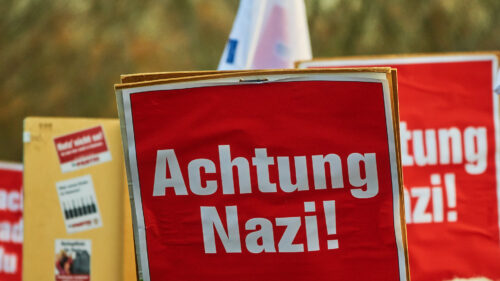
The history of far-right extremism in Germany is long and complex. Ultranationalist movements that emerged in the late 19th century culminated in the rise of the Nazi Party. After World War II, Germany enshrined militant democracy in its constitution and passed laws banning Nazi symbols and political parties threatening democratic order.
Over time, this framework addressed new challenges, including the resurgence of far-right parties like the National Democratic Party, the xenophobic violence after reunification, and today’s rise of the Alternative for Germany, a populist party capitalizing on fears related to immigration and economic uncertainty.
How militant democracy works in practice
Militant democracy involves government actions to curb hate speech, ban extremist organizations and enforce antidiscrimination laws. Agencies like the Federal Office for the Protection of the Constitution monitor extremist groups and help prevent violence, while educational and integration programs aim to address radicalization’s social roots.
Yet militant democracy raises difficult questions. While many see these policies as necessary to safeguard democracy, others worry about their impact on freedom of expression and political dissent. Critics argue that restrictions can suppress minority opinions and deepen societal divisions. Far-right groups often portray these measures as oppressive government overreach, fueling further polarization. This tension between protecting democracy and preserving democratic freedoms remains an ongoing challenge.
A recent example highlights this dilemma. Felix Klein, Germany’s Federal Commissioner for Combating Antisemitism, has proposed legislation to criminalize chants such as “From the River to the Sea, Palestine will be free.” Here is where it all falls: Critics of Klein can easily argue that this is censorship and not fighting against antisemitism.
The law reflects Germany’s tradition of militant democracy but also raises concerns about where the line should be drawn between hate speech and free political expression. While these policy responses address the recent sharp rise in antisemitic incidents, some argue that certain measures are misplaced or premature. However, they often overlook the fact that Israelis also use the phrase. Should we then also ban that usage and label it antisemitic?
The ongoing tension between security and freedom
At the same time, Germany’s experience invites reflection on the complex balance between safeguarding democracy and upholding freedoms. As militant democracy policies evolve, questions persist about their potential to suppress legitimate dissent or alienate segments of the population. Does militant democracy effectively prevent extremism, or does it risk deepening divisions and undermining the very freedoms it seeks to protect? Germany’s case remains a live experiment in managing this tension in a democratic society.
You can read the CIA Factbook and listen to MI6 people for your analysis, or you could read perspectives from our 3,000+ authors from 90+ countries and make sense of the world. Sign up for our free newsletters now.
<label for=”Your email will be shared with fairobserver and subject to its Privacy Policy”>I agree to receive emails and other content from Fair Observer. I understand that I may repeal my consent at any time. You can review our Privacy Policy and Terms of Use for further information…</label>
Ultimately, militant democracy reminds us that democracy is not guaranteed but requires ongoing defense against both old and new threats. Understanding the psychological and social dynamics of radicalization is essential to shaping policies that are effective yet respect core democratic values. The evolving German response, including Klein’s legislative initiatives, offers a crucial example for democracies worldwide as they navigate the challenges of protecting pluralism and freedom in an uncertain world.
[Kaitlyn Diana edited this piece.]
The views expressed in this article are the author’s own and do not necessarily reflect Fair Observer’s editorial policy.
Comment
0 Comments
Newest
Oldest
Most Voted
Most Voted
Inline Feedbacks
View all comments
Commenting Guidelines
Please read our commenting guidelines before commenting.
1. Be Respectful: Please be polite to the author. Avoid hostility. The whole point of Fair Observer is openness to different perspectives from perspectives from around the world.
2. Comment Thoughtfully: Please be relevant and constructive. We do not allow personal attacks, disinformation or trolling. We will remove hate speech or incitement.
3. Contribute Usefully: Add something of value — a point of view, an argument, a personal experience or a relevant link if you are citing statistics and key facts.
<label style=”font-size: 18px;”>
I have read and agree to the above commenting guidelines.
</label>
Please agree to the guidelines before proceeding.
I
Agree, Proceed to Login
Cancel
Related Reading
Germany’s Firefighters Fail to Put Far-Right Infiltration Out
Germany’s million-strong volunteer firefighter corps is a culturally influential and trusted institution. Now, however, it faces far-right infiltration attempts. The…
by
Kiran Bowry,
September 12, 2023
How to Demobilize the Far Right
There are many means of demobilizing the far right, with non-state actors playing a crucial role.
by
Michael Zeller,
October 28, 2021
From Opera to MMA: Nationalist Symbolism and the German Far Right
The symbolism of the Nibelungenlied has a long history of co-option by Germany’s extremists.
by
Michael Zeller,
August 12, 2021
The Strategy of Tension: Bringing Down German Democracy
A neo-Nazi plan to ignite a civil war and bring about the collapse of German democracy echoes Italy’s Years of…
by
Leonard Weinberg,
June 29, 2021
Support Fair Observer
We rely on your support for our independence, diversity and quality.
For more than 10 years, Fair Observer has been free, fair and independent. No billionaire
owns us, no advertisers control us. We are a reader-supported nonprofit. Unlike many other
publications, we keep our content free for readers regardless of where they live or whether
they can afford to pay. We have no paywalls and no ads.
In the post-truth era of fake news, echo chambers and filter bubbles, we publish a plurality
of perspectives from around the world. Anyone can publish with us, but everyone goes through
a rigorous editorial process. So, you get fact-checked, well-reasoned content instead of
noise.
We publish 3,000+ voices from 90+ countries. We also conduct education and training programs
on subjects ranging from digital media and journalism to writing and critical thinking. This
doesn’t come cheap. Servers, editors, trainers and web developers cost
money.
Please consider supporting us on a regular basis as a recurring donor or a
sustaining member.
Will you support FO’s journalism?
We rely on your support for our independence, diversity and quality.
Donation Cycle
<label for=”donation_cycle_one_time”>One Time</label>
<label for=”donation_cycle_monthly”>Monthly</label>
<label for=”donation_cycle_yearly”>Yearly</label>
Donation Amount
<label for=”amount_11″>$11</label>
<label for=”amount_111″>$111</label>
<label for=”other”>Other</label>
$
The IRS recognizes Fair Observer as a section 501(c)(3) registered public charity
(EIN: 46-4070943), enabling you to claim a tax deduction.
Make Sense of the World
Unique Insights from 3,000+ Contributors in 90+ Countries
<label
for=”Your email will be shared with fairobserver and subject to its Privacy Policy”>I
agree to receive emails and other content from Fair Observer. I understand
that I
may repeal my consent at any time. You can review our Privacy Policy
and Terms of Use
for further
information .</label>
for=”Your email will be shared with fairobserver and subject to its Privacy Policy”>I
agree to receive emails and other content from Fair Observer. I understand
that I
may repeal my consent at any time. You can review our Privacy Policy
and Terms of Use
for further
information .</label>
No owners, no ads, just global voices and first class editors. We’re a nonprofit that puts real journalism first. Join us — subscribe to our free newsletters — now.
<label for=”Your email will be shared with fairobserver and subject to its Privacy Policy”>I agree to receive emails and other content from Fair Observer. I understand that I may repeal my consent at any time. You can review our Privacy Policy and Terms of Use for further information…</label>
</main>
Fair Observer, 461 Harbor Blvd, Belmont, CA 94002, USA
<footer class=”mart70 fo-black-bg padt50 padb30″>
Sections
PUBLICATION
Support Fair Observer
We rely on your support for our independence, diversity and quality.


</footer>

<footer id=”fixed-footer” class=”support-footer”>


Support
independent, crowdsourced, nonprofit
journalism.
Fair Observer is a 501(c)(3) independent nonprofit. We are not owned by billionaires or controlled by
advertisers. We publish nearly 3,000 authors from over 90 countries after fact-checking and editing each
piece. We do not have a paywall and anyone can read us for free. With your vital donations, we can
continue
to do our work.
Please make a recurring (or even one-time) donation today. Even $1 goes a long way because
a
million donors
like you mean one million dollars. Thank you for keeping us independent, free and fair.
One Time
Monthly
Yearly
Monthly
Yearly
Continue 

</footer>

Sign into your Fair Observer Account
<label class=”tml-label” for=”user_login”>Username or Email Address</label>
<label class=”tml-label” for=”user_pass”>Password</label>
<label class=”tml-label” for=”rememberme”>Remember Me</label>
Log In
Forgot
Password
Forgot Password
Enter your registered email address or username. You will receive a
link to create a new password via email.
Please enter your username or email address. You will receive an email message with instructions on how to reset your password.
<label class=”tml-label” for=”user_login”>Username or Email Address</label>
Get New Password
Or
Return to
Login
Forgot Password
We have sent a link to your registered email address to reset your password.
<circle cx=”12.5″ cy=”12″ r=”12″ fill=”#414141″ />
Back to
Login
Become a Member & Enjoy Exclusive Benefits!
<circle cx=”12.5″ cy=”12″ r=”12″ fill=”#414141″ />
Access to comments feature
<circle cx=”12.5″ cy=”12″ r=”12″ fill=”#414141″ />
Bookmark your favorite articles
<circle cx=”12.5″ cy=”12″ r=”12″ fill=”#414141″ />
Exclusive invitations to FO° Talks & FO° Live
<circle cx=”12.5″ cy=”12″ r=”12″ fill=”#414141″ />
Access to all of our e-publications
Return to
Login
Login
NEWSLETTER
Make Sense of the World
Unique Insights from 2,500+ Contributors in 90+ Countries

<label
for=”Your email will be shared with fairobserver and subject to it’s Privacy Policy”>I
agree to receive emails and other content from Fair Observer. I understand
that I may repeal my consent at any time. You can review our Privacy Policy
and Terms of Use
for further information.</label>
for=”Your email will be shared with fairobserver and subject to it’s Privacy Policy”>I
agree to receive emails and other content from Fair Observer. I understand
that I may repeal my consent at any time. You can review our Privacy Policy
and Terms of Use
for further information.</label>
NEWSLETTER
Make Sense of the World
Unique Insights from 2,500+ Contributors in 90+ Countries
<label
for=”Your email will be shared with fairobserver and subject to it’s Privacy Policy”>I
agree to receive emails and other content from Fair Observer. I understand
that I may repeal my consent at any time. You can review our Privacy Policy
and Terms of Use
for further information.</label>
for=”Your email will be shared with fairobserver and subject to it’s Privacy Policy”>I
agree to receive emails and other content from Fair Observer. I understand
that I may repeal my consent at any time. You can review our Privacy Policy
and Terms of Use
for further information.</label>

Make Sense of the World
Unique Insights from 2,500+ Contributors in 90+ Countries
<label
for=”Your email will be shared with fairobserver and subject to its Privacy Policy”>I
agree to receive emails and other content from Fair Observer. I understand that I
may repeal my consent at any time. You can review our Privacy Policy and Terms of Use for further
information .</label>
for=”Your email will be shared with fairobserver and subject to its Privacy Policy”>I
agree to receive emails and other content from Fair Observer. I understand that I
may repeal my consent at any time. You can review our Privacy Policy and Terms of Use for further
information .</label>
We Need Your Consent
We use cookies to give you the best possible experience. Learn more about how we use cookies or edit your cookie preferences. Privacy Policy. My Options I Accept
Privacy & Cookies Policy
Close
Edit Cookie Preferences
The Fair Observer website uses digital cookies so it can collect statistics on how many visitors come to the site, what content is viewed and for how long, and the general location of the computer network of the visitor. These statistics are collected and processed using the Google Analytics service. Fair Observer uses these aggregate statistics from website visits to help improve the content of the website and to provide regular reports to our current and future donors and funding organizations. The type of digital cookie information collected during your visit and any derived data cannot be used or combined with other information to personally identify you. Fair Observer does not use personal data collected from its website for advertising purposes or to market to you.
As a convenience to you, Fair Observer provides buttons that link to popular social media sites, called social sharing buttons, to help you share Fair Observer content and your comments and opinions about it on these social media sites. These social sharing buttons are provided by and are part of these social media sites. They may collect and use personal data as described in their respective policies. Fair Observer does not receive personal data from your use of these social sharing buttons. It is not necessary that you use these buttons to read Fair Observer content or to share on social media.
Necessary
<label class=”form-check-label” for=”wt-cli-checkbox-necessary”>Necessary</label>
Always Enabled
These cookies essential for the website to function.
Social Media
<label for=”wt-cli-checkbox-social_media” class=”cli-slider” data-cli-enable=”Enabled” data-cli-disable=”Disabled”>Social Media</label>
These cookies are used to enable sharing or following of content that you find interesting on our website. These settings apply to third-party social networking and other websites.
Performance & Functionality
<label for=”wt-cli-checkbox-performance” class=”cli-slider” data-cli-enable=”Enabled” data-cli-disable=”Disabled”>Performance & Functionality</label>
These cookies are used to enhance the performance and functionality of our website. They provide statistics on how our website is used and help us improve by measuring errors. Certain functionalities on our website may become unavailable without these cookies.
Analytics
<label for=”wt-cli-checkbox-analytics” class=”cli-slider” data-cli-enable=”Enabled” data-cli-disable=”Disabled”>Analytics</label>
SAVE & ACCEPT
<textarea id=’wpd-editor-source-code’></textarea>Insert
</body>
</html>
Total Views:
Source: World Politics - fairobserver.com