<g id=”cross”>
<line class=”cls-1″ x1=”7″ x2=”25″ y1=”7″ y2=”25″ />
<line class=”cls-1″ x1=”7″ x2=”25″ y1=”25″ y2=”7″ />
</g>
Revealing the Clash of Our Time: Generations, Not Nations
<circle cx=”10.5″ cy=”10.5″ r=”7.5″ />
<line x1=”21″ x2=”15.8″ y1=”21″ y2=”15.8″ />
<nav class=”fo-navigation pos-r” itemscope itemtype=”http://schema.org/Navigation”>
Login
Sections <circle cx=”10.5″ cy=”10.5″ r=”7.5″ />
<line x1=”21″ x2=”15.8″ y1=”21″ y2=”15.8″ />
Search
<circle cx=”10.5″ cy=”10.5″ r=”7.5″ />
<line x1=”21″ x2=”15.8″ y1=”21″ y2=”15.8″ />
Search


PUBLICATION
Support Fair Observer
We rely on your support for our independence, diversity and quality.
</nav>
</header>

<main id=”main” class=”site-main” role=”main”> 




Friday, December 12, 2025
<header class=”entry-header”>
Revealing the Clash of Our Time: Generations, Not Nations
Samuel P. Huntington argued that global conflict after the Cold War would emerge between civilizations. Three decades later, those civilizational tensions remain — but a second, cross-cutting divide is transforming politics from within: the generational fault line. Gen Z, raised under economic precarity, climate instability and digital hyper-connectivity, is confronting institutions built by older elites.
By
Friday, December 12, 2025
</header>

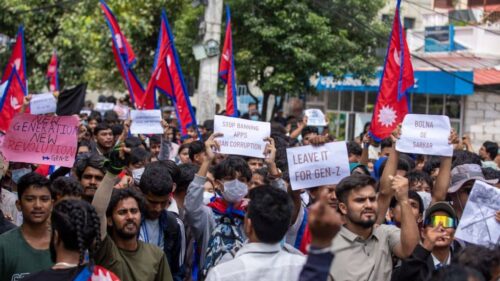
Group of young activists against land exploitation.

December 12, 2025 07:23 EDT

Check out our comment feature!
Saved Successfully.
This article saved into your bookmarks. Click here to view your bookmarks.


When American political scientist Samuel P. Huntington published The Clash of Civilizations, he argued that post-Cold War conflict would shift from ideology to culture, with Western, Islamic, Sinic and other blocs clashing along deep cultural fault lines. Three decades later, his map still explains much of the world’s violence: leaders in Ukraine, Gaza, Myanmar and India routinely invoke “civilizational defense,” showing how cultural identity remains a powerful political weapon.
Huntington remains relevant not because he foresaw specific crises, but because he recognized how elites use civilizational narratives to legitimize exclusion and mobilize support. Yet his framework missed a crucial overlay: the internal fractures within civilizations themselves, especially a rising generational divide.
Huntington did not anticipate that young people across very different cultural blocs would face strikingly similar economic and ecological disruptions, producing grievances rooted not in civilizational identity but in shared material insecurity. This internal rift is visible from Muslim-majority Bangladesh to Nepal’s Hindu-Buddhist politics to Western democracies, where young people confront ruling elites who benefited from systems no longer delivering for younger cohorts.
These parallel movements show that today’s conflicts are shaped as much by generational struggles within civilizations as by cultural boundaries between them. Huntington mapped the external edges; the generational fault lines running through his civilizations are the missing layer needed to understand contemporary upheaval.
How intergenerational inequality reshapes conflict
Intergenerational inequality has become a structural force driving unrest because young people across civilizations now enter adulthood under conditions fundamentally different from their elders. A harmonized study of 42 countries shows that intergenerational income inequality (IGI) has risen sharply in most high-income states, as younger adults face widening wage and employment gaps while older cohorts benefit from asset gains and protected job markets.
At the same time, global reviews show that inequality between countries hasfallen while inequality within them has grown, creating internal hierarchies that disproportionately burden younger generations. These patterns explain why young adults from the US and the UK to Bangladesh and Kenya share a vocabulary of exclusion grounded not in culture but in material disadvantage: debt, insecure work, unaffordable housing and limited mobility.
Scholars argue that this economic gap is reshaping politics by producing distinct “historical generations” formed during periods of crisis — financial collapse, climate instability and pandemic disruption. Youth movements emerge when a generation’s ideals collide with existing institutions, generating conflict with entrenched systems rather than with elders as individuals.
A “generational us,”as described by Sociologist Cécile Van de Velde, forms when young adults recognize that broader structures favor older insiders. This aligns with theories that youth activism reflects both developmental needs for agency and the unique “generational times” in which they come of age, clarifying why generational pressures now fracture civilizations from within while extending — rather than replacing — Huntington’s framework.
How Gen Z mobilization extends Huntington’s thesis
Any claim about a “clash of generations” must reckon with history. The late 1960s and 1970s saw an unprecedented wave of youth uprisings — from Paris and Prague to Mexico City, Karachi and Berkeley — that challenged authoritarianism, colonial wars and rigid gender norms. Some historians now describe 1968 as a transnational youth revolt, linked by television, travel and a shared vocabulary of anti-imperialism and liberation.
Those movements, however, were still largely organized through national student unions, parties and ideological currents — socialism, Maoism, anticolonial nationalism, feminism. Many tried to build new “isms” and institutions: radical parties, alternative universities and new media. Their victories and defeats helped create the world we inherited, from expanded university systems to more liberal cultural norms.
By contrast, today’s Gen Z mobilizations arise after those ideological projects have frayed. Austerity, privatization and climate breakdown have undermined faith in both old socialist and neoliberal promises.
Young people organize around more concrete and immediate demands — affordable housing, an end to police abuse, climate safety, honest elections — and less around grand blueprints for utopia. Sociologists of contemporary movements in Spain and Italy describe a “precarious generation” whose protests reflect frustration with unstable jobs and shrinking welfare states.
Digital media also changes the scale and speed of connection. When the climate movement Fridays for Future called a global strike in September 2019, an estimated 6 million people joined protests in over 150 countries, making it one of the largest coordinated youth mobilizations in history.
Gen Z is not the first protest generation. What is new is that they act as a global political generation formed in a hyper-connected, unequal and warming world where older ideological projects appear exhausted.
Gen Z uprisings across the Global South
Recent uprisings from Dhaka to Jakarta show how generational anger erupts inside very different “civilizations,” exposing shared grievances beneath local histories.
In Bangladesh, student protests over a public-sector quota system in 2024 quickly escalated into a nationwide revolt against authoritarian rule, joblessness and police violence. Weeks of marches and strikes ended with Prime Minister Sheikh Hasina’s resignation after the military refused to sustain a harsh crackdown. UN officials and rights groups documented hundreds of killings and alleged that the true toll may exceed 1,400, underscoring the extraordinary price young Bangladeshis paid to force political change.
Nepal reveals a related dynamic through the ballot box. The 2022 election of rapper-engineer Balendra “Balen” Shah as Kathmandu’s mayor reflected young urban voters’ frustration with corruption, pollution and stagnant services. Youth campaigns such as “Enough is Enough” and the rise of the Rastriya Swatantra Party channel a broader rejection of an older political class that promised federal democracy but delivered patronage and gridlock.
Indonesia’s recent unrest similarly showed how quickly discontent spreads. Revelations about lavish parliamentary perks triggered youth-led demonstrations across 32 of 38 provinces, coordinated on TikTok and messaging apps, resulting in several deaths and more than a thousand arrests.
Kenya offers another parallel: in 2024, Gen Z-led protests against a punitive finance bill forced the government to retreat even after security forces killed and disappeared demonstrators.
The most noticeable aspect of the “Gen Z” movement is that many of these movements are deliberately decentralized, more like swarms than hierarchies. As an expat participant of the Gen Z uprising in Bangladesh 2024, I closely observed this complex pattern. It was led by a generation, not political leaders. But people from all generations and walks of life spontaneously participated.
Taken together, these cases reveal young people confronting older ruling blocs within their own societies, often against the background of civilizational rhetoric deployed by those very elites.
When youth take power: beyond identity, towards material justice
Another sign that generational politics is reshaping Huntington’s map is the way youth-driven movements are now propelling leaders with layered identities and materially redistributive platforms into office.
In New York City, Zohran Mamdani’s rise from local organizer to mayor illustrates this shift. A Ugandan-born Muslim democratic socialist, he first won a New York State Assembly seat in 2020 by defeating a long-time incumbent with a grassroots campaign focused on tenants, immigrants and working-class voters.
In 2025, he then won the Democratic primary and general election for mayor against figures like former governor Andrew Cuomo, running on policies such as rent freezes, free buses and taxing the wealthy. Coverage of his campaign notes that his core support came from younger, more diverse voters mobilized through social media and volunteer networks rather than traditional party machines.
Globally, similar patterns appear. Chile’s president Gabriel Boric moved from leading 2011 student protests against inequality to heading a left-wing coalition that promised tax reform, expanded social rights and a new constitution. In many countries, young climate activists like Greta Thunberg and Vanessa Nakate have not sought office but have shifted public debate by insisting that older leaders confront the long-term costs of their decisions.
The clash between two generations
Social and political scientists define “generational units” as the unfolding of major events across local and world history that were experienced by a specific group of youth in their impressionable years. Sociologists theorized that different world times shaped different generations into historical or political generations.
The 1970s youth movements were the historical response of youth in a post-colonial world. Modernity, liberalism, communism and other “-isms” showed a path in the bleak era of nuclear and modern expansionism. The youth of the 21st century becomes a political generation with a realization of the modernist fallacy — the dangerous fiction, according to sociologist Bruno Latour, that promised freedom from dependency on nature, reduction of human labour, by separating nature and culture.
We are a rare nonprofit in the world news space. Most other organizations are owned by billionaires or governments. We are bottom-up, not top-down and bring you perspectives from around the world. So, sign up now for our free newsletters to hear from our 3,000+ voices from 90+ countries.
<label for=”Your email will be shared with fairobserver and subject to its Privacy Policy”>I agree to receive emails and other content from Fair Observer. I understand that I may repeal my consent at any time. You can review our Privacy Policy and Terms of Use for further information…</label>
Rather, the youth now face an apocalyptic future of natural disasters, social and intellectual collapse, all made by older generations. The economic, technological, political and educational promises are already shattered. They can see how porous identities are, and they respond by not clashing between the civilizations — rather merging and reshaping them, like Latour’s Hybrids. These kids outrun shooting cops in Pikachu costumes in the middle of a full-on riot. Earth now has the largest youth population in human history, and our species is evolving culturally and socially to provide the basics for them.
[Casey Herrmann edited this piece]
The views expressed in this article are the author’s own and do not necessarily reflect Fair Observer’s editorial policy.
Comment
0 Comments
Newest
Oldest
Most Voted
Most Voted
Inline Feedbacks
View all comments
Commenting Guidelines
Please read our commenting guidelines before commenting.
1. Be Respectful: Please be polite to the author. Avoid hostility. The whole point of Fair Observer is openness to different perspectives from perspectives from around the world.
2. Comment Thoughtfully: Please be relevant and constructive. We do not allow personal attacks, disinformation or trolling. We will remove hate speech or incitement.
3. Contribute Usefully: Add something of value — a point of view, an argument, a personal experience or a relevant link if you are citing statistics and key facts.
<label style=”font-size: 18px;”>
I have read and agree to the above commenting guidelines.
</label>
Please agree to the guidelines before proceeding.
I
Agree, Proceed to Login
Cancel
Related Reading
The Unseriousness of Young Revolutionaries
Young protesters across the world use humor, memes and pop culture to confront failing governments and rigid institutions. Their decentralized…
by
Tara Yarwais,
November 8, 2025
FO° Talks: How Zohran Mamdani and Gen Z Voters Are Shaping the New York Mayoral Race
In this episode of FO° Talks, Rohan Khattar Singh and Daniel Idfresne examine how New York City Mayor Eric Adams’s…
by
Daniel Idfresne & Rohan Khattar Singh,
October 30, 2025
FO° Exclusive: Economic Pain and Political Turmoil Around the World
In this section of the September 2025 episode of FO° Exclusive, Atul Singh and Glenn Carle discuss how decades of…
by
Glenn Carle & Atul Singh,
October 6, 2025
Transparency as the Foundation for Bangladesh’s 2026 General Elections
Bangladesh heads toward a pivotal 2026 election under Chief Adviser Muhammad Yunus’s provisional government. After Sheikh Hasina’s ouster, transparency is…
by
Abubakar Iqbal Sheikh,
September 26, 2025
Support Fair Observer
We rely on your support for our independence, diversity and quality.
For more than 10 years, Fair Observer has been free, fair and independent. No billionaire
owns us, no advertisers control us. We are a reader-supported nonprofit. Unlike many other
publications, we keep our content free for readers regardless of where they live or whether
they can afford to pay. We have no paywalls and no ads.
In the post-truth era of fake news, echo chambers and filter bubbles, we publish a plurality
of perspectives from around the world. Anyone can publish with us, but everyone goes through
a rigorous editorial process. So, you get fact-checked, well-reasoned content instead of
noise.
We publish 3,000+ voices from 90+ countries. We also conduct education and training programs
on subjects ranging from digital media and journalism to writing and critical thinking. This
doesn’t come cheap. Servers, editors, trainers and web developers cost
money.
Please consider supporting us on a regular basis as a recurring donor or a
sustaining member.
Will you support FO’s journalism?
We rely on your support for our independence, diversity and quality.
Donation Cycle
<label for=”donation_cycle_one_time”>One Time</label>
<label for=”donation_cycle_monthly”>Monthly</label>
<label for=”donation_cycle_yearly”>Yearly</label>
Donation Amount
<label for=”amount_11″>$11</label>
<label for=”amount_111″>$111</label>
<label for=”other”>Other</label>
$
The IRS recognizes Fair Observer as a section 501(c)(3) registered public charity
(EIN: 46-4070943), enabling you to claim a tax deduction.
Most Popular
Islamofactism, Part 8: Hate Speech Against Muslims
The word “Islamophobia” and its definition have been highly contested amongst scholars, authors and policymakers regarding its ability to allow…
by
Rahul Sur,
August 31, 2025
Fighting Islamophobia With Islamofactism: A New Ten-Part Series
The word “Islamophobia” and its definition have been highly contested amongst scholars, authors and policymakers regarding its ability to allow…
by
Rahul Sur,
August 8, 2025
Make Sense of the World
Unique Insights from 3,000+ Contributors in 90+ Countries
<label
for=”Your email will be shared with fairobserver and subject to its Privacy Policy”>I
agree to receive emails and other content from Fair Observer. I understand
that I
may repeal my consent at any time. You can review our Privacy Policy
and Terms of Use
for further
information .</label>
for=”Your email will be shared with fairobserver and subject to its Privacy Policy”>I
agree to receive emails and other content from Fair Observer. I understand
that I
may repeal my consent at any time. You can review our Privacy Policy
and Terms of Use
for further
information .</label>
Look at the world through many prisms — 3,000+ pairs of eyes from 90+ countries. We are a rare nonprofit in the world news space and you can get our newsletters for free.
<label for=”Your email will be shared with fairobserver and subject to its Privacy Policy”>I agree to receive emails and other content from Fair Observer. I understand that I may repeal my consent at any time. You can review our Privacy Policy and Terms of Use for further information…</label>
</main>
Fair Observer, 461 Harbor Blvd, Belmont, CA 94002, USA
<footer class=”mart70 fo-black-bg padt50 padb30″>
Sections
PUBLICATION
Support Fair Observer
We rely on your support for our independence, diversity and quality.


</footer>

<footer id=”fixed-footer” class=”support-footer”>


Support
independent, crowdsourced, nonprofit
journalism.
Fair Observer is a 501(c)(3) independent nonprofit. We are not owned by billionaires or controlled by
advertisers. We publish nearly 3,000 authors from over 90 countries after fact-checking and editing each
piece. We do not have a paywall and anyone can read us for free. With your vital donations, we can
continue
to do our work.
Please make a recurring (or even one-time) donation today. Even $1 goes a long way because
a
million donors
like you mean one million dollars. Thank you for keeping us independent, free and fair.
One Time
Monthly
Yearly
Monthly
Yearly
Continue 

</footer>

Sign into your Fair Observer Account
<label class=”tml-label” for=”user_login”>Username or Email Address</label>
<label class=”tml-label” for=”user_pass”>Password</label>
<label class=”tml-label” for=”rememberme”>Remember Me</label>
Log In
Forgot
Password
Forgot Password
Enter your registered email address or username. You will receive a
link to create a new password via email.
Please enter your username or email address. You will receive an email message with instructions on how to reset your password.
<label class=”tml-label” for=”user_login”>Username or Email Address</label>
Get New Password
Or
Return to
Login
Forgot Password
We have sent a link to your registered email address to reset your password.
<circle cx=”12.5″ cy=”12″ r=”12″ fill=”#414141″ />
Back to
Login
Become a Member & Enjoy Exclusive Benefits!
<circle cx=”12.5″ cy=”12″ r=”12″ fill=”#414141″ />
Access to comments feature
<circle cx=”12.5″ cy=”12″ r=”12″ fill=”#414141″ />
Bookmark your favorite articles
<circle cx=”12.5″ cy=”12″ r=”12″ fill=”#414141″ />
Exclusive invitations to FO° Talks & FO° Live
<circle cx=”12.5″ cy=”12″ r=”12″ fill=”#414141″ />
Access to all of our e-publications
Return to
Login
Login
NEWSLETTER
Make Sense of the World
Unique Insights from 2,500+ Contributors in 90+ Countries

<label
for=”Your email will be shared with fairobserver and subject to it’s Privacy Policy”>I
agree to receive emails and other content from Fair Observer. I understand
that I may repeal my consent at any time. You can review our Privacy Policy
and Terms of Use
for further information.</label>
for=”Your email will be shared with fairobserver and subject to it’s Privacy Policy”>I
agree to receive emails and other content from Fair Observer. I understand
that I may repeal my consent at any time. You can review our Privacy Policy
and Terms of Use
for further information.</label>
NEWSLETTER
Make Sense of the World
Unique Insights from 2,500+ Contributors in 90+ Countries
<label
for=”Your email will be shared with fairobserver and subject to it’s Privacy Policy”>I
agree to receive emails and other content from Fair Observer. I understand
that I may repeal my consent at any time. You can review our Privacy Policy
and Terms of Use
for further information.</label>
for=”Your email will be shared with fairobserver and subject to it’s Privacy Policy”>I
agree to receive emails and other content from Fair Observer. I understand
that I may repeal my consent at any time. You can review our Privacy Policy
and Terms of Use
for further information.</label>

Make Sense of the World
Unique Insights from 2,500+ Contributors in 90+ Countries
<label
for=”Your email will be shared with fairobserver and subject to its Privacy Policy”>I
agree to receive emails and other content from Fair Observer. I understand that I
may repeal my consent at any time. You can review our Privacy Policy and Terms of Use for further
information .</label>
for=”Your email will be shared with fairobserver and subject to its Privacy Policy”>I
agree to receive emails and other content from Fair Observer. I understand that I
may repeal my consent at any time. You can review our Privacy Policy and Terms of Use for further
information .</label>
We Need Your Consent
We use cookies to give you the best possible experience. Learn more about how we use cookies or edit your cookie preferences. Privacy Policy. My Options I Accept
Privacy & Cookies Policy
Close
Edit Cookie Preferences
The Fair Observer website uses digital cookies so it can collect statistics on how many visitors come to the site, what content is viewed and for how long, and the general location of the computer network of the visitor. These statistics are collected and processed using the Google Analytics service. Fair Observer uses these aggregate statistics from website visits to help improve the content of the website and to provide regular reports to our current and future donors and funding organizations. The type of digital cookie information collected during your visit and any derived data cannot be used or combined with other information to personally identify you. Fair Observer does not use personal data collected from its website for advertising purposes or to market to you.
As a convenience to you, Fair Observer provides buttons that link to popular social media sites, called social sharing buttons, to help you share Fair Observer content and your comments and opinions about it on these social media sites. These social sharing buttons are provided by and are part of these social media sites. They may collect and use personal data as described in their respective policies. Fair Observer does not receive personal data from your use of these social sharing buttons. It is not necessary that you use these buttons to read Fair Observer content or to share on social media.
Necessary
<label class=”form-check-label” for=”wt-cli-checkbox-necessary”>Necessary</label>
Always Enabled
These cookies essential for the website to function.
Social Media
<label for=”wt-cli-checkbox-social_media” class=”cli-slider” data-cli-enable=”Enabled” data-cli-disable=”Disabled”>Social Media</label>
These cookies are used to enable sharing or following of content that you find interesting on our website. These settings apply to third-party social networking and other websites.
Performance & Functionality
<label for=”wt-cli-checkbox-performance” class=”cli-slider” data-cli-enable=”Enabled” data-cli-disable=”Disabled”>Performance & Functionality</label>
These cookies are used to enhance the performance and functionality of our website. They provide statistics on how our website is used and help us improve by measuring errors. Certain functionalities on our website may become unavailable without these cookies.
Analytics
<label for=”wt-cli-checkbox-analytics” class=”cli-slider” data-cli-enable=”Enabled” data-cli-disable=”Disabled”>Analytics</label>
SAVE & ACCEPT
<textarea id=’wpd-editor-source-code’></textarea>Insert
</body>
</html>
Total Views:
Source: World Politics - fairobserver.com