<g id=”cross”>
<line class=”cls-1″ x1=”7″ x2=”25″ y1=”7″ y2=”25″ />
<line class=”cls-1″ x1=”7″ x2=”25″ y1=”25″ y2=”7″ />
</g>
A Nation’s Rivers Remember What Was Cut Away: Indonesia’s Flood Crisis
<circle cx=”10.5″ cy=”10.5″ r=”7.5″ />
<line x1=”21″ x2=”15.8″ y1=”21″ y2=”15.8″ />
<nav class=”fo-navigation pos-r” itemscope itemtype=”http://schema.org/Navigation”>
Login
Sections <circle cx=”10.5″ cy=”10.5″ r=”7.5″ />
<line x1=”21″ x2=”15.8″ y1=”21″ y2=”15.8″ />
Search
<circle cx=”10.5″ cy=”10.5″ r=”7.5″ />
<line x1=”21″ x2=”15.8″ y1=”21″ y2=”15.8″ />
Search


PUBLICATION
Support Fair Observer
We rely on your support for our independence, diversity and quality.
</nav>
</header>

<main id=”main” class=”site-main” role=”main”> 


Sunday, December 28, 2025
<header class=”entry-header”>
A Nation’s Rivers Remember What Was Cut Away: Indonesia’s Flood Crisis
Legal deforestation has stripped Sumatra’s watersheds of natural flood defenses, turning extreme rainfall into a predictable humanitarian disaster. Plantation expansion and sanctioned land clearing have intensified flooding while undermining Indonesia’s climate commitments and public trust. The crisis exposes a stark moral and policy choice between extractive development and a resilient path grounded in forest protection and restoration.
By
Sunday, December 28, 2025
</header>
Via Shutterstock.

December 28, 2025 08:07 EDT

Check out our comment feature!
Saved Successfully.
This article saved into your bookmarks. Click here to view your bookmarks.


Indonesia is burning and bleeding at the same time: what should be a sober, national reckoning has been turned into a ledger of permits and profit, with legal land-clearing now the dominant engine of forest loss across Sumatra, Kalimantan and Papua as plantations, pulp mills and mineral concessions expand — palm oil remains a major driver while the nickel rush and new processing plants are doubling deforestation rates around smelters and mining zones, shredding habitats and coastal fisheries in their wake.
Legal deforestation as national policy
Satellite and field analyses indicate that the clearing is not a fringe crime but a mapped, sanctioned process tied to strategic projects and concessions, and that the damage is concentrated where biodiversity and carbon stores are richest.
According to Global Forest Watch, Indonesia lost 260,000 hectares of forest in 2024, releasing an estimated 190 million tonnes of carbon dioxide into the atmosphere, a figure echoed by civil society monitors and contested by official tallies.
The scale of forest loss leaves little room for abstract debate. Independent monitoring found that Indonesia’s tree cover losses in 2024 were measured in the hundreds of thousands of hectares — roughly the equivalent of several Jakarta’s — and that nearly all the most recent losses occurred within legally authorized concessions. That transformation of upland watersheds into monoculture plantations has a hydraulic consequence: forests act like sponges, and when those sponges are replaced by single-species oil palm stands, runoff spikes and flash floods become more likely.
Global Canopy’s (a nonprofit that targets the market forces destroying nature) work in Aceh, documented for policymakers and communities, shows plantation-dominated catchments flood three to five times more often than intact forested systems — not an abstract correlation but a local lived reality.
From land-use change to climate diplomacy
This is not only an internal policy dilemma. Indonesia sits at the center of global commodity chains and climate diplomacy. Land-use change — much of it driven by plantation expansion — has accounted for nearly half of the country’s greenhouse gas emissions over recent decades, complicating pledges made at international conferences and undermining credibility with partners seeking durable climate action.
The diplomatic irony is sharp: victories at trade panels or at the World Trade Organization (WTO) over market access for palm derivatives ring hollow if the homeland keeps being sold short of the resilience needed to face a warmer, stormier century.
Comparative experience matters. The late-2025 floods in Sumatra are part of an unsettling pattern observed elsewhere in tropical forest states. In Brazil, accelerating Amazon clearance has produced urban flooding and heat stress in Amazonian cities. In Belém, the loss of tree cover led to a summer of chronic flooding and record temperatures that became impossible to ignore during a recent international climate conference. These are parallel expressions of a single governance problem: an extractive approach to natural capital that externalises risk onto marginalised communities and into the future.
The Philippines’ extraordinary late-2024 typhoon season, which displaced over a million people, and Myanmar’s loss of nearly 290,000 hectares of forest in the same year, underscore that Sumatra’s floods are part of a wider Southeast Asian crisis of climate vulnerability and ecological degradation.
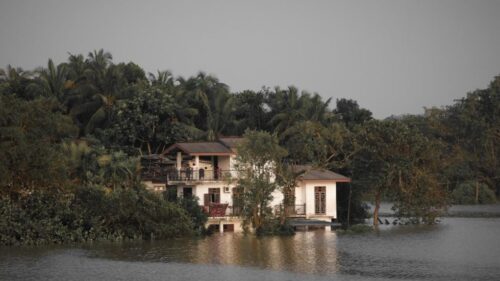
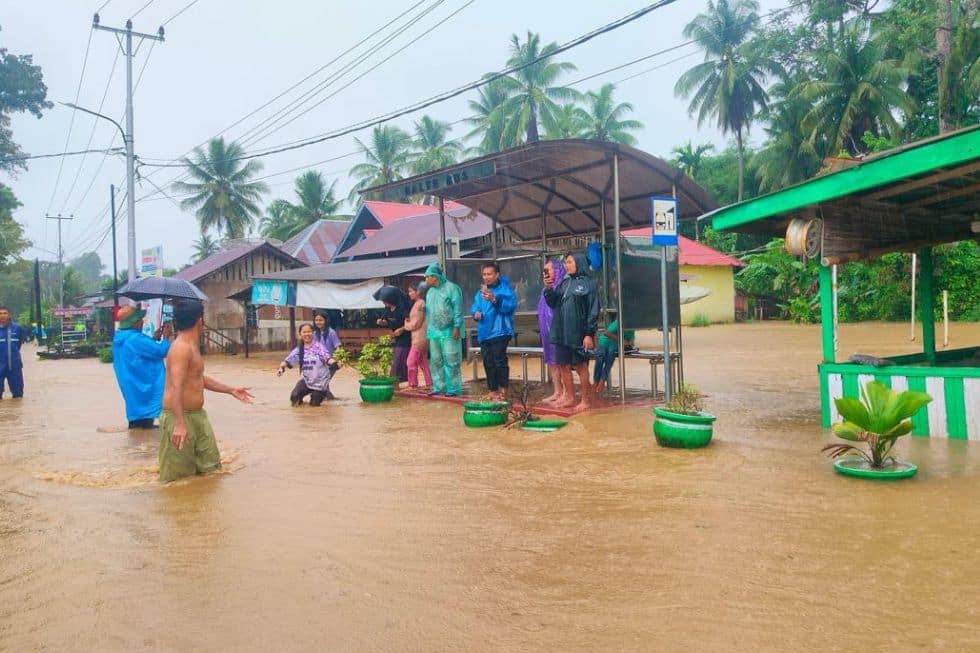
Sumatra’s floods pose a stark moral question: how much forest and how many rivers must be sacrificed before a development model is judged dangerous to its own people? The answer is visible in submerged roofs, muddy queues for clean water and communities whose losses were predictable. When an unusually intense November cyclone met landscapes reshaped for profit, a humanitarian catastrophe became inevitable.
The human toll
Human costs are staggering and still rising. Official tallies and reporting in the immediate aftermath of the Sumatra flood recorded 1,000 dead, 200 missing, tens of thousands evacuated and critical infrastructure severed — bridges, power lines and communications — leaving pockets of the island almost inaccessible to rescuers.
Recent climate-driven storms and landslides in western Indonesia have taken hundreds of lives and left many still unaccounted for, a humanitarian tragedy that has exposed gaps in preparedness and raised difficult questions about national urgency and accountability. This is not an abstract policy debate but a clear moral responsibility: every hectare of forest lost erodes food security, water regulation and the resilience on which our communities will depend in the decades ahead.
Suppose we are serious about safeguarding the next generation. In that case, we need transparent moratoria on destructive concessions, swift support for affected families, and a credible plan to restore and protect the forests that anchor the nation’s safety and stability.
Trust, leadership and the policy response
The images from flooded towns and isolated villages carry another figure: trust, eroded. Where systems for land stewardship and disaster response should have been robust, communities report thin budgets and slow escalation of national assistance, exposing gaps between legal authority and practical rescue capacity.
In this context, President Prabowo Subianto’s call for expanded oil palm planting in Papua to support biofuel production and reduce reliance on imported fossil fuels raises concern. Indonesia needs leadership that reads the lessons of today’s climate disasters carefully and responds with policies that strengthen resilience rather than deepen ecological risk.
Policy responses must therefore be twofold: immediate and structural. First, emergency governance needs simplification so that severe events trigger rapid national mechanisms for logistics, finance and military support — mechanisms that are not dependent on protracted interbureaucratic certainties. The procedural hesitation of past weeks translated into delayed helicopters, late convoys and preventable suffering.
Second, the longer arc of reform must reframe land use as a security imperative. Legal moratoria that remain porous and concessions that permit conversion of high-risk watersheds should be tightened into enforceable obligations, accompanied by credible, independently audited standards for plantation certification.
Reforestation of critical catchments and support for agroforestry — policy instruments that align livelihood diversification with ecological restoration — offer practical ways to reduce flood risk while preserving income. Evidence-based policy, backed by rigorous monitoring and sanctions for non-compliance, will be central to restoring both ecosystems and confidence.
International partners also have a role beyond moralizing. Technical cooperation to strengthen remote sensing and concession transparency, finance for watershed restoration and trade agreements that incentivise low-impact production would turn global demand into leverage for better governance rather than a driver of degradation.
The Council on Strategic Risks and other think tanks have argued that climate adaptation belongs inside national security planning; protecting ports, energy grids and rural lifelines against climate shocks is not a discretionary budget item but a foundational defense of national capability.
The moral and strategic reckoning
The moral ledger here is clear and severe. When landscapes are fundamentally reshaped for export and the legal system prioritizes short-term gains over long-term resilience, the cost is disastrous: lives are lost, towns are displaced and diplomacy suffers. The choice isn’t between conservation and development but between a fragile, extractive approach that repeatedly harms its citizens and a resilient path that safeguards livelihoods by repairing the hydrological and social systems that support them.
Read more, think deeper and become smarter, perhaps even wiser, one article at a time. Sign up for our free newsletters now.
<label for=”Your email will be shared with fairobserver and subject to its Privacy Policy”>I agree to receive emails and other content from Fair Observer. I understand that I may repeal my consent at any time. You can review our Privacy Policy and Terms of Use for further information…</label>
Sumatra’s rivers will remember what was cut from their slopes. Rebuilding will require more than sandbags and temporary shelters; it demands an honest recalibration of national priorities, one that reconciles sovereign economic interests with the sober realities of climate risk and ecological limits. That is a foreign-policy truth as well as a domestic necessity: partners will judge commitments by deeds, not speeches; communities will judge leaders by whether tomorrow’s rains are met by forests and systems that hold. The most immediate tributary of security is the watershed — and the next crisis will not wait for better intentions.
[Kaitlyn Diana edited this piece.]
The views expressed in this article are the author’s own and do not necessarily reflect Fair Observer’s editorial policy.
Comment
0 Comments
Newest
Oldest
Most Voted
Most Voted
Inline Feedbacks
View all comments
Commenting Guidelines
Please read our commenting guidelines before commenting.
1. Be Respectful: Please be polite to the author. Avoid hostility. The whole point of Fair Observer is openness to different perspectives from perspectives from around the world.
2. Comment Thoughtfully: Please be relevant and constructive. We do not allow personal attacks, disinformation or trolling. We will remove hate speech or incitement.
3. Contribute Usefully: Add something of value — a point of view, an argument, a personal experience or a relevant link if you are citing statistics and key facts.
<label style=”font-size: 18px;”>
I have read and agree to the above commenting guidelines.
</label>
Please agree to the guidelines before proceeding.
I
Agree, Proceed to Login
Cancel
Related Reading
The Silent Waters: Rebuilding a Nation Amid Loss, Failure and Rising Climate Threats
Recent flooding across South and Southeast Asia has claimed over a thousand lives. Sri Lanka, in particular, lost 627 people,…
by
Asanga Abeyagoonasekera,
December 12, 2025
Pakistan Must Confront its Climate Challenge
Two centuries of fossil fuel combustion, industrial expansion and resource exploitation have caused global warming. This acceleration has exacerbated climate…
by
Azhar Azam,
November 12, 2025
The Amazon Under Threat: The Urgency of COP30 in Brazil
Brazil faces a test of leadership as it hosts COP30 in Belém amid a worsening climate emergency and global denialism….
by
Luiz Cesar Pimentel,
November 5, 2025
Support Fair Observer
We rely on your support for our independence, diversity and quality.
For more than 10 years, Fair Observer has been free, fair and independent. No billionaire
owns us, no advertisers control us. We are a reader-supported nonprofit. Unlike many other
publications, we keep our content free for readers regardless of where they live or whether
they can afford to pay. We have no paywalls and no ads.
In the post-truth era of fake news, echo chambers and filter bubbles, we publish a plurality
of perspectives from around the world. Anyone can publish with us, but everyone goes through
a rigorous editorial process. So, you get fact-checked, well-reasoned content instead of
noise.
We publish 3,000+ voices from 90+ countries. We also conduct education and training programs
on subjects ranging from digital media and journalism to writing and critical thinking. This
doesn’t come cheap. Servers, editors, trainers and web developers cost
money.
Please consider supporting us on a regular basis as a recurring donor or a
sustaining member.
Will you support FO’s journalism?
We rely on your support for our independence, diversity and quality.
Donation Cycle
<label for=”donation_cycle_one_time”>One Time</label>
<label for=”donation_cycle_monthly”>Monthly</label>
<label for=”donation_cycle_yearly”>Yearly</label>
Donation Amount
<label for=”amount_11″>$11</label>
<label for=”amount_111″>$111</label>
<label for=”other”>Other</label>
$
The IRS recognizes Fair Observer as a section 501(c)(3) registered public charity
(EIN: 46-4070943), enabling you to claim a tax deduction.
Most Popular
How Indexed Insurance Could Build US Climate Resilience
As billion-dollar disasters become the new normal in the United States, traditional insurance systems are cracking under pressure. Indexed (parametric)…
by
J. Freya H. Latwin,
November 11, 2025
Make Sense of the World
Unique Insights from 3,000+ Contributors in 90+ Countries
<label
for=”Your email will be shared with fairobserver and subject to its Privacy Policy”>I
agree to receive emails and other content from Fair Observer. I understand
that I
may repeal my consent at any time. You can review our Privacy Policy
and Terms of Use
for further
information .</label>
for=”Your email will be shared with fairobserver and subject to its Privacy Policy”>I
agree to receive emails and other content from Fair Observer. I understand
that I
may repeal my consent at any time. You can review our Privacy Policy
and Terms of Use
for further
information .</label>
No owners, no ads, just global voices and first class editors. We’re a nonprofit that puts real journalism first. Join us — subscribe to our free newsletters — now.
<label for=”Your email will be shared with fairobserver and subject to its Privacy Policy”>I agree to receive emails and other content from Fair Observer. I understand that I may repeal my consent at any time. You can review our Privacy Policy and Terms of Use for further information…</label>
</main>
Fair Observer, 461 Harbor Blvd, Belmont, CA 94002, USA
<footer class=”mart70 fo-black-bg padt50 padb30″>
Sections
PUBLICATION
Support Fair Observer
We rely on your support for our independence, diversity and quality.


</footer>

<footer id=”fixed-footer” class=”support-footer”>


Support
independent, crowdsourced, nonprofit
journalism.
Fair Observer is a 501(c)(3) independent nonprofit. We are not owned by billionaires or controlled by
advertisers. We publish nearly 3,000 authors from over 90 countries after fact-checking and editing each
piece. We do not have a paywall and anyone can read us for free. With your vital donations, we can
continue
to do our work.
Please make a recurring (or even one-time) donation today. Even $1 goes a long way because
a
million donors
like you mean one million dollars. Thank you for keeping us independent, free and fair.
One Time
Monthly
Yearly
Monthly
Yearly
Continue 

</footer>

Sign into your Fair Observer Account
<label class=”tml-label” for=”user_login”>Username or Email Address</label>
<label class=”tml-label” for=”user_pass”>Password</label>
<label class=”tml-label” for=”rememberme”>Remember Me</label>
Log In
Forgot
Password
Forgot Password
Enter your registered email address or username. You will receive a
link to create a new password via email.
Please enter your username or email address. You will receive an email message with instructions on how to reset your password.
<label class=”tml-label” for=”user_login”>Username or Email Address</label>
Get New Password
Or
Return to
Login
Forgot Password
We have sent a link to your registered email address to reset your password.
<circle cx=”12.5″ cy=”12″ r=”12″ fill=”#414141″ />
Back to
Login
Become a Member & Enjoy Exclusive Benefits!
<circle cx=”12.5″ cy=”12″ r=”12″ fill=”#414141″ />
Access to comments feature
<circle cx=”12.5″ cy=”12″ r=”12″ fill=”#414141″ />
Bookmark your favorite articles
<circle cx=”12.5″ cy=”12″ r=”12″ fill=”#414141″ />
Exclusive invitations to FO° Talks & FO° Live
<circle cx=”12.5″ cy=”12″ r=”12″ fill=”#414141″ />
Access to all of our e-publications
Return to
Login
Login
NEWSLETTER
Make Sense of the World
Unique Insights from 2,500+ Contributors in 90+ Countries

<label
for=”Your email will be shared with fairobserver and subject to it’s Privacy Policy”>I
agree to receive emails and other content from Fair Observer. I understand
that I may repeal my consent at any time. You can review our Privacy Policy
and Terms of Use
for further information.</label>
for=”Your email will be shared with fairobserver and subject to it’s Privacy Policy”>I
agree to receive emails and other content from Fair Observer. I understand
that I may repeal my consent at any time. You can review our Privacy Policy
and Terms of Use
for further information.</label>
NEWSLETTER
Make Sense of the World
Unique Insights from 2,500+ Contributors in 90+ Countries
<label
for=”Your email will be shared with fairobserver and subject to it’s Privacy Policy”>I
agree to receive emails and other content from Fair Observer. I understand
that I may repeal my consent at any time. You can review our Privacy Policy
and Terms of Use
for further information.</label>
for=”Your email will be shared with fairobserver and subject to it’s Privacy Policy”>I
agree to receive emails and other content from Fair Observer. I understand
that I may repeal my consent at any time. You can review our Privacy Policy
and Terms of Use
for further information.</label>

Make Sense of the World
Unique Insights from 2,500+ Contributors in 90+ Countries
<label
for=”Your email will be shared with fairobserver and subject to its Privacy Policy”>I
agree to receive emails and other content from Fair Observer. I understand that I
may repeal my consent at any time. You can review our Privacy Policy and Terms of Use for further
information .</label>
for=”Your email will be shared with fairobserver and subject to its Privacy Policy”>I
agree to receive emails and other content from Fair Observer. I understand that I
may repeal my consent at any time. You can review our Privacy Policy and Terms of Use for further
information .</label>
We Need Your Consent
We use cookies to give you the best possible experience. Learn more about how we use cookies or edit your cookie preferences. Privacy Policy. My Options I Accept
Privacy & Cookies Policy
Close
Edit Cookie Preferences
The Fair Observer website uses digital cookies so it can collect statistics on how many visitors come to the site, what content is viewed and for how long, and the general location of the computer network of the visitor. These statistics are collected and processed using the Google Analytics service. Fair Observer uses these aggregate statistics from website visits to help improve the content of the website and to provide regular reports to our current and future donors and funding organizations. The type of digital cookie information collected during your visit and any derived data cannot be used or combined with other information to personally identify you. Fair Observer does not use personal data collected from its website for advertising purposes or to market to you.
As a convenience to you, Fair Observer provides buttons that link to popular social media sites, called social sharing buttons, to help you share Fair Observer content and your comments and opinions about it on these social media sites. These social sharing buttons are provided by and are part of these social media sites. They may collect and use personal data as described in their respective policies. Fair Observer does not receive personal data from your use of these social sharing buttons. It is not necessary that you use these buttons to read Fair Observer content or to share on social media.
Necessary
<label class=”form-check-label” for=”wt-cli-checkbox-necessary”>Necessary</label>
Always Enabled
These cookies essential for the website to function.
Social Media
<label for=”wt-cli-checkbox-social_media” class=”cli-slider” data-cli-enable=”Enabled” data-cli-disable=”Disabled”>Social Media</label>
These cookies are used to enable sharing or following of content that you find interesting on our website. These settings apply to third-party social networking and other websites.
Performance & Functionality
<label for=”wt-cli-checkbox-performance” class=”cli-slider” data-cli-enable=”Enabled” data-cli-disable=”Disabled”>Performance & Functionality</label>
These cookies are used to enhance the performance and functionality of our website. They provide statistics on how our website is used and help us improve by measuring errors. Certain functionalities on our website may become unavailable without these cookies.
Analytics
<label for=”wt-cli-checkbox-analytics” class=”cli-slider” data-cli-enable=”Enabled” data-cli-disable=”Disabled”>Analytics</label>
SAVE & ACCEPT
<textarea id=’wpd-editor-source-code’></textarea>Insert
</body>
</html>
Total Views:
Source: World Politics - fairobserver.com