<g id=”cross”>
<line class=”cls-1″ x1=”7″ x2=”25″ y1=”7″ y2=”25″ />
<line class=”cls-1″ x1=”7″ x2=”25″ y1=”25″ y2=”7″ />
</g>
All Muscle, Little Friends: Ecuador’s Foreign Policy Problem
<circle cx=”10.5″ cy=”10.5″ r=”7.5″ />
<line x1=”21″ x2=”15.8″ y1=”21″ y2=”15.8″ />
<nav class=”fo-navigation pos-r” itemscope itemtype=”http://schema.org/Navigation”>
Login
Sections <circle cx=”10.5″ cy=”10.5″ r=”7.5″ />
<line x1=”21″ x2=”15.8″ y1=”21″ y2=”15.8″ />
Search
<circle cx=”10.5″ cy=”10.5″ r=”7.5″ />
<line x1=”21″ x2=”15.8″ y1=”21″ y2=”15.8″ />
Search


PUBLICATION
Support Fair Observer
We rely on your support for our independence, diversity and quality.
</nav>
</header>

<main id=”main” class=”site-main” role=”main”> 



Sunday, December 14, 2025
<header class=”entry-header”>
All Muscle, Little Friends: Ecuador’s Foreign Policy Problem
Given the multifaceted crisis in Ecuador, the government’s diplomatic playbook does not appear to align with the country’s escalating conflicts. Ecuador’s politicians are taking domestic actions and developing international relationships that could harm the country’s future. As a result of its current actions, the government is paying the price in lost trust from potential allies and a lack of coalitions.
By
Sunday, December 14, 2025
</header>
Via Shutterstock.

December 14, 2025 08:17 EDT

Check out our comment feature!
Saved Successfully.
This article saved into your bookmarks. Click here to view your bookmarks.


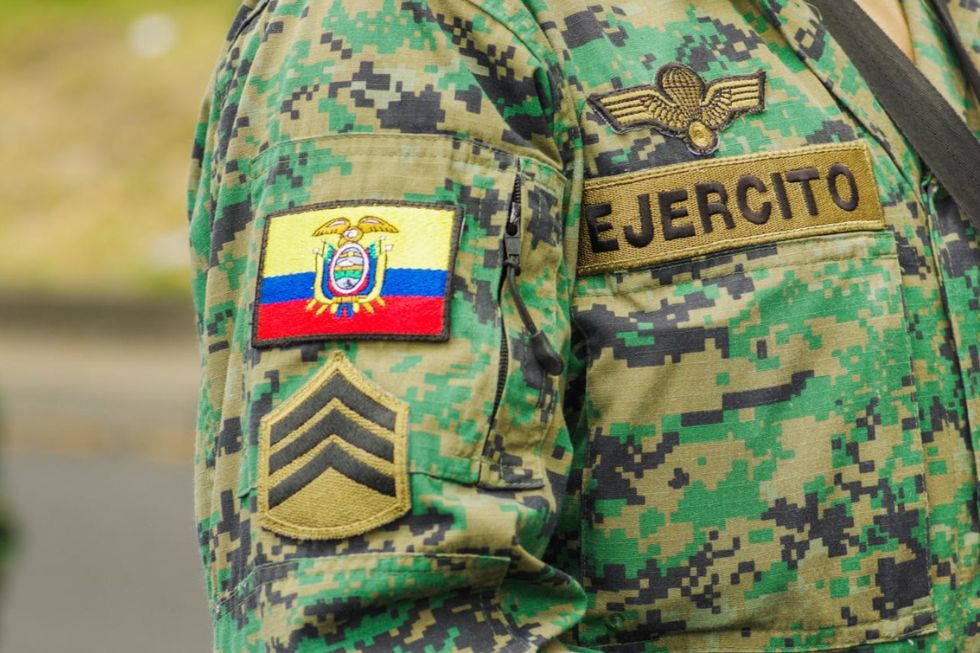
Ecuador’s security crisis is reshaping how the government sees domestic issues and how it engages with the world. The new diplomatic playbook the government is utilizing, marked by military deals, foreign troops and the rhetoric of war, makes the shift in Ecuador plain. Within the approach to the security crisis lies the government’s intent to turn its foreign policy into an extension of its mano dura agenda: an iron-fist response to the spiraling violence at home. However, this laser-like focus can lead the government to misread the crisis and, in doing so, weaken the partnerships Ecuador needs to confront it.
Conflict at home
To understand the government’s approach, the domestic context matters. Ecuador’s current government has framed the security crisis as an “internal armed conflict” and decided to advance further domestic militarization. The country’s deep security crisis, which currently claims 30 lives a day, has ushered in a political reset in the government’s actions.
As a consequence of the consistent violence, this crisis has secured President Daniel Noboa a second term backed by a legislative majority and broad electoral support for his tough-on-crime style. The strategy Noboa is deploying borrows from Latin American models built for different threats. Declaring an “internal conflict” mirrors Salvadoran President Nayib Bukele’s war-like approach in the country’s security crisis. Furthermore, the labeling of local gangs as terrorists echoes how Colombia has historically treated guerrilla groups. However, Ecuador is not fighting the same kind of conflict as Colombia and El Salvador.
Ecuador’s criminal landscape is shaped by fragmented gangs tied to international organized crime. Most Ecuadorian gangs merely operate as logistical partners, moving cocaine to Europe and running illegal mines tied to foreign networks. Framing these gangs as terrorists in a domestic war ignores the larger source of conflict in Ecuador’s security crisis. Thus, the Ecuadorian government doubles down on a flawed reading of the conflicts. Further, Noboa’s adoption of mano dura has not stopped at Ecuador’s borders; it now defines the country’s foreign policy.
A shift in foreign policy
The shift is already playing out in ways that leave Ecuador’s traditional foreign policy instincts behind. Once sovereignty-first, Ecuador’s diplomacy now functions as a platform to enlist foreign powers in its war on crime, including moving tooverturn a long-standing ban on foreign military bases. With Ecuador planning to host US naval forces in Manta and having reached out to Erik Prince’s Blackwater paramilitary to support Ecuadorian training, the government has paved the way for foreign military presence. Simply put, the government now sees foreign policy as an extension of its domestic mano dura.
Global relations and the source of the problem
While Ecuador is receiving international aid, the misreading of Ecuador’s situation by its government has important implications for foreign policy and resolving the conflict. By defining a transnational crisis as a domestic war, Ecuador isolates the problem to its borders and forces itself to bear the blame and burden of a crisis it did not create alone. Rather than shaping a narrative of global responsibility, Ecuador’s government is turning inward and viewing the crisis as a domestic issue. With this perspective, Ecuador is relying on militarized partnerships to control and resolve a conflict within its borders.
The diplomatic cost of how Ecuador’s government presents its situation is not minor. By narrowing the crisis to Ecuador’s borders, the government sidelines the potential cooperative partnerships it needs to lead an internationally coordinated response.
Among the most critical and most overlooked partnerships are with cocaine-consuming countries like those in Europe and the Americas. Though absent from Noboa’s rhetoric on where the crisis is located, these regions are central to the violence Ecuador faces. The demand in these areas sustains the trade and, by extension, the violence.
Ecuador’s global relationships and next steps
Ecuador has shown no clear interest in building coalitions with consumer countries, specifically holding them accountable for the current security crisis. Since taking office, Noboa has made several trips to Europe and the US, focusing on security cooperation, technology transfer and intelligence sharing, rather than raising the shared responsibility these countries have as consumers.
In early 2024, the government hosted the mayors of Antwerp, Rotterdam and Hamburg (Europe’s key cocaine ports) in Quito, Ecuador. However, the gesture lacked meaningful follow-up from either side as a strategy to build long-lasting coalitions with consumer nations, and next steps were not finalized. Thus, Ecuador’s actions, along with these meetings, will not be able to move beyond symbolism. To fix the transnational issue, consumer countries must be treated not only as enforcement partners but as direct actors in a market that is driving Ecuador’s collapse.
Mano dura has equally undermined Ecuador’s regional coalition-building. In a region where organized crime is deeply intertwined with neighboring countries, coordinated Latin American action is essential to confront the cross-border networks that sustain it. Ecuador’s recent actions have done the opposite to support Latin partnerships.
In late 2024, Ecuador hosted the Ibero-American Summit in Cuenca, a biennial meeting where Latin American and Iberian heads of state gather to discuss regional cooperation. This time, none of the Latin American presidents attended. Their absence followed Ecuador’s controversial raid on Mexico’s embassy, which violated international law and drew widespread condemnation.
While the Latin American boycott from the conference was not officially declared, the message was clear: the Ecuadorian government’s actions eroded regional trust. What could have been a platform for building a shared security strategy became a symbol of diplomatic isolation and a missed opportunity, shaped in part by the same mano dura logic the government applies at home.
Read more, think deeper and become smarter, perhaps even wiser, one article at a time. Sign up for our free newsletters now.
<label for=”Your email will be shared with fairobserver and subject to its Privacy Policy”>I agree to receive emails and other content from Fair Observer. I understand that I may repeal my consent at any time. You can review our Privacy Policy and Terms of Use for further information…</label>
What is at stake for Ecuador’s future is the chance to build bridges and strategically position itself on the global stage. Ecuador has an opportunity to lead on a crisis with global roots. But by framing the security crisis as an internal issue and doubling down on militarized partnerships, the government has narrowed down its options to resolve the matter. The current trajectory may deliver a short-term impact, but the government risks long-term stagnation. Furthermore, the Ecuadorian government may miss the chance to reshape policies around the world when countries are willing to support Ecuador.
[Georgianne Martinez Cushmore edited this piece.]
The views expressed in this article are the author’s own and do not necessarily reflect Fair Observer’s editorial policy.
Comment
0 Comments
Newest
Oldest
Most Voted
Most Voted
Inline Feedbacks
View all comments
Commenting Guidelines
Please read our commenting guidelines before commenting.
1. Be Respectful: Please be polite to the author. Avoid hostility. The whole point of Fair Observer is openness to different perspectives from perspectives from around the world.
2. Comment Thoughtfully: Please be relevant and constructive. We do not allow personal attacks, disinformation or trolling. We will remove hate speech or incitement.
3. Contribute Usefully: Add something of value — a point of view, an argument, a personal experience or a relevant link if you are citing statistics and key facts.
<label style=”font-size: 18px;”>
I have read and agree to the above commenting guidelines.
</label>
Please agree to the guidelines before proceeding.
I
Agree, Proceed to Login
Cancel
Related Reading
US Revokes Colombian President’s Visa: The Volatile Relationship Between North and South America
Colombian President Gustavo Petro confronted US President Donald Trump at the UN General Assembly over foreign intervention and climate policy….
by
Laura Pavon,
October 22, 2025
FO° Talks: Venezuela’s Maduro Rallies His Supporters as Tensions With US Escalate
In this episode of FO° Talks, Rohan Khattar Singh and Kyle Moran examine escalating US-Venezuela tensions, sparked by American strikes…
by
Kyle Moran & Rohan Khattar Singh,
October 15, 2025
Latin America’s ‘New’ New Left
The recent election in Colombia has produced new hope for the country–and for the whole region.
by
John Feffer,
August 4, 2022
Support Fair Observer
We rely on your support for our independence, diversity and quality.
For more than 10 years, Fair Observer has been free, fair and independent. No billionaire
owns us, no advertisers control us. We are a reader-supported nonprofit. Unlike many other
publications, we keep our content free for readers regardless of where they live or whether
they can afford to pay. We have no paywalls and no ads.
In the post-truth era of fake news, echo chambers and filter bubbles, we publish a plurality
of perspectives from around the world. Anyone can publish with us, but everyone goes through
a rigorous editorial process. So, you get fact-checked, well-reasoned content instead of
noise.
We publish 3,000+ voices from 90+ countries. We also conduct education and training programs
on subjects ranging from digital media and journalism to writing and critical thinking. This
doesn’t come cheap. Servers, editors, trainers and web developers cost
money.
Please consider supporting us on a regular basis as a recurring donor or a
sustaining member.
Will you support FO’s journalism?
We rely on your support for our independence, diversity and quality.
Donation Cycle
<label for=”donation_cycle_one_time”>One Time</label>
<label for=”donation_cycle_monthly”>Monthly</label>
<label for=”donation_cycle_yearly”>Yearly</label>
Donation Amount
<label for=”amount_11″>$11</label>
<label for=”amount_111″>$111</label>
<label for=”other”>Other</label>
$
The IRS recognizes Fair Observer as a section 501(c)(3) registered public charity
(EIN: 46-4070943), enabling you to claim a tax deduction.
Make Sense of the World
Unique Insights from 3,000+ Contributors in 90+ Countries
<label
for=”Your email will be shared with fairobserver and subject to its Privacy Policy”>I
agree to receive emails and other content from Fair Observer. I understand
that I
may repeal my consent at any time. You can review our Privacy Policy
and Terms of Use
for further
information .</label>
for=”Your email will be shared with fairobserver and subject to its Privacy Policy”>I
agree to receive emails and other content from Fair Observer. I understand
that I
may repeal my consent at any time. You can review our Privacy Policy
and Terms of Use
for further
information .</label>
We’re independent, nonprofit and powered by 3,000+ voices from around the world — not billionaires or governments. Enjoy real journalism, sign up for our free newsletters.
<label for=”Your email will be shared with fairobserver and subject to its Privacy Policy”>I agree to receive emails and other content from Fair Observer. I understand that I may repeal my consent at any time. You can review our Privacy Policy and Terms of Use for further information…</label>
</main>
Fair Observer, 461 Harbor Blvd, Belmont, CA 94002, USA
<footer class=”mart70 fo-black-bg padt50 padb30″>
Sections
PUBLICATION
Support Fair Observer
We rely on your support for our independence, diversity and quality.


</footer>

<footer id=”fixed-footer” class=”support-footer”>


Support
independent, crowdsourced, nonprofit
journalism.
Fair Observer is a 501(c)(3) independent nonprofit. We are not owned by billionaires or controlled by
advertisers. We publish nearly 3,000 authors from over 90 countries after fact-checking and editing each
piece. We do not have a paywall and anyone can read us for free. With your vital donations, we can
continue
to do our work.
Please make a recurring (or even one-time) donation today. Even $1 goes a long way because
a
million donors
like you mean one million dollars. Thank you for keeping us independent, free and fair.
One Time
Monthly
Yearly
Monthly
Yearly
Continue 

</footer>

Sign into your Fair Observer Account
<label class=”tml-label” for=”user_login”>Username or Email Address</label>
<label class=”tml-label” for=”user_pass”>Password</label>
<label class=”tml-label” for=”rememberme”>Remember Me</label>
Log In
Forgot
Password
Forgot Password
Enter your registered email address or username. You will receive a
link to create a new password via email.
Please enter your username or email address. You will receive an email message with instructions on how to reset your password.
<label class=”tml-label” for=”user_login”>Username or Email Address</label>
Get New Password
Or
Return to
Login
Forgot Password
We have sent a link to your registered email address to reset your password.
<circle cx=”12.5″ cy=”12″ r=”12″ fill=”#414141″ />
Back to
Login
Become a Member & Enjoy Exclusive Benefits!
<circle cx=”12.5″ cy=”12″ r=”12″ fill=”#414141″ />
Access to comments feature
<circle cx=”12.5″ cy=”12″ r=”12″ fill=”#414141″ />
Bookmark your favorite articles
<circle cx=”12.5″ cy=”12″ r=”12″ fill=”#414141″ />
Exclusive invitations to FO° Talks & FO° Live
<circle cx=”12.5″ cy=”12″ r=”12″ fill=”#414141″ />
Access to all of our e-publications
Return to
Login
Login
NEWSLETTER
Make Sense of the World
Unique Insights from 2,500+ Contributors in 90+ Countries

<label
for=”Your email will be shared with fairobserver and subject to it’s Privacy Policy”>I
agree to receive emails and other content from Fair Observer. I understand
that I may repeal my consent at any time. You can review our Privacy Policy
and Terms of Use
for further information.</label>
for=”Your email will be shared with fairobserver and subject to it’s Privacy Policy”>I
agree to receive emails and other content from Fair Observer. I understand
that I may repeal my consent at any time. You can review our Privacy Policy
and Terms of Use
for further information.</label>
NEWSLETTER
Make Sense of the World
Unique Insights from 2,500+ Contributors in 90+ Countries
<label
for=”Your email will be shared with fairobserver and subject to it’s Privacy Policy”>I
agree to receive emails and other content from Fair Observer. I understand
that I may repeal my consent at any time. You can review our Privacy Policy
and Terms of Use
for further information.</label>
for=”Your email will be shared with fairobserver and subject to it’s Privacy Policy”>I
agree to receive emails and other content from Fair Observer. I understand
that I may repeal my consent at any time. You can review our Privacy Policy
and Terms of Use
for further information.</label>

Make Sense of the World
Unique Insights from 2,500+ Contributors in 90+ Countries
<label
for=”Your email will be shared with fairobserver and subject to its Privacy Policy”>I
agree to receive emails and other content from Fair Observer. I understand that I
may repeal my consent at any time. You can review our Privacy Policy and Terms of Use for further
information .</label>
for=”Your email will be shared with fairobserver and subject to its Privacy Policy”>I
agree to receive emails and other content from Fair Observer. I understand that I
may repeal my consent at any time. You can review our Privacy Policy and Terms of Use for further
information .</label>
We Need Your Consent
We use cookies to give you the best possible experience. Learn more about how we use cookies or edit your cookie preferences. Privacy Policy. My Options I Accept
Privacy & Cookies Policy
Close
Edit Cookie Preferences
The Fair Observer website uses digital cookies so it can collect statistics on how many visitors come to the site, what content is viewed and for how long, and the general location of the computer network of the visitor. These statistics are collected and processed using the Google Analytics service. Fair Observer uses these aggregate statistics from website visits to help improve the content of the website and to provide regular reports to our current and future donors and funding organizations. The type of digital cookie information collected during your visit and any derived data cannot be used or combined with other information to personally identify you. Fair Observer does not use personal data collected from its website for advertising purposes or to market to you.
As a convenience to you, Fair Observer provides buttons that link to popular social media sites, called social sharing buttons, to help you share Fair Observer content and your comments and opinions about it on these social media sites. These social sharing buttons are provided by and are part of these social media sites. They may collect and use personal data as described in their respective policies. Fair Observer does not receive personal data from your use of these social sharing buttons. It is not necessary that you use these buttons to read Fair Observer content or to share on social media.
Necessary
<label class=”form-check-label” for=”wt-cli-checkbox-necessary”>Necessary</label>
Always Enabled
These cookies essential for the website to function.
Social Media
<label for=”wt-cli-checkbox-social_media” class=”cli-slider” data-cli-enable=”Enabled” data-cli-disable=”Disabled”>Social Media</label>
These cookies are used to enable sharing or following of content that you find interesting on our website. These settings apply to third-party social networking and other websites.
Performance & Functionality
<label for=”wt-cli-checkbox-performance” class=”cli-slider” data-cli-enable=”Enabled” data-cli-disable=”Disabled”>Performance & Functionality</label>
These cookies are used to enhance the performance and functionality of our website. They provide statistics on how our website is used and help us improve by measuring errors. Certain functionalities on our website may become unavailable without these cookies.
Analytics
<label for=”wt-cli-checkbox-analytics” class=”cli-slider” data-cli-enable=”Enabled” data-cli-disable=”Disabled”>Analytics</label>
SAVE & ACCEPT
<textarea id=’wpd-editor-source-code’></textarea>Insert
</body>
</html>
Total Views:
Source: World Politics - fairobserver.com