<g id=”cross”>
<line class=”cls-1″ x1=”7″ x2=”25″ y1=”7″ y2=”25″ />
<line class=”cls-1″ x1=”7″ x2=”25″ y1=”25″ y2=”7″ />
</g>
Peter Thiel Fights the Antichrist and Defends Mamdani Voters
<circle cx=”10.5″ cy=”10.5″ r=”7.5″ />
<line x1=”21″ x2=”15.8″ y1=”21″ y2=”15.8″ />
<nav class=”fo-navigation pos-r” itemscope itemtype=”http://schema.org/Navigation”>
Login
Sections <circle cx=”10.5″ cy=”10.5″ r=”7.5″ />
<line x1=”21″ x2=”15.8″ y1=”21″ y2=”15.8″ />
Search
<circle cx=”10.5″ cy=”10.5″ r=”7.5″ />
<line x1=”21″ x2=”15.8″ y1=”21″ y2=”15.8″ />
Search


PUBLICATION
Support Fair Observer
We rely on your support for our independence, diversity and quality.
</nav>
</header>

<main id=”main” class=”site-main” role=”main”> 



Friday, November 14, 2025
<header class=”entry-header”>

The office of Devil’s Advocate is a historical reality. Created in 1587, the jurist’s task was to
poke holes in dossiers proposing the canonization of a new saint. Our easier task is to poke
holes in the dominant narratives.
Peter Thiel Fights the Antichrist and Defends Mamdani Voters
Peter Thiel surprisingly urges fellow MAGA conservatives to understand, not dismiss, why young New Yorkers elected a Muslim democratic socialist mayor. Yet this same billionaire simultaneously wages war against an “Antichrist” he identifies with tech regulation advocates. His contradictory stance reveals Silicon Valley’s — and America’s — conflicted relationship with political change.
By
Friday, November 14, 2025
</header>
Via Shutterstock.

November 14, 2025 05:46 EDT

Check out our comment feature!
Saved Successfully.
This article saved into your bookmarks. Click here to view your bookmarks.


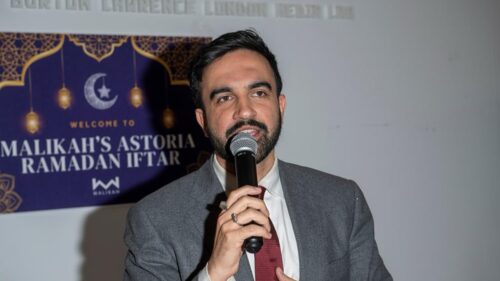
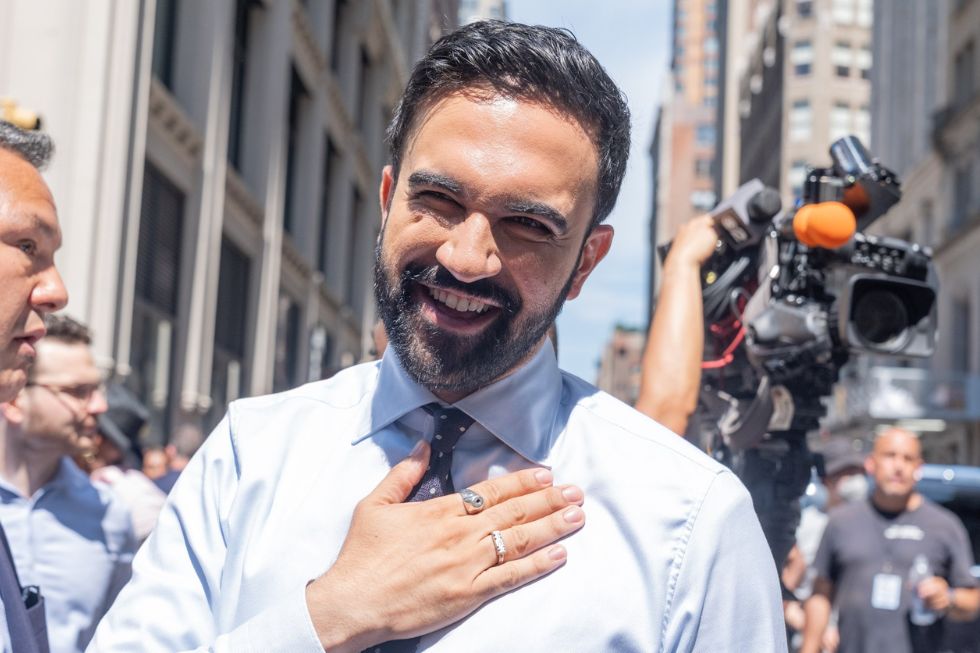
Zohran Mamdani’s election as New York City’s new mayor predictably surprised a lot of people. Who in the United States a year ago would have believed a Muslim born in Africa who calls himself a “democratic socialist” might ever prevail in a high-stakes electoral contest in the city of Wall Street? For many, it’s even more surprising than the population electing a self-imbued, narcissistic television celebrity and real estate huckster president of the US… not once, but twice (and three times by his own reckoning).
How could this have happened in the biggest city and financial capital of the US of A? For generations, Americans were brought up and taught in school to think of socialism as a creation of Satan. Apparently, the younger generations have forgotten the lessons inculcated by their parents and teachers. But the older generations are still intent on witnessing the truth, either by fighting or fleeing. According to a poll conducted by the JL Partners research firm, 765,000 New Yorkers (9% of city residents) indicated they would “definitely” leave the city if Mamdani became mayor.
One prominent member of the American elite, Peter Thiel, dares to differ. The founder of PayPal and Palantir Technologies, promoter of JD Vance, a pillar of Silicon Valley, sees Mamdani’s election not as a threat, but as a wakeup call. Thiel appears to believe that he and his cronies needed to be awakened because they had fallen asleep intellectually and morally during what he calls the “multi-decade political bull market.”
But instead of immediately retreating to his “apocalypse insurance” bunker many believe he has constructed in New Zealand, Thiel demonstrated a more mature response in an email he had shared with friends back in 2020. That is when he wisely and prudently offered this advice: “When 70% of Millennials say they are pro-socialist, we need to do better than simply dismiss them by saying that they are stupid or entitled or brainwashed; we should try and understand why.”
A load of political bull?
As Devil’s Advocate, I always wonder about the language people use, especially when they put forward concepts for which there is no agreed meaning. What does Thiel understand when he refers to a “multi-decade political bull market?” We all know what is meant by a bull market. But does it make any sense to apply that curious metaphor for the fickle behavior of investors focused on increasing their personal wealth to politics, which concerns the conditions that permit human societies to survive and develop?
It shouldn’t surprise us that Thiel, the venture capitalist, thinks of society itself as little more than a marketplace. It’s a popular ideology in the US among those who have been influenced by economists and philosophers Friedrich Hayek, Ayn Rand and Milton Friedman. Life itself is a marketplace, sometimes a bull, sometimes a bear.
Thiel developed the metaphor in an interview with The Free Press:
“I really don’t like the socialism of Mamdani, but I’m not surprised. Capitalism is not working for a lot of people in New York City. It’s not working for young people. I don’t think his policies will work, but I’m not surprised he won. In some sense, we’re in this multi-decade political bull market where politics is becoming more intense.”
He may be referring to a Forbes article published back in 2008 in which “Robertson Morrow of Clarium Capital argued that the U.S. is at the beginning of a ‘bull market in politics.’” Morrow was referring to the sudden enthusiasm for politics created around the image of President-elect Barack Obama. His election followed eight years of George W. Bush–Dick Cheney politics that had turned Beltway culture into a club for aging neocons schooled in repressive political control.
Here is Morrow’s version of the political bull market:
“The most ambitious and capable young people have generally frowned upon politics, sensing that they had more lucrative and intellectually challenging opportunities in the business world. But now, for a wide variety of reasons, that is changing.”
Thiel may be right in thinking that Obama’s style paved the way for a new generation’s illusory collective belief that they might be called upon to play a role in transforming a political landscape. Obama seduced young and even many middle-aged voters with the slogan, “hope and change.” But what was the result of that bullish youth movement once Obama had departed? The president who followed Obama, Donald Trump, was born in 1946. He was followed by a president born in 1942, who was replaced again by his 1946 opponent. And of course, Congress has been consistently dominated by the McConnells, Pelosis, Feinsteins, Schumers and others, who increasingly find it difficult to stand up or finish their sentences.
Given that Trump, a unique personality, won two of those three elections, our associations with the idea of “bullish” might point in a different direction. What do both bulls and Trump produce in quantity? It’s usually abbreviated, “BS.”
But Trump, however prolific a contributor he tends to be, didn’t invent political BS. It’s a feature of the system. Without it, nobody would win an election. Trump’s predecessor, US President Joe Biden, produced his share of it, certainly with less brio than The Donald, but equally as much deleterious effect. His foreign policy thrived on BS. Its endless justifications of an ongoing genocide logically complemented its performance as the bull in the (Russian) China shop when it provoked the bear and then, with feigned shock, insisted Russian President Vladimir Putin’s reaction was “unprovoked.”
The two parties in the US are traditionally represented as donkeys and elephants, both of which may appear as endearing mascots. But, where foreign policy is concerned, both have acquired the habit of acting like an aggressive, impatient bull. This behavior became inevitable, at least since the 1890s, when US presidents began challenging and then assimilating other dominant nations’ empires: the Spanish in 1898, the Japanese and the British in the aftermath of World War II. But the US had learned some of the painful lessons of European colonialism, seeing it as a burden as well as a source of wealth. Uncle Sam’s bull no longer sought to control and administer those newly corralled possessions. Instead, it focused on making all the cows in the pasture understand they were all dependent on the bull’s favors (the dollar).
Thiel can be politically bullish because, metaphorically, as a member of the elite, he identifies with the bull in the pasture (though the man himself doesn’t target the females of his species). In a pasture where he isn’t alone, since a multitude of bulls dominate, Thiel has found ways of achieving his aims even while allowing another bigger bull — his friend, Tesla CEO Elon Musk — assume the symbolic and often material role of reigning over the cows.
Understanding the Antichrist
So here we have an intriguing paradox. Breaking with his class, Thiel says he wants to “understand” rather than vilify the generation that votes for Mamdani and has a soft spot in its heart for the heresy of socialism. And yet this is the same man who recently declared war against an omnipresent “Antichrist.” And it isn’t a joke. Everyone knows the devil can cite scripture and disguise himself as a saint. Thiel has identified various individuals whose role the Antichrist has assumed, the most comical example being the obviously evil Swedish activist, Greta Thunberg. But The Guardian tells us there are others who, if not the Antichrist themselves, he labels as “legionnaires of the antichrist.” Some of these demonic figures are the researcher Eliezer Yudkowsky, former Oxford professor Nick Bostrom and (why not?) Microsoft cofounder Bill Gates, whose diabolical identity we ourselves deconstructed last week.
What are the crimes he attributes to Greta, Eliezer, Nick and Bill? All of them have recommended some form of restraint on the development and commercialization of Silicon Valley’s unbridled innovation. In the name of public interest, to protect civilization from an AI apocalypse, they want to establish norms concerning the scope of research, experimentation and dissemination of the technologies created and exploited by Thiel and his fellow Silicon Valley billionaires. In Thiel’s own words, “In the 21st century, the Anti-Christ is a Luddite who wants to ban all science.”
By “science,” Thiel isn’t referring, as most of us do, to the physical, natural or human sciences. In his eyes, the word designating the quest for knowledge (scientia) is nothing more than the kind of marketable technology he and his technofeudalist friends produce. In other words, the tools that permit private interests to control and exploit the lives and resources of the rest of the population.
Thiel’s reasoning is always surprising. Doesn’t Gates deserve membership in his technofeudal elite? Thiel explains his logic: Because Gates, basically for the sake of his image, plays the game of philanthropy — an activity that would never seriously tempt Thiel and his fellow Rand style egoists — the founder of Microsoft qualifies as “a very, very awful person” and even an “antichrist candidate.” Why? Because Thiel is suspicious of anyone who focuses on solving existential risks like climate change, nuclear war or AI.
Protected by his wealth and sure of his status as a member of the Silicon Valley elite, Thiel, like his buddy Musk, has a taste for saying whatever outrageous idea he happens to be thinking. In an interview with The New York Times journalist Ross Douthat, he famously expressed his doubt about whether the human species should be allowed to survive. In an interview focused on his theory of the Antichrist, he told Douthat that “the slogan of the Antichrist is ‘peace and safety.’” Does that mean his Christian ideal would be “war and insecurity?”
Given that Thiel was the driving force behind the creation of Palantir Technologies and its visionary leader, one could make the case that war and insecurity are indeed at the core of his godly vision of human society. The company makes its goals clear: “We seek out the most critical problems we can find—the ones that pose threats not only to many of the world’s most important institutions, but to the people they serve as well.”
In other words, Palantir puts institutions ahead of people, whom it honors “as well,” as an afterthought. Palantir CEO Alex Karp proudly claimed that Palantir’s mission is “to disrupt and make the institutions we partner with the very best in the world. And, when it’s necessary, to scare enemies, and on occasion, kill them.” Thiel and Karp see the world their technology serves as a dangerous battle zone. They believe that for civilization to function requires powerful tools of mass surveillance and predictive policing. How else might the “good” people defeat the Antichrist?
Which side is Thiel on?
We come back to the paradox revealed in the wake of the New York City election. The man who sees the drama of our civilization as a combat of a virtuous elite against the threat of Gog and Magog at the same time reproaches his own allies with being overly aggressive in their judgment of Mamdani. “If all you can say,” Thiel complains, “is that Mamdani is a jihadist, communist, ridiculous young person, what that sounds like to me is that you still don’t have any idea what to do about housing or student debt. If that’s the best you can do, you are going to keep losing.”
Instead of going into combat with the younger generation that voted in the New York City election for a reviled “democratic socialist,” Thiel implores his friends, who are only too ready to designate Mamdani as the equivalent of the Antichrist, to “try and understand why” the Muslim from Uganda was elected.
Given the madness on display in today’s national politics, at a time when the US President offers a warm welcome in the Oval Office to a different Muslim — Syrian President Ahmad al-Sharaa, a former leader of terror groups al-Qaeda and ISIS — does it make sense to listen to the wise words of Thiel, the self-appointed inquisitor in pursuit of the Antichrist? Trump calls Mamdani “communist, not socialist.” Wouldn’t that make him the Antichrist?
Should we now think of Thiel as the voice of reason who, alone among Wall Street’s and Silicon Valley’s billionaire class, is calling for empathizing with and understanding the motives of the discontented New Yorkers who elected Mamdani? Is this even more significant than the idea some people have put forward of Mamdani as a model and inspiration for progressive renewal within the Democratic party?
And finally, will anyone across the political spectrum heed Thiel’s request to listen to the voices of the discontented and “try and understand why?”
We’re independent, nonprofit and powered by 3,000+ voices from around the world — not billionaires or governments. Enjoy real journalism, sign up for our free newsletters.
<label for=”Your email will be shared with fairobserver and subject to its Privacy Policy”>I agree to receive emails and other content from Fair Observer. I understand that I may repeal my consent at any time. You can review our Privacy Policy and Terms of Use for further information…</label>
*[The Devil’s Advocate pursues the tradition Fair Observer began in 2017 with the launch of our “Devil’s Dictionary.” It does so with a slight change of focus, moving from language itself — political and journalistic rhetoric — to the substantial issues in the news. Read more of the Fair Observer Devil’s Dictionary. The news we consume deserves to be seen from an outsider’s point of view. And who could be more outside official discourse than Old Nick himself?]
[Lee Thompson-Kolar edited this piece.]
The views expressed in this article are the author’s own and do not necessarily reflect Fair Observer’s editorial policy.
Comment
0 Comments
Newest
Oldest
Most Voted
Most Voted
Inline Feedbacks
View all comments
Commenting Guidelines
Please read our commenting guidelines before commenting.
1. Be Respectful: Please be polite to the author. Avoid hostility. The whole point of Fair Observer is openness to different perspectives from perspectives from around the world.
2. Comment Thoughtfully: Please be relevant and constructive. We do not allow personal attacks, disinformation or trolling. We will remove hate speech or incitement.
3. Contribute Usefully: Add something of value — a point of view, an argument, a personal experience or a relevant link if you are citing statistics and key facts.
<label style=”font-size: 18px;”>
I have read and agree to the above commenting guidelines.
</label>
Please agree to the guidelines before proceeding.
I
Agree, Proceed to Login
Cancel
Related Reading
Cheney, Trump and Billionaires Define Our Post-Ethics Era
The US political elite now inhabits a “post conflict-of-interest world.” The ultra-wealthy openly shape policies. From Lyndon B. Johnson to…
by
Peter Isackson,
November 7, 2025
FO° Talks: How Zohran Mamdani and Gen Z Voters Are Shaping the New York Mayoral Race
In this episode of FO° Talks, Rohan Khattar Singh and Daniel Idfresne examine how New York City Mayor Eric Adams’s…
by
Daniel Idfresne & Rohan Khattar Singh,
October 30, 2025
Zohran Mamdani: Hypocrisy, Socialism and the Danger of Elitist Politics
Zohran Mamdani, son of elite parents and raised in privilege, champions socialist policies while enjoying capitalist comforts. Critics argue he…
by
Christopher Roper Schell,
July 6, 2025
Billionaires Line Up to Save New York from Democracy
Billionaire Bill Ackman’s panic over a progressive political upset in New York reflects the priorities of a system where money,…
by
Peter Isackson,
July 2, 2025
Support Fair Observer
We rely on your support for our independence, diversity and quality.
For more than 10 years, Fair Observer has been free, fair and independent. No billionaire
owns us, no advertisers control us. We are a reader-supported nonprofit. Unlike many other
publications, we keep our content free for readers regardless of where they live or whether
they can afford to pay. We have no paywalls and no ads.
In the post-truth era of fake news, echo chambers and filter bubbles, we publish a plurality
of perspectives from around the world. Anyone can publish with us, but everyone goes through
a rigorous editorial process. So, you get fact-checked, well-reasoned content instead of
noise.
We publish 3,000+ voices from 90+ countries. We also conduct education and training programs
on subjects ranging from digital media and journalism to writing and critical thinking. This
doesn’t come cheap. Servers, editors, trainers and web developers cost
money.
Please consider supporting us on a regular basis as a recurring donor or a
sustaining member.
Will you support FO’s journalism?
We rely on your support for our independence, diversity and quality.
Donation Cycle
<label for=”donation_cycle_one_time”>One Time</label>
<label for=”donation_cycle_monthly”>Monthly</label>
<label for=”donation_cycle_yearly”>Yearly</label>
Donation Amount
<label for=”amount_11″>$11</label>
<label for=”amount_111″>$111</label>
<label for=”other”>Other</label>
$
The IRS recognizes Fair Observer as a section 501(c)(3) registered public charity
(EIN: 46-4070943), enabling you to claim a tax deduction.
Make Sense of the World
Unique Insights from 3,000+ Contributors in 90+ Countries
<label
for=”Your email will be shared with fairobserver and subject to its Privacy Policy”>I
agree to receive emails and other content from Fair Observer. I understand
that I
may repeal my consent at any time. You can review our Privacy Policy
and Terms of Use
for further
information .</label>
for=”Your email will be shared with fairobserver and subject to its Privacy Policy”>I
agree to receive emails and other content from Fair Observer. I understand
that I
may repeal my consent at any time. You can review our Privacy Policy
and Terms of Use
for further
information .</label>
We’re independent, nonprofit and powered by 3,000+ voices from around the world — not billionaires or governments. Enjoy real journalism, sign up for our free newsletters.
<label for=”Your email will be shared with fairobserver and subject to its Privacy Policy”>I agree to receive emails and other content from Fair Observer. I understand that I may repeal my consent at any time. You can review our Privacy Policy and Terms of Use for further information…</label>
</main>
Fair Observer, 461 Harbor Blvd, Belmont, CA 94002, USA
<footer class=”mart70 fo-black-bg padt50 padb30″>
Sections
PUBLICATION
Support Fair Observer
We rely on your support for our independence, diversity and quality.


</footer>

<footer id=”fixed-footer” class=”support-footer”>


Support
independent, crowdsourced, nonprofit
journalism.
Fair Observer is a 501(c)(3) independent nonprofit. We are not owned by billionaires or controlled by
advertisers. We publish nearly 3,000 authors from over 90 countries after fact-checking and editing each
piece. We do not have a paywall and anyone can read us for free. With your vital donations, we can
continue
to do our work.
Please make a recurring (or even one-time) donation today. Even $1 goes a long way because
a
million donors
like you mean one million dollars. Thank you for keeping us independent, free and fair.
One Time
Monthly
Yearly
Monthly
Yearly
Continue 

</footer>

Sign into your Fair Observer Account
<label class=”tml-label” for=”user_login”>Username or Email Address</label>
<label class=”tml-label” for=”user_pass”>Password</label>
<label class=”tml-label” for=”rememberme”>Remember Me</label>
Log In
Forgot
Password
Forgot Password
Enter your registered email address or username. You will receive a
link to create a new password via email.
Please enter your username or email address. You will receive an email message with instructions on how to reset your password.
<label class=”tml-label” for=”user_login”>Username or Email Address</label>
Get New Password
Or
Return to
Login
Forgot Password
We have sent a link to your registered email address to reset your password.
<circle cx=”12.5″ cy=”12″ r=”12″ fill=”#414141″ />
Back to
Login
Become a Member & Enjoy Exclusive Benefits!
<circle cx=”12.5″ cy=”12″ r=”12″ fill=”#414141″ />
Access to comments feature
<circle cx=”12.5″ cy=”12″ r=”12″ fill=”#414141″ />
Bookmark your favorite articles
<circle cx=”12.5″ cy=”12″ r=”12″ fill=”#414141″ />
Exclusive invitations to FO° Talks & FO° Live
<circle cx=”12.5″ cy=”12″ r=”12″ fill=”#414141″ />
Access to all of our e-publications
Return to
Login
Login
NEWSLETTER
Make Sense of the World
Unique Insights from 2,500+ Contributors in 90+ Countries

<label
for=”Your email will be shared with fairobserver and subject to it’s Privacy Policy”>I
agree to receive emails and other content from Fair Observer. I understand
that I may repeal my consent at any time. You can review our Privacy Policy
and Terms of Use
for further information.</label>
for=”Your email will be shared with fairobserver and subject to it’s Privacy Policy”>I
agree to receive emails and other content from Fair Observer. I understand
that I may repeal my consent at any time. You can review our Privacy Policy
and Terms of Use
for further information.</label>
NEWSLETTER
Make Sense of the World
Unique Insights from 2,500+ Contributors in 90+ Countries
<label
for=”Your email will be shared with fairobserver and subject to it’s Privacy Policy”>I
agree to receive emails and other content from Fair Observer. I understand
that I may repeal my consent at any time. You can review our Privacy Policy
and Terms of Use
for further information.</label>
for=”Your email will be shared with fairobserver and subject to it’s Privacy Policy”>I
agree to receive emails and other content from Fair Observer. I understand
that I may repeal my consent at any time. You can review our Privacy Policy
and Terms of Use
for further information.</label>

Make Sense of the World
Unique Insights from 2,500+ Contributors in 90+ Countries
<label
for=”Your email will be shared with fairobserver and subject to its Privacy Policy”>I
agree to receive emails and other content from Fair Observer. I understand that I
may repeal my consent at any time. You can review our Privacy Policy and Terms of Use for further
information .</label>
for=”Your email will be shared with fairobserver and subject to its Privacy Policy”>I
agree to receive emails and other content from Fair Observer. I understand that I
may repeal my consent at any time. You can review our Privacy Policy and Terms of Use for further
information .</label>
We Need Your Consent
We use cookies to give you the best possible experience. Learn more about how we use cookies or edit your cookie preferences. Privacy Policy. My Options I Accept
Privacy & Cookies Policy
Close
Edit Cookie Preferences
The Fair Observer website uses digital cookies so it can collect statistics on how many visitors come to the site, what content is viewed and for how long, and the general location of the computer network of the visitor. These statistics are collected and processed using the Google Analytics service. Fair Observer uses these aggregate statistics from website visits to help improve the content of the website and to provide regular reports to our current and future donors and funding organizations. The type of digital cookie information collected during your visit and any derived data cannot be used or combined with other information to personally identify you. Fair Observer does not use personal data collected from its website for advertising purposes or to market to you.
As a convenience to you, Fair Observer provides buttons that link to popular social media sites, called social sharing buttons, to help you share Fair Observer content and your comments and opinions about it on these social media sites. These social sharing buttons are provided by and are part of these social media sites. They may collect and use personal data as described in their respective policies. Fair Observer does not receive personal data from your use of these social sharing buttons. It is not necessary that you use these buttons to read Fair Observer content or to share on social media.
Necessary
<label class=”form-check-label” for=”wt-cli-checkbox-necessary”>Necessary</label>
Always Enabled
These cookies essential for the website to function.
Social Media
<label for=”wt-cli-checkbox-social_media” class=”cli-slider” data-cli-enable=”Enabled” data-cli-disable=”Disabled”>Social Media</label>
These cookies are used to enable sharing or following of content that you find interesting on our website. These settings apply to third-party social networking and other websites.
Performance & Functionality
<label for=”wt-cli-checkbox-performance” class=”cli-slider” data-cli-enable=”Enabled” data-cli-disable=”Disabled”>Performance & Functionality</label>
These cookies are used to enhance the performance and functionality of our website. They provide statistics on how our website is used and help us improve by measuring errors. Certain functionalities on our website may become unavailable without these cookies.
Analytics
<label for=”wt-cli-checkbox-analytics” class=”cli-slider” data-cli-enable=”Enabled” data-cli-disable=”Disabled”>Analytics</label>
SAVE & ACCEPT
<textarea id=’wpd-editor-source-code’></textarea>Insert
</body>
</html>
Total Views:
Source: World Politics - fairobserver.com