<g id=”cross”>
<line class=”cls-1″ x1=”7″ x2=”25″ y1=”7″ y2=”25″ />
<line class=”cls-1″ x1=”7″ x2=”25″ y1=”25″ y2=”7″ />
</g>
Refuge and Realpolitik: India’s Asylum Dilemmas in a Broken System
<circle cx=”10.5″ cy=”10.5″ r=”7.5″ />
<line x1=”21″ x2=”15.8″ y1=”21″ y2=”15.8″ />
<nav class=”fo-navigation pos-r” itemscope itemtype=”http://schema.org/Navigation”>
Login
Sections <circle cx=”10.5″ cy=”10.5″ r=”7.5″ />
<line x1=”21″ x2=”15.8″ y1=”21″ y2=”15.8″ />
Search
<circle cx=”10.5″ cy=”10.5″ r=”7.5″ />
<line x1=”21″ x2=”15.8″ y1=”21″ y2=”15.8″ />
Search


PUBLICATION
Support Fair Observer
We rely on your support for our independence, diversity and quality.
</nav>
</header>

<main id=”main” class=”site-main” role=”main”> 







Wednesday, December 10, 2025
<header class=”entry-header”>
Refuge and Realpolitik: India’s Asylum Dilemmas in a Broken System
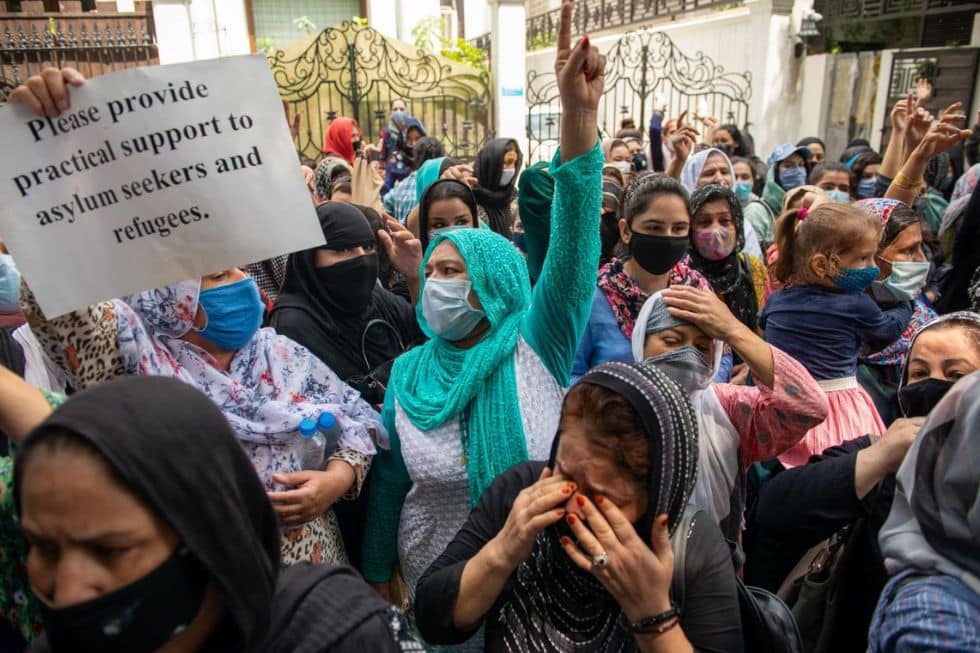
India’s asylum policy is often criticized for excluding muslim populations from its framework. However, India has and continues to take in many muslims from neighboring countries, despite this lack. Still, a more robust and complete framework for asylum seekers and refugees is needed that includes India within the global conversation on immigration.
By
Wednesday, December 10, 2025
</header>
Via Shutterstock.

December 10, 2025 07:19 EDT

Check out our comment feature!
Saved Successfully.
This article saved into your bookmarks. Click here to view your bookmarks.


When India passed the Citizenship Amendment Act (CAA) in 2019, there were reasons to be skeptical about its implications. The law’s exclusion of Muslim refugees seemed difficult to reconcile with Articles 14 and 21 of the Indian Constitution, which guarantee equality before the law and protection of life and liberty to all persons. Coupled with the proposed National Register of Citizens (NRC), there was concern that poor and undocumented minorities — many of them native-born — might face disenfranchisement or detention.
Yet five years on, with the benefit of hindsight, it is clear that none of the worst-case predictions have materialized. There have been no mass detention camps, no sweeping disenfranchisement and no deportations on anything near the scale seen in the United States or even in Western Europe.
Implications of the CAA
India has no codified asylum law and is not a signatory to the 1951 Refugee Convention. The CAA, which offers a path to citizenship for non-Muslim minorities from Pakistan, Bangladesh and Afghanistan, is ethically troubling for its explicit exclusion of Muslims, including persecuted sects like Ahmadis, Shias and Hazaras.
India also fails to recognize atheists, queer people and political dissidents, all of whom may face real persecution in the region. Additionally, the CAA excludes asylum seekers from other jurisdictions, such as the Uyghurs from Xinjiang and persecuted Christian communities in Myanmar. There is a clear case for reforming the CAA to include these groups and make it consistent with India’s constitutional commitment to nondiscrimination and equal protection.
The CAA was not a diabolical master plan nor “fascist” ideological blueprint, but rather a kind of ad hoc triage — an attempt, however flawed, to deal with the overwhelming demographic and administrative pressures of undocumented migration, particularly from Bangladesh. Like much of India’s immigration policy, it was reactive and shaped more by logistical and political considerations than by any coherent doctrinal vision.
India’s role in immigration
India has long played a unique role as a receiving state in South Asia. During the Bangladesh Liberation War in 1971, India took in an estimated ten million refugees, overwhelmingly Bangladeshi Hindus fleeing communal violence. Between 1971 and 2011, it was estimated that over 11 million Bangladeshi Hindus entered India. Today, at least two million still reside in the country.
Since the early 1970s, for which we have good data, there has been no counterbalancing of Indian Muslim asylum claims in the nearby Muslim-majority nations Bangladesh, Pakistan, Malaysia, Indonesia, Oman or the Maldives. The number of Indian Muslims seeking asylum in the US, UK, Canada, Australia and the EU has also been statistically insignificant. The UN High Commissioner for Refugees (UNHCR) records and national statistics for all these countries confirm this.
Au contraire, India continues to host significant refugee populations: over 100,000 Tibetans, including the Dalai Lama, approximately 95,000 Sri Lankan Tamils, Afghan and Myanmar minorities, and individuals such as the Bangladeshi feminist author Taslima Nasreen, as well as the Pakistan-born singer Adnan Sami, the latter granted full citizenship. Unlike its neighbors, India has extended sanctuary for decades, often without international financial or logistical support.
Migration around the globe
Despite this record, India is often singled out. In July 2025, The Washington Post ran the headline: “In India’s deportation drive, Muslim men recount being tossed into the sea.” To make matters worse, the article was reprinted subsequently by Genocide Watch! The article referred to boat repatriations of Rohingya that involved no deaths or injuries to anyone involved.
On the contrary, thousands of migrants — mostly from Muslim-majority states — have drowned since 2015 in the Mediterranean due to Frontex-supported border practices. The US deports mostly Hispanics from Central America. Australia continues to detain asylum seekers offshore, many of them Muslim. Yet we do not see headlines accusing these countries of “deporting Catholics” or “tossing Muslims into the sea.”
Pakistan has embarked on the deportation of 1.7 million undocumented Afghans, unprecedented in postwar history. The Washington Post’s headline would appear grotesque if applied to the United States, the EU or any comparable democracy, or even to Pakistan. Yet, such language is reserved for India, where humanitarian inconsistencies are interpreted not as flaws of governance, but as actions of a “genocidal state.”
To be fair, India deported approximately 192 Rohingya in May 2025. Its pushbacks of undocumented Bangladeshis are far more numerous, amounting to tens of thousands annually, according to the Border Security Force. These actions frequently occur without formal legal proceedings, raising genuine due process concerns and sometimes imperiling Indian Bengali-speaking Muslims.
Recent evidence demonstrates that Rohingya camps in Bangladesh are being used by groups like the Arakan Rohingya Salvation Army (ARSA) and the Rohingya Solidarity Organization (RSO) to recruit, smuggle meth and train fighters. The 2025 Crisis Group report links these groups to Myanmar’s ongoing civil war. India, bordering the narcotics-trafficking Golden Triangle in Myanmar, fears militant and narcotics spillover — reframing the Rohingya issue as both a humanitarian crisis and a regional security threat.
Still, the scale of deportations from India pales in comparison to other democracies, operating with vastly greater capacity and international legitimacy — and with less scrutiny. The US deported over 271,000 people last year. Frontex, the EU’s border agency, carried out more than 86,000 forced or voluntary returns in 2022. Australia has kept over 3,000 asylum seekers in offshore facilities since 2013.
Reframing the refugee framework in India
Without a doubt, India needs a more coherent refugee framework. One viable option is adopting a differentiated risk framework, akin to what Germany has implemented, which prioritizes vulnerable groups for protection while retaining case-by-case scrutiny. Another is establishing an independent asylum determination body, much like Canada’s Immigration and Refugee Board, which separates executive discretion from legal adjudication and increases transparency.
India’s refugee policy is flawed — at times exclusionary and often inconsistent. Like many democracies, India struggles with migration, state capacity and identity. Islamophobic rhetoric and anti-immigrant hysteria do exist in India, and in some cases, mirror the nativist panic and punitive enforcement patterns seen in the US under the Immigration and Customs Enforcement (ICE), or the securitized asylum discourse in Europe and Australia.
We are a rare nonprofit in the world news space. Most other organizations are owned by billionaires or governments. We are bottom-up, not top-down and bring you perspectives from around the world. So, sign up now for our free newsletters to hear from our 3,000+ voices from 90+ countries.
<label for=”Your email will be shared with fairobserver and subject to its Privacy Policy”>I agree to receive emails and other content from Fair Observer. I understand that I may repeal my consent at any time. You can review our Privacy Policy and Terms of Use for further information…</label>
But this is precisely why nuance is important. India belongs squarely within the global democratic conversation on asylum, borders and belonging, not outside it. Vilification as a genocidal anti-Muslim ethnocracy — instead of well-deserved criticism of its legal and structural limitations — is neither factually grounded nor helpful in light of genuine border control imperatives around terrorism and narcotics.
[Natalie Sorlie edited this piece.]
The views expressed in this article are the author’s own and do not necessarily reflect Fair Observer’s editorial policy.
Comment
0 Comments
Newest
Oldest
Most Voted
Most Voted
Inline Feedbacks
View all comments
Commenting Guidelines
Please read our commenting guidelines before commenting.
1. Be Respectful: Please be polite to the author. Avoid hostility. The whole point of Fair Observer is openness to different perspectives from perspectives from around the world.
2. Comment Thoughtfully: Please be relevant and constructive. We do not allow personal attacks, disinformation or trolling. We will remove hate speech or incitement.
3. Contribute Usefully: Add something of value — a point of view, an argument, a personal experience or a relevant link if you are citing statistics and key facts.
<label style=”font-size: 18px;”>
I have read and agree to the above commenting guidelines.
</label>
Please agree to the guidelines before proceeding.
I
Agree, Proceed to Login
Cancel
Related Reading
Bangladesh Now Aligns With China, India Worries
China seeks to counter India’s rise by deepening its influence in South Asia and binding Bangladesh through trade, infrastructure and…
by
Shokin Chauhan & Atul Singh,
October 26, 2025
FO° Talks: Life Inside Donald Trump’s Notorious Alligator Alcatraz Detention Center in Florida
In this episode of FO° Talk, Rohan Khattar Singh and Kaitlyn Diana discuss US President Donald Trump’s controversial detention center…
by
Kaitlyn Diana & Rohan Khattar Singh,
September 27, 2025
Does India Oppress Muslims? Not Now, Not Ever. Here’s Why.
In a 2023 piece for TomDispatch, Priti Gulati Cox and Stan Cox argued that India oppresses its large Muslim minority….
by
Prashant Sharma,
April 11, 2024
If You’re a Refugee, Best to be White and Christian
Thousands of Ukrainians have fled to European nations since the Russian invasion in February. Unlike African or Middle Eastern refugees,…
by
Helen Benedict,
December 6, 2022
Support Fair Observer
We rely on your support for our independence, diversity and quality.
For more than 10 years, Fair Observer has been free, fair and independent. No billionaire
owns us, no advertisers control us. We are a reader-supported nonprofit. Unlike many other
publications, we keep our content free for readers regardless of where they live or whether
they can afford to pay. We have no paywalls and no ads.
In the post-truth era of fake news, echo chambers and filter bubbles, we publish a plurality
of perspectives from around the world. Anyone can publish with us, but everyone goes through
a rigorous editorial process. So, you get fact-checked, well-reasoned content instead of
noise.
We publish 3,000+ voices from 90+ countries. We also conduct education and training programs
on subjects ranging from digital media and journalism to writing and critical thinking. This
doesn’t come cheap. Servers, editors, trainers and web developers cost
money.
Please consider supporting us on a regular basis as a recurring donor or a
sustaining member.
Will you support FO’s journalism?
We rely on your support for our independence, diversity and quality.
Donation Cycle
<label for=”donation_cycle_one_time”>One Time</label>
<label for=”donation_cycle_monthly”>Monthly</label>
<label for=”donation_cycle_yearly”>Yearly</label>
Donation Amount
<label for=”amount_11″>$11</label>
<label for=”amount_111″>$111</label>
<label for=”other”>Other</label>
$
The IRS recognizes Fair Observer as a section 501(c)(3) registered public charity
(EIN: 46-4070943), enabling you to claim a tax deduction.
Most Popular
Is Diane Abbott Right?
The UK Labour Party faced a political crisis after Member of Parliament Diane Abbott wrote a letter distinguishing racism against…
by
Ellis Cashmore,
July 18, 2025
My Vindication: A Tale of Blackness, Womanhood and Self-Advocacy
My life was too mundane. So, I filled the banality by becoming an advocate for black women. Join me in…
by
Alana James,
July 31, 2024
New AI Programs Compromise the Rights of Helpless Migrants
With the rapid advancement of artificial intelligence, algorithmic border governance technology has become an ever-present factor in international migration. This…
by
Nafees Ahmad,
April 24, 2024
Make Sense of the World
Unique Insights from 3,000+ Contributors in 90+ Countries
<label
for=”Your email will be shared with fairobserver and subject to its Privacy Policy”>I
agree to receive emails and other content from Fair Observer. I understand
that I
may repeal my consent at any time. You can review our Privacy Policy
and Terms of Use
for further
information .</label>
for=”Your email will be shared with fairobserver and subject to its Privacy Policy”>I
agree to receive emails and other content from Fair Observer. I understand
that I
may repeal my consent at any time. You can review our Privacy Policy
and Terms of Use
for further
information .</label>
You can read the CIA Factbook and listen to MI6 people for your analysis, or you could read perspectives from our 3,000+ authors from 90+ countries and make sense of the world. Sign up for our free newsletters now.
<label for=”Your email will be shared with fairobserver and subject to its Privacy Policy”>I agree to receive emails and other content from Fair Observer. I understand that I may repeal my consent at any time. You can review our Privacy Policy and Terms of Use for further information…</label>
</main>
Fair Observer, 461 Harbor Blvd, Belmont, CA 94002, USA
<footer class=”mart70 fo-black-bg padt50 padb30″>
Sections
PUBLICATION
Support Fair Observer
We rely on your support for our independence, diversity and quality.


</footer>

<footer id=”fixed-footer” class=”support-footer”>


Support
independent, crowdsourced, nonprofit
journalism.
Fair Observer is a 501(c)(3) independent nonprofit. We are not owned by billionaires or controlled by
advertisers. We publish nearly 3,000 authors from over 90 countries after fact-checking and editing each
piece. We do not have a paywall and anyone can read us for free. With your vital donations, we can
continue
to do our work.
Please make a recurring (or even one-time) donation today. Even $1 goes a long way because
a
million donors
like you mean one million dollars. Thank you for keeping us independent, free and fair.
One Time
Monthly
Yearly
Monthly
Yearly
Continue 

</footer>

Sign into your Fair Observer Account
<label class=”tml-label” for=”user_login”>Username or Email Address</label>
<label class=”tml-label” for=”user_pass”>Password</label>
<label class=”tml-label” for=”rememberme”>Remember Me</label>
Log In
Forgot
Password
Forgot Password
Enter your registered email address or username. You will receive a
link to create a new password via email.
Please enter your username or email address. You will receive an email message with instructions on how to reset your password.
<label class=”tml-label” for=”user_login”>Username or Email Address</label>
Get New Password
Or
Return to
Login
Forgot Password
We have sent a link to your registered email address to reset your password.
<circle cx=”12.5″ cy=”12″ r=”12″ fill=”#414141″ />
Back to
Login
Become a Member & Enjoy Exclusive Benefits!
<circle cx=”12.5″ cy=”12″ r=”12″ fill=”#414141″ />
Access to comments feature
<circle cx=”12.5″ cy=”12″ r=”12″ fill=”#414141″ />
Bookmark your favorite articles
<circle cx=”12.5″ cy=”12″ r=”12″ fill=”#414141″ />
Exclusive invitations to FO° Talks & FO° Live
<circle cx=”12.5″ cy=”12″ r=”12″ fill=”#414141″ />
Access to all of our e-publications
Return to
Login
Login
NEWSLETTER
Make Sense of the World
Unique Insights from 2,500+ Contributors in 90+ Countries

<label
for=”Your email will be shared with fairobserver and subject to it’s Privacy Policy”>I
agree to receive emails and other content from Fair Observer. I understand
that I may repeal my consent at any time. You can review our Privacy Policy
and Terms of Use
for further information.</label>
for=”Your email will be shared with fairobserver and subject to it’s Privacy Policy”>I
agree to receive emails and other content from Fair Observer. I understand
that I may repeal my consent at any time. You can review our Privacy Policy
and Terms of Use
for further information.</label>
NEWSLETTER
Make Sense of the World
Unique Insights from 2,500+ Contributors in 90+ Countries
<label
for=”Your email will be shared with fairobserver and subject to it’s Privacy Policy”>I
agree to receive emails and other content from Fair Observer. I understand
that I may repeal my consent at any time. You can review our Privacy Policy
and Terms of Use
for further information.</label>
for=”Your email will be shared with fairobserver and subject to it’s Privacy Policy”>I
agree to receive emails and other content from Fair Observer. I understand
that I may repeal my consent at any time. You can review our Privacy Policy
and Terms of Use
for further information.</label>

Make Sense of the World
Unique Insights from 2,500+ Contributors in 90+ Countries
<label
for=”Your email will be shared with fairobserver and subject to its Privacy Policy”>I
agree to receive emails and other content from Fair Observer. I understand that I
may repeal my consent at any time. You can review our Privacy Policy and Terms of Use for further
information .</label>
for=”Your email will be shared with fairobserver and subject to its Privacy Policy”>I
agree to receive emails and other content from Fair Observer. I understand that I
may repeal my consent at any time. You can review our Privacy Policy and Terms of Use for further
information .</label>
We Need Your Consent
We use cookies to give you the best possible experience. Learn more about how we use cookies or edit your cookie preferences. Privacy Policy. My Options I Accept
Privacy & Cookies Policy
Close
Edit Cookie Preferences
The Fair Observer website uses digital cookies so it can collect statistics on how many visitors come to the site, what content is viewed and for how long, and the general location of the computer network of the visitor. These statistics are collected and processed using the Google Analytics service. Fair Observer uses these aggregate statistics from website visits to help improve the content of the website and to provide regular reports to our current and future donors and funding organizations. The type of digital cookie information collected during your visit and any derived data cannot be used or combined with other information to personally identify you. Fair Observer does not use personal data collected from its website for advertising purposes or to market to you.
As a convenience to you, Fair Observer provides buttons that link to popular social media sites, called social sharing buttons, to help you share Fair Observer content and your comments and opinions about it on these social media sites. These social sharing buttons are provided by and are part of these social media sites. They may collect and use personal data as described in their respective policies. Fair Observer does not receive personal data from your use of these social sharing buttons. It is not necessary that you use these buttons to read Fair Observer content or to share on social media.
Necessary
<label class=”form-check-label” for=”wt-cli-checkbox-necessary”>Necessary</label>
Always Enabled
These cookies essential for the website to function.
Social Media
<label for=”wt-cli-checkbox-social_media” class=”cli-slider” data-cli-enable=”Enabled” data-cli-disable=”Disabled”>Social Media</label>
These cookies are used to enable sharing or following of content that you find interesting on our website. These settings apply to third-party social networking and other websites.
Performance & Functionality
<label for=”wt-cli-checkbox-performance” class=”cli-slider” data-cli-enable=”Enabled” data-cli-disable=”Disabled”>Performance & Functionality</label>
These cookies are used to enhance the performance and functionality of our website. They provide statistics on how our website is used and help us improve by measuring errors. Certain functionalities on our website may become unavailable without these cookies.
Analytics
<label for=”wt-cli-checkbox-analytics” class=”cli-slider” data-cli-enable=”Enabled” data-cli-disable=”Disabled”>Analytics</label>
SAVE & ACCEPT
<textarea id=’wpd-editor-source-code’></textarea>Insert
</body>
</html>
Total Views:
Source: World Politics - fairobserver.com