Afghanistan: The Crisis the US Chose to Forget and Why That Is a Strategic Mistake
Afghanistan is experiencing a worsening humanitarian crisis that has largely disappeared from US attention, leaving millions without food, shelter or basic security. Since the Taliban’s return, women and girls have been systematically excluded from public life, crippling aid delivery and forcing families into extreme measures such as child labor and forced marriage. Abandonment fuels long-term instability, and ignoring the crisis carries consequences far beyond Afghanistan.
“I see children sitting on the floor begging for food,” a field worker tells me after returning from the mosque. “Parents say their children have not eaten all day. They have no roof, no certainty.”
This is not Afghanistan in 2001 or 2010. This is Afghanistan now.
The gendered toll of exclusion
Four years after the US withdrawal, Afghanistan has largely vanished from the American news cycle. But the crisis unfolding there has not paused. It has intensified quietly and dangerously with consequences that extend far beyond Afghan borders.
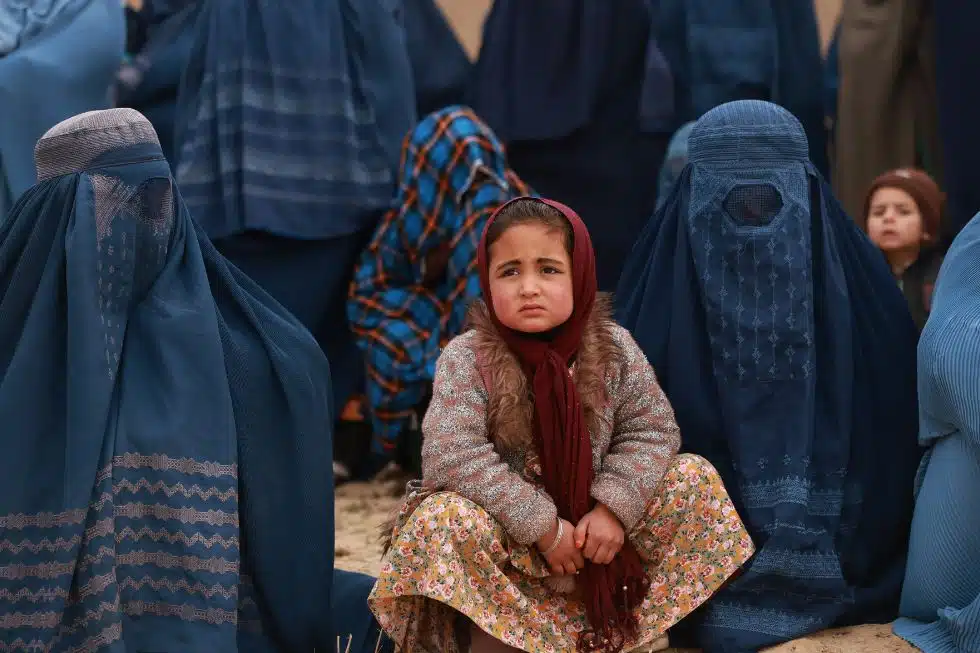
According to the UN, 21.9 million Afghans, more than half the population, now require humanitarian assistance to survive. Hunger, displacement and poverty are widespread. Their effects are not evenly distributed. They fall most heavily on women and children.
Since August 2021, the Taliban has systematically removed women from public life. Girls are barred from secondary education. Women are prohibited from working with international aid organizations. That single decision forced major humanitarian agencies to suspend operations, freezing more than $46 million in assistance in 2022 alone. Clinics closed. Food deliveries stopped. Fragile communities collapsed.
For Washington, this is not just a moral failure. It is a strategic one. When women are excluded from aid delivery, humanitarian systems break down. When humanitarian systems fail, instability deepens. And when instability deepens in a country with a long history of transnational militancy, the risks do not remain local.
Afghanistan is once again becoming a place where desperation replaces governance and survival replaces social order. These are the conditions in which extremist networks recruit, operate and regenerate. The lesson of the past two decades should be clear. Prolonged collapse is not neutral. It is catalytic.
Climate stress and closing doors
Climate stress is accelerating this breakdown. Drought, water scarcity and agricultural failure have hollowed out rural livelihoods. Families live in tents. Children miss school because their parents cannot afford notebooks or pens. Girls beyond sixth grade are denied education, entirely wiping out future human capital in a country already stripped of opportunity.
At the same time, escape routes are closing. As of late 2025, the US has paused visa processing for Afghan nationals, including many who had previously been approved for resettlement. Pakistan has expelled more than a million Afghan families, forcing people back across the border only to sleep outdoors, sick, exposed and without medical care. This is the environment in which ABAAD: Afghan Women Forward operates, supporting women who have fallen through every remaining safety net.
Lives on the edge: stories of survival
Jamila lives in Kapisa with her three children and elderly father. Abandoned by her husband, she lacks the male sponsorship required to obtain a Taskira Afghanistan’s national identity document. Without it, her children cannot attend school or access health care. Instead, they work alongside her in dangerous agricultural labor. When winter comes, and the land fails, hunger follows.
Yashfa’s story shows how stigma becomes a permanent sentence. While a university student, she became pregnant out of wedlock. She was imprisoned for two years and gave birth in jail. Her daughter, Iman, was rejected by her father and labeled illegitimate. When women’s shelters were shut down, Yashfa and her child were forced back into an abusive household. Community members later attempted to kill Iman for dishonoring the family. ABAAD intervened, providing food documentation and securing Iman’s right to begin school. Survival here required constant negotiation, not protection by law.
Zahra’s family, in exchange for her 12-year-old daughter’s marriage, agreed for her husband’s remarriage to a second wife. She escaped to a shelter while pregnant. When shelters closed, she was pushed onto the streets with her children. Her son Aazar suffers from a life-threatening illness. ABAAD now provides housing, medical care and food, but her security remains fragile.
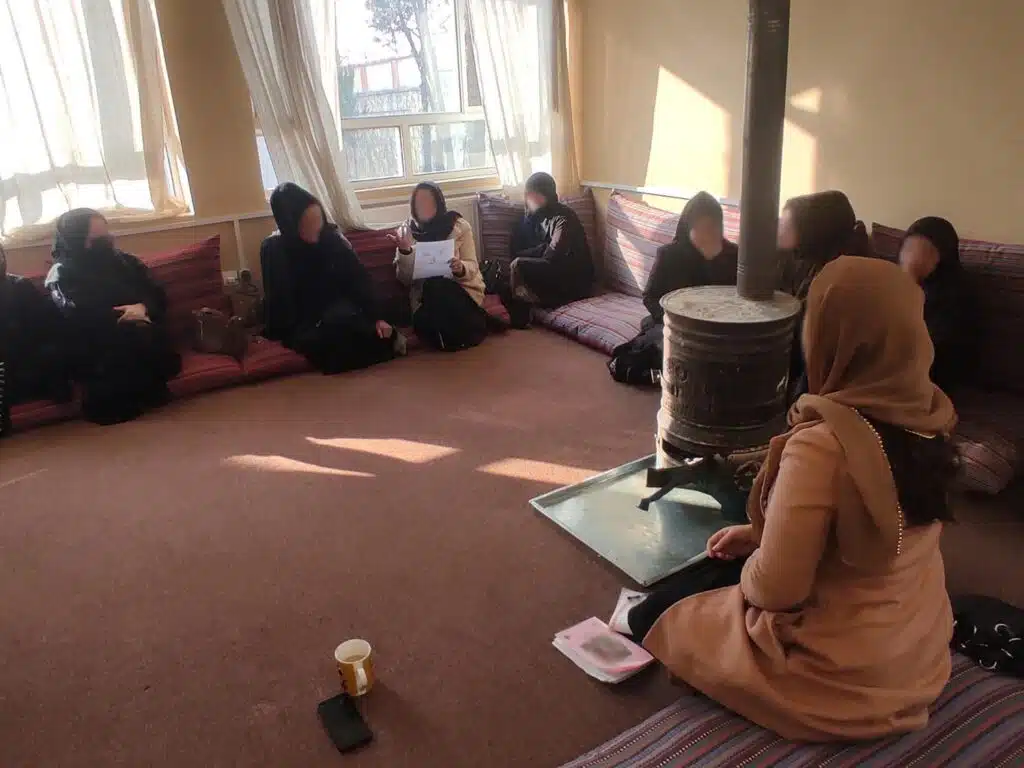
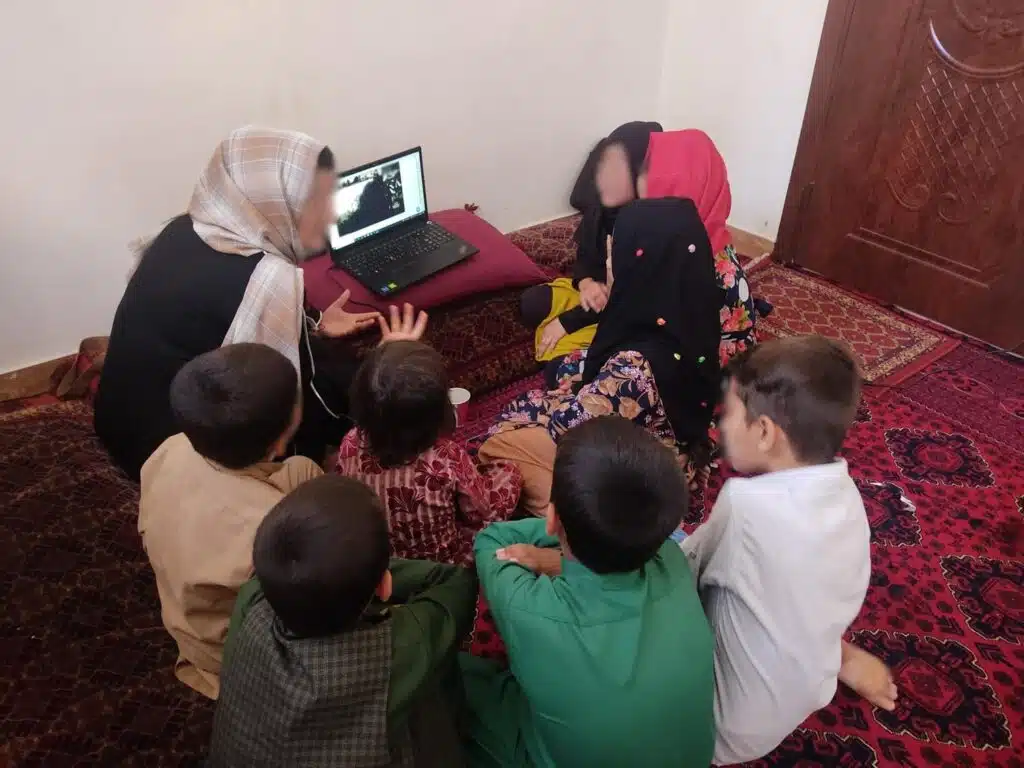
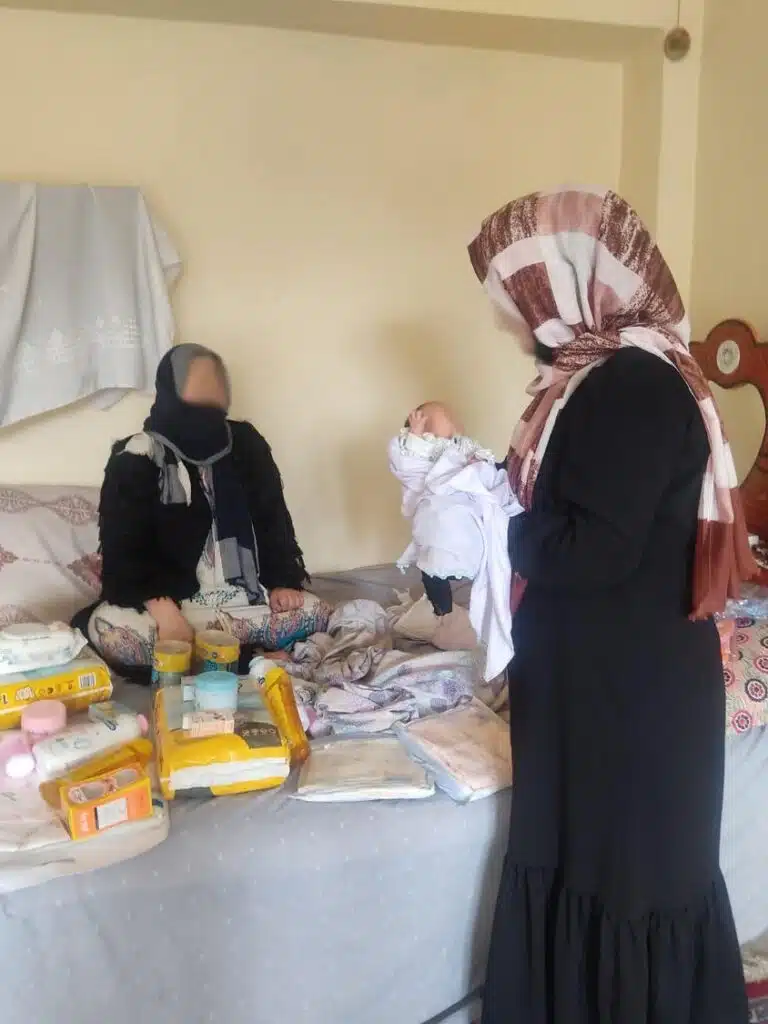
The women ABAAD helps gather to discuss their next steps.ABAAD provides language and other educational opportunities to children.A new mother surrounded by baby supplies provided by ABAAD.
These are not isolated cases. Twenty-nine percent of Afghan women are married before 18. Ten percent before 15. There is no minimum legal age for marriage. As food insecurity worsens, families resort to desperate measures of child labor, forced marriage and, in extreme cases, selling children to settle debts or buy food.
This is how societies unravel.
Glimmers of hope amid collapse
And yet even amid collapse, there are points of light. One ABAAD student, Yasamin, recently gained admission to the University of Bologna after completing a language preparation program. Others are learning English, coding and digital skills tools that offer income and agency in an economy that has erased women’s formal participation.
For US policymakers, this distinction matters. Aid alone does not create stability. Survival without agency does not prevent radicalization. What Afghan women need is continuity, education skills and pathways to work that persist beyond news cycles and political fatigue.
As one ABAAD worker put it, daily life is now “a mix of pain, uncertainty and survival. Hope and security have been almost entirely removed. People feel imprisoned in a world without a future.” Afghanistan has not stabilized. It has been abandoned.
For the US, looking away is not neutrality. It is a strategic choice to allow long-term instability to harden in a region with proven capacity to export violence, insecurity and humanitarian shock. Forgotten crises do not stay contained. They metastasize.
Afghan women and children are not asking for pity.
Read more, think deeper and become smarter, perhaps even wiser, one article at a time. Sign up for our free newsletters now.
<label for=”Your email will be shared with fairobserver and subject to its Privacy Policy”>I agree to receive emails and other content from Fair Observer. I understand that I may repeal my consent at any time. You can review our Privacy Policy and Terms of Use for further information…</label>
They are asking not to be erased. And history shows that erasure always comes at a cost.
[For more information on ABAAD: Afghan Women Forward, please visit their website.]
[India Abroad first published a version of this piece.]
Please read our commenting guidelines before commenting.
1. Be Respectful: Please be polite to the author. Avoid hostility. The whole point of Fair Observer is openness to different perspectives from perspectives from around the world.
2. Comment Thoughtfully: Please be relevant and constructive. We do not allow personal attacks, disinformation or trolling. We will remove hate speech or incitement.
3. Contribute Usefully: Add something of value — a point of view, an argument, a personal experience or a relevant link if you are citing statistics and key facts.
<label style=”font-size: 18px;”>
I have read and agree to the above commenting guidelines. </label>
We rely on your support for our independence, diversity and quality.
For more than 10 years, Fair Observer has been free, fair and independent. No billionaire owns us, no advertisers control us. We are a reader-supported nonprofit. Unlike many other publications, we keep our content free for readers regardless of where they live or whether they can afford to pay. We have no paywalls and no ads.
In the post-truth era of fake news, echo chambers and filter bubbles, we publish a plurality of perspectives from around the world. Anyone can publish with us, but everyone goes through a rigorous editorial process. So, you get fact-checked, well-reasoned content instead of noise.
We publish 3,000+ voices from 90+ countries. We also conduct education and training programs on subjects ranging from digital media and journalism to writing and critical thinking. This doesn’t come cheap. Servers, editors, trainers and web developers cost money. Please consider supporting us on a regular basis as a recurring donor or a sustaining member.
Will you support FO’s journalism?
We rely on your support for our independence, diversity and quality.
The IRS recognizes Fair Observer as a section 501(c)(3) registered public charity (EIN: 46-4070943), enabling you to claim a tax deduction.
Make Sense of the World
Unique Insights from 3,000+ Contributors in 90+ Countries
<label for=”Your email will be shared with fairobserver and subject to its Privacy Policy”>I agree to receive emails and other content from Fair Observer. I understand that I may repeal my consent at any time. You can review our Privacy Policy and Terms of Use for further information .</label>
No owners, no ads, just global voices and first class editors. We’re a nonprofit that puts real journalism first. Join us — subscribe to our free newsletters — now.
<label for=”Your email will be shared with fairobserver and subject to its Privacy Policy”>I agree to receive emails and other content from Fair Observer. I understand that I may repeal my consent at any time. You can review our Privacy Policy and Terms of Use for further information…</label>
</main>
Fair Observer, 461 Harbor Blvd, Belmont, CA 94002, USA
Support independent, crowdsourced, nonprofit journalism.
Fair Observer is a 501(c)(3) independent nonprofit. We are not owned by billionaires or controlled by advertisers. We publish nearly 3,000 authors from over 90 countries after fact-checking and editing each piece. We do not have a paywall and anyone can read us for free. With your vital donations, we can continue to do our work.
Please make a recurring (or even one-time) donation today. Even $1 goes a long way because a million donors like you mean one million dollars. Thank you for keeping us independent, free and fair.
One Time Monthly Yearly
Continue
</footer>
Sign into your Fair Observer Account
<label class=”tml-label” for=”user_login”>Username or Email Address</label>
Unique Insights from 2,500+ Contributors in 90+ Countries
<label for=”Your email will be shared with fairobserver and subject to it’s Privacy Policy”>I agree to receive emails and other content from Fair Observer. I understand that I may repeal my consent at any time. You can review our Privacy Policy and Terms of Use for further information.</label>
NEWSLETTER
Make Sense of the World
Unique Insights from 2,500+ Contributors in 90+ Countries
<label for=”Your email will be shared with fairobserver and subject to it’s Privacy Policy”>I agree to receive emails and other content from Fair Observer. I understand that I may repeal my consent at any time. You can review our Privacy Policy and Terms of Use for further information.</label>
Make Sense of the World
Unique Insights from 2,500+ Contributors in 90+ Countries
<label for=”Your email will be shared with fairobserver and subject to its Privacy Policy”>I agree to receive emails and other content from Fair Observer. I understand that I may repeal my consent at any time. You can review our Privacy Policy and Terms of Use for further information .</label>
We Need Your Consent
We use cookies to give you the best possible experience. Learn more about how we use cookies or edit your cookie preferences. Privacy Policy. My Options I Accept
Privacy & Cookies Policy
Close
Edit Cookie Preferences
The Fair Observer website uses digital cookies so it can collect statistics on how many visitors come to the site, what content is viewed and for how long, and the general location of the computer network of the visitor. These statistics are collected and processed using the Google Analytics service. Fair Observer uses these aggregate statistics from website visits to help improve the content of the website and to provide regular reports to our current and future donors and funding organizations. The type of digital cookie information collected during your visit and any derived data cannot be used or combined with other information to personally identify you. Fair Observer does not use personal data collected from its website for advertising purposes or to market to you.
As a convenience to you, Fair Observer provides buttons that link to popular social media sites, called social sharing buttons, to help you share Fair Observer content and your comments and opinions about it on these social media sites. These social sharing buttons are provided by and are part of these social media sites. They may collect and use personal data as described in their respective policies. Fair Observer does not receive personal data from your use of these social sharing buttons. It is not necessary that you use these buttons to read Fair Observer content or to share on social media.
These cookies are used to enable sharing or following of content that you find interesting on our website. These settings apply to third-party social networking and other websites.
These cookies are used to enhance the performance and functionality of our website. They provide statistics on how our website is used and help us improve by measuring errors. Certain functionalities on our website may become unavailable without these cookies.