<g id=”cross”>
<line class=”cls-1″ x1=”7″ x2=”25″ y1=”7″ y2=”25″ />
<line class=”cls-1″ x1=”7″ x2=”25″ y1=”25″ y2=”7″ />
</g>
Freedom Talk, War Risk: America’s Iran Playbook
<circle cx=”10.5″ cy=”10.5″ r=”7.5″ />
<line x1=”21″ x2=”15.8″ y1=”21″ y2=”15.8″ />
<nav class=”fo-navigation pos-r” itemscope itemtype=”http://schema.org/SiteNavigationElement”>
Login
Sections <circle cx=”10.5″ cy=”10.5″ r=”7.5″ />
<line x1=”21″ x2=”15.8″ y1=”21″ y2=”15.8″ /> Search
<line x1=”21″ x2=”15.8″ y1=”21″ y2=”15.8″ />
Search


PUBLICATION
Support Fair Observer
We rely on your support for our independence, diversity and quality.
</nav>
<circle cx=”10.5″ cy=”10.5″ r=”7.5″ />
<line x1=”21″ x2=”15.8″ y1=”21″ y2=”15.8″ />
<line x1=”21″ x2=”15.8″ y1=”21″ y2=”15.8″ />
Search
</header>

<main id=”main” class=”site-main” role=”main”> 



Wednesday, February 18, 2026
<header class=”entry-header”>
Middle East News
Freedom Talk, War Risk: America’s Iran Playbook
Washington frames Iran policy as a choice between “freedom” and “appeasement,” even as it expands its military posture alongside indirect talks. This coercion, packaged as solidarity, risks escalating tensions and narrowing diplomatic space. If conflict follows, Iranian civilians are the first to suffer, caught between repression at home and external military pressure.
By
Wednesday, February 18, 2026
</header>
Via Shutterstock.

February 18, 2026 06:43 EDT

Check out our comment feature!
Saved Successfully.
This article saved into your bookmarks. Click here to view your bookmarks.


Iran is never a simple subject in Washington. It is easy to point to Tehran’s own failures and stop there. But that move turns every American threat into a moral project by default, and it lets policymakers avoid a harder audit: what US pressure does in practice, and what it reliably produces.
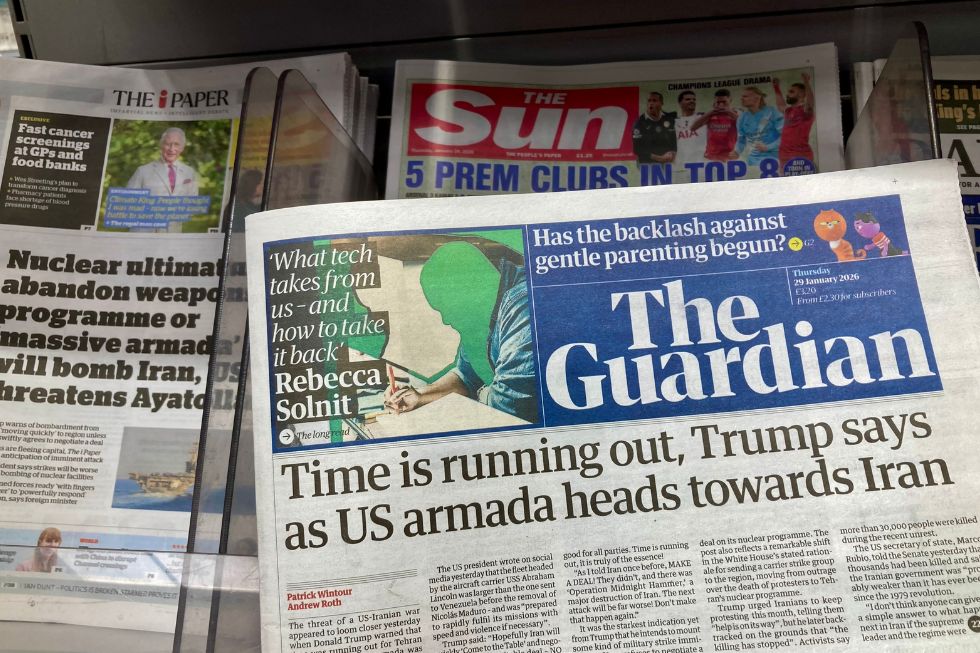
Right now, that audit matters. The US says it wants diplomacy with Iran, with indirect talks in Oman restarting after the June 2025 Israel-Iran conflict and subsequent US strikes on Iranian nuclear sites. At the same time, US force posture around Iran has visibly thickened: a carrier strike group, additional destroyers and an expanding mix of aircraft at regional bases. Even when officials insist the goal is “leverage,” a buildup is still a buildup — and it changes incentives on all sides.
Freedom as framing
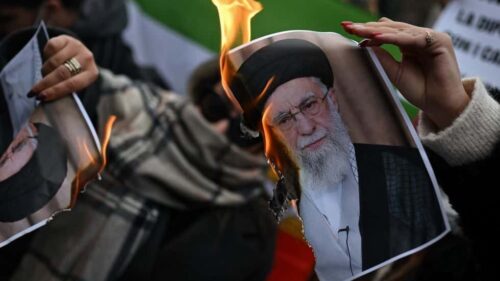
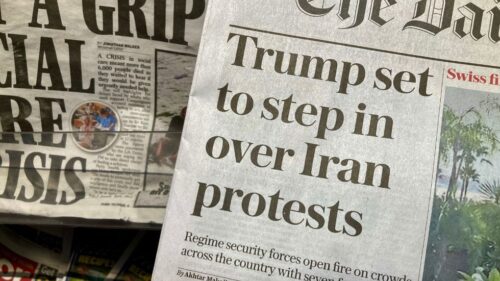
American officials often speak about Iran in the language of solidarity. During recent unrest, Washington again reached for familiar lines about standing with the Iranian people and supporting their rights. The sentiment is understandable. It is also politically convenient: it turns a complex society into a single moral symbol, and it allows coercion to be sold as compassion.
The problem is not that freedom is an illegitimate concern. It is that the freedom frame, on its own, does not tell you what tools will actually help. When the loudest policy instrument is pressure — sanctions, threats and military positioning “support” can become something else: a signal to Tehran that outside powers are investing in escalation, and a signal to Iranian activists that help is coming in the form of confrontation they do not control.
When violence is already unfolding in the streets, external cheerleading can harden the state’s security logic and raise the stakes for protesters. And when the crackdown is used to justify military options, the public is asked to believe a comforting fiction: that force will punish rulers while sparing society.
Logistics speak louder than slogans
War talk is dramatic. Logistics is boring. But logistics is what makes wars possible — and what makes them last. In recent weeks, open-source tracking, satellite imagery and official statements have pointed to a broad US effort to “set the theater” in the Middle East. Reuters reported the arrival of the USS Abraham Lincoln and supporting warships in the region. Whatever the administration’s intent, a buildup of this kind expands the menu of credible military options.
Around that wider picture, a more specific claim has circulated: that C-17 cargo traffic into the region has surged to unusually high levels. The exact number is disputed and does not need to carry the argument. The point is what such a surge would mean. Strategic airlift is not a photo opportunity. It is how you move munitions, air-defense components, spare parts, fuel bladders, engineering gear, medical capacity and the mundane necessities that turn “options” into executable plans.
A posture built for “deterrence” can quickly become a posture built for action. Once assets are in place, the threshold for using them drops — not because leaders become reckless overnight, but because the system rewards readiness. If you have paid the political and financial cost of deploying, you are more likely to reach for the deployed tool when diplomacy stalls.
Negotiations under the shadow of force
The United States and Iran returned to indirect talks in Oman in early February. The Associated Press described a process focused, at least formally, on the nuclear file, with Tehran seeking sanctions relief and Washington pressing for broader constraints. Both sides have incentives to keep the channel open. Neither side trusts the other enough to make the first large move.
In that environment, “diplomacy plus pressure” is sold as a balanced strategy. But balance is not guaranteed. The pressure side tends to grow faster than the diplomacy side, especially when domestic politics rewards toughness and punishes compromise.
When talks are paired with visible deployments, diplomacy can look less like a route to de-escalation and more like a stage-setting exercise: negotiate if you accept our terms; if you do not, the machinery is already in motion. Even if that is not the intent, it is the message that is received.
The result is a familiar spiral. Tehran reads the buildup as preparation for an attack and doubles down on survivability. Washington reads Tehran’s hardening as proof that pressure must increase. The space for genuine bargaining shrinks, and the probability of miscalculation rises.
A recent reminder of who pays in war
It is tempting to talk about “limited strikes” and “surgical options.” The June 2025 Israel-Iran conflict should have killed that temptation. In those 12 days, civilians in both countries learned a lesson that strategists often abstract away: modern war bleeds outward. UN human rights officials warned that Israeli strikes and evacuation orders drove large-scale displacement, with many fleeing Tehran.
The Evin Prison strike, which occurred on June 23, 2025, during the 12-day war, underlined the same point. Reuters reported Iranian officials saying at least 71 people were killed there, including staff, detainees and visiting family members. Human Rights Watch later called the attack an apparent war crime, arguing it struck a civilian facility with no evident military target.
On the Israeli side, Human Rights Watch documented Iranian missile strikes that hit civilian areas, causing deaths, injuries and displacement. None of this is surprising. It is what happens when states trade fire at scale. It is also why the claim “we will only hit the regime” rarely survives contact with reality.
Some politicians tried to wrap that conflict in emancipatory language. Israeli Prime Minister Benjamin Netanyahu invoked Iran’s “Woman, Life, Freedom” movement while talking about regime change; women’s rights observers warned that co-opting a grassroots struggle to justify external aggression can backfire, associating an internal movement with a foreign military campaign. Meanwhile, Iranian women and activists were left navigating a landscape that was both more violent and more securitized.
That is the pattern worth underlining. When outside powers promise liberation through coercion, they often hand domestic hardliners their favorite tool: a security narrative. The immediate victims are civilians. The longer-term victims are the political spaces that dissent needs in order to survive.
The Maduro template: law-and-order language, military reality
In January 2026, a US operation ended with the capture of Venezuela’s president Nicolás Maduro, framed as law enforcement with military backing and condemned abroad (including in a UK Parliament research briefing). Critics called it abduction. Venezuela is not Iran, but the method travels: moral urgency and legal packaging can make force look procedural. Iran should not be the next test case.
What a pro-Iranian-people policy would actually avoid
None of this requires romanticizing Tehran or ignoring Iranian state violence. It requires separating two questions that are too often fused together: whether Iran’s political order is unjust, and whether American coercion is therefore democratic.
A policy that genuinely prioritizes Iranians would do the opposite of what escalation does. It would reduce the likelihood of war. It would treat civilian harm as central, not as collateral. And it would be honest about the record: wars sold as moral interventions do not reliably produce freer societies, especially when the intervening power defines freedom as compliance.
You can read the CIA Factbook and listen to MI6 people for your analysis, or you could read perspectives from our 3,000+ authors from 90+ countries and make sense of the world. Sign up for our free newsletters now.
<label for=”Your email will be shared with fairobserver and subject to its Privacy Policy”>I agree to receive emails and other content from Fair Observer. I understand that I may repeal my consent at any time. You can review our Privacy Policy and Terms of Use for further information…</label>
That starts with discipline: if negotiations are real, deployments should not outrun them. Washington should state what it is deterring — and what it is not — and define “limited” for the civilians who would bear it. There are tools other than threats: a narrow, verifiable nuclear deal with reciprocal relief; humanitarian carve-outs and back channels that cool the theater; and support for independent information flows without turning protest into a proxy battlefield. Freedom is a powerful word. But in Iran policy, the revealing one is “pressure” — and pressure, paired with logistics, ends in rubble and displacement.
[Kaitlyn Diana edited this piece.]
The views expressed in this article are the author’s own and do not necessarily reflect Fair Observer’s editorial policy.
Comment
0 Comments
Newest
Oldest
Most Voted
Most Voted
Inline Feedbacks
View all comments
Commenting Guidelines
Please read our commenting guidelines before commenting.
1. Be Respectful: Please be polite to the author. Avoid hostility. The whole point of Fair Observer is openness to different perspectives from perspectives from around the world.
2. Comment Thoughtfully: Please be relevant and constructive. We do not allow personal attacks, disinformation or trolling. We will remove hate speech or incitement.
3. Contribute Usefully: Add something of value — a point of view, an argument, a personal experience or a relevant link if you are citing statistics and key facts.
<label style=”font-size: 18px;”>
I have read and agree to the above commenting guidelines.
</label>
Please agree to the guidelines before proceeding.
I
Agree, Proceed to Login
Cancel
Related Reading
FO Talks: Is Sovereignty Dead? Trump’s Maduro Arrest and the End of Global Norms
In this episode of FO Talks, Atul Singh and Leonardo Vivas examine US President Donald Trump’s extraction of Venezuelan President…
by
Leonardo Vivas & Atul Singh,
February 15, 2026
A Smart Intervention by the US Could Cause Iran’s Islamic Regime to Collapse
The 2025 collapse of the Iranian Islamic regime’s Forward Defense doctrine and the systematic destruction of its strategic deterrents have…
by
Ali Omar Forozish,
February 7, 2026
Trump Backs Down From Iran Threats, for Now
Mounting economic collapse initially drove Iran’s largest protests since 1979, but they were quickly fueled by open demands for regime…
by
Gary Grappo,
January 17, 2026
Support Fair Observer
We rely on your support for our independence, diversity and quality.
For more than 10 years, Fair Observer has been free, fair and independent. No billionaire
owns us, no advertisers control us. We are a reader-supported nonprofit. Unlike many other
publications, we keep our content free for readers regardless of where they live or whether
they can afford to pay. We have no paywalls and no ads.
In the post-truth era of fake news, echo chambers and filter bubbles, we publish a plurality
of perspectives from around the world. Anyone can publish with us, but everyone goes through
a rigorous editorial process. So, you get fact-checked, well-reasoned content instead of
noise.
We publish 3,000+ voices from 90+ countries. We also conduct education and training programs
on subjects ranging from digital media and journalism to writing and critical thinking. This
doesn’t come cheap. Servers, editors, trainers and web developers cost
money.
Please consider supporting us on a regular basis as a recurring donor or a
sustaining member.
Will you support FO’s journalism?
We rely on your support for our independence, diversity and quality.
Donation Cycle
<label for=”donation_cycle_one_time”>One Time</label>
<label for=”donation_cycle_monthly”>Monthly</label>
<label for=”donation_cycle_yearly”>Yearly</label>
Donation Amount
<label for=”amount_11″>$11</label>
<label for=”amount_111″>$111</label>
<label for=”other”>Other</label>
$
The IRS recognizes Fair Observer as a section 501(c)(3) registered public charity
(EIN: 46-4070943), enabling you to claim a tax deduction.
Make Sense of the World
Unique Insights from 3,000+ Contributors in 90+ Countries
<label
for=”Your email will be shared with fairobserver and subject to its Privacy Policy”>I
agree to receive emails and other content from Fair Observer. I understand
that I
may repeal my consent at any time. You can review our Privacy Policy
and Terms of Use
for further
information .</label>
for=”Your email will be shared with fairobserver and subject to its Privacy Policy”>I
agree to receive emails and other content from Fair Observer. I understand
that I
may repeal my consent at any time. You can review our Privacy Policy
and Terms of Use
for further
information .</label>
We are a nonprofit, truly independent media organization committed to delivering diverse, fact-based global analysis. If you like what you are reading, sign up for our free newsletters now.
<label for=”Your email will be shared with fairobserver and subject to its Privacy Policy”>I agree to receive emails and other content from Fair Observer. I understand that I may repeal my consent at any time. You can review our Privacy Policy and Terms of Use for further information…</label>
</main>
Fair Observer, 461 Harbor Blvd, Belmont, CA 94002, USA
<footer class=”mart70 fo-black-bg padt50 padb30″>
Sections
PUBLICATION
Support Fair Observer
We rely on your support for our independence, diversity and quality.


</footer>

<footer id=”fixed-footer” class=”support-footer”>


Support
independent, crowdsourced, nonprofit
journalism.
Fair Observer is a 501(c)(3) independent nonprofit. We are not owned by billionaires or controlled by
advertisers. We publish nearly 3,000 authors from over 90 countries after fact-checking and editing each
piece. We do not have a paywall and anyone can read us for free. With your vital donations, we can
continue
to do our work.
Please make a recurring (or even one-time) donation today. Even $1 goes a long way because
a
million donors
like you mean one million dollars. Thank you for keeping us independent, free and fair.
One Time
Monthly
Yearly
Monthly
Yearly
Continue 

</footer>

Sign into your Fair Observer Account
<label class=”tml-label” for=”user_login”>Username or Email Address</label>
<label class=”tml-label” for=”user_pass”>Password</label>
<label class=”tml-label” for=”rememberme”>Remember Me</label>
Log In
Forgot
Password
Password
Forgot Password
Enter your registered email address or username. You will receive a
link to create a new password via email.
Please enter your username or email address. You will receive an email message with instructions on how to reset your password.
<label class=”tml-label” for=”user_login”>Username or Email Address</label>
Get New Password
Or
Return to
Login
Forgot Password
We have sent a link to your registered email address to reset your password.
<circle cx=”12.5″ cy=”12″ r=”12″ fill=”#414141″ />
Back to
Login
Become a Member & Enjoy Exclusive Benefits!
<circle cx=”12.5″ cy=”12″ r=”12″ fill=”#414141″ />
Access to comments feature
<circle cx=”12.5″ cy=”12″ r=”12″ fill=”#414141″ />
Bookmark your favorite articles
<circle cx=”12.5″ cy=”12″ r=”12″ fill=”#414141″ />
Exclusive invitations to FO° Talks & FO° Live
<circle cx=”12.5″ cy=”12″ r=”12″ fill=”#414141″ />
Access to all of our e-publications
Return to
Login
Login
NEWSLETTER
Make Sense of the World
Unique Insights from 2,500+ Contributors in 90+ Countries

<label
for=”Your email will be shared with fairobserver and subject to it’s Privacy Policy”>I
agree to receive emails and other content from Fair Observer. I understand
that I may repeal my consent at any time. You can review our Privacy Policy
and Terms of Use
for further information.</label>
for=”Your email will be shared with fairobserver and subject to it’s Privacy Policy”>I
agree to receive emails and other content from Fair Observer. I understand
that I may repeal my consent at any time. You can review our Privacy Policy
and Terms of Use
for further information.</label>
NEWSLETTER
Make Sense of the World
Unique Insights from 2,500+ Contributors in 90+ Countries
<label
for=”Your email will be shared with fairobserver and subject to it’s Privacy Policy”>I
agree to receive emails and other content from Fair Observer. I understand
that I may repeal my consent at any time. You can review our Privacy Policy
and Terms of Use
for further information.</label>
for=”Your email will be shared with fairobserver and subject to it’s Privacy Policy”>I
agree to receive emails and other content from Fair Observer. I understand
that I may repeal my consent at any time. You can review our Privacy Policy
and Terms of Use
for further information.</label>

Make Sense of the World
Unique Insights from 2,500+ Contributors in 90+ Countries
<label
for=”Your email will be shared with fairobserver and subject to its Privacy Policy”>I
agree to receive emails and other content from Fair Observer. I understand that I
may repeal my consent at any time. You can review our Privacy Policy and Terms of Use for further
information .</label>
for=”Your email will be shared with fairobserver and subject to its Privacy Policy”>I
agree to receive emails and other content from Fair Observer. I understand that I
may repeal my consent at any time. You can review our Privacy Policy and Terms of Use for further
information .</label>
We Need Your Consent
We use cookies to give you the best possible experience. Learn more about how we use cookies or edit your cookie preferences. Privacy Policy. My Options I Accept
Privacy & Cookies Policy
Close
Edit Cookie Preferences
The Fair Observer website uses digital cookies so it can collect statistics on how many visitors come to the site, what content is viewed and for how long, and the general location of the computer network of the visitor. These statistics are collected and processed using the Google Analytics service. Fair Observer uses these aggregate statistics from website visits to help improve the content of the website and to provide regular reports to our current and future donors and funding organizations. The type of digital cookie information collected during your visit and any derived data cannot be used or combined with other information to personally identify you. Fair Observer does not use personal data collected from its website for advertising purposes or to market to you.
As a convenience to you, Fair Observer provides buttons that link to popular social media sites, called social sharing buttons, to help you share Fair Observer content and your comments and opinions about it on these social media sites. These social sharing buttons are provided by and are part of these social media sites. They may collect and use personal data as described in their respective policies. Fair Observer does not receive personal data from your use of these social sharing buttons. It is not necessary that you use these buttons to read Fair Observer content or to share on social media.
Necessary
<label class=”form-check-label” for=”wt-cli-checkbox-necessary”>Necessary</label>
Always Enabled
These cookies essential for the website to function.
Social Media
<label for=”wt-cli-checkbox-social_media” class=”cli-slider” data-cli-enable=”Enabled” data-cli-disable=”Disabled”>Social Media</label>
These cookies are used to enable sharing or following of content that you find interesting on our website. These settings apply to third-party social networking and other websites.
Performance & Functionality
<label for=”wt-cli-checkbox-performance” class=”cli-slider” data-cli-enable=”Enabled” data-cli-disable=”Disabled”>Performance & Functionality</label>
These cookies are used to enhance the performance and functionality of our website. They provide statistics on how our website is used and help us improve by measuring errors. Certain functionalities on our website may become unavailable without these cookies.
Analytics
<label for=”wt-cli-checkbox-analytics” class=”cli-slider” data-cli-enable=”Enabled” data-cli-disable=”Disabled”>Analytics</label>
SAVE & ACCEPT
<textarea id=’wpd-editor-source-code’></textarea>Insert
</body></html>
Total Views:
Source: World Politics - fairobserver.com