A Specter Is Haunting the Media — the Specter of Reza Pahlavi
Recent protests in Iran reveal deep sociopolitical and ethnonational tensions, complicated by media narratives that disproportionately elevate Reza Pahlavi while marginalizing non-Persian voices. Pahlavi’s vision risks repeating authoritarian patterns and excluding alternative demands. Without inclusive representation, Iran’s struggle for a democratic future as a multinational country remains at risk of failure.
Due to the longstanding tensions under the Iranian regime, as well as the unresolved consequences of the Jin, Jiyan, Azadi uprising, widespread protests have once again erupted in the country. These protests can be attributed to real sociopolitical, economic, ethnonational and gender-based pressures.
During the demonstrations, a concurrent war of narratives over political meanings, leadership and legitimacy unfolded across Iranian opposition media abroad and, in some cases, within international media. Some of these media presented themselves as platforms for opposition groups. However, their disproportionate coverage of the narratives did not merely circulate information but also served as propaganda. This is even more apparent when such coverage shapes visibility, hierarchy and authority among opposition voices.
Here, propaganda is not necessarily the promotion of misinformation or conspiracy theories. It can also take the form of cherry-picked facts that favor certain voices. Propaganda, in this sense, instead of generating false narratives, legitimizes, embellishes and amplifies rumors that are already within society, those most readily believed.
Iranian collective memory still remembers a rumor that was circulated throughout the country by the media in 1979. The rumor that former Iranian Supreme Leader Ayatollah Khomeini’s image had appeared on the moon. This was a story that once captivated Iran.
The cult of personality and media mythmaking
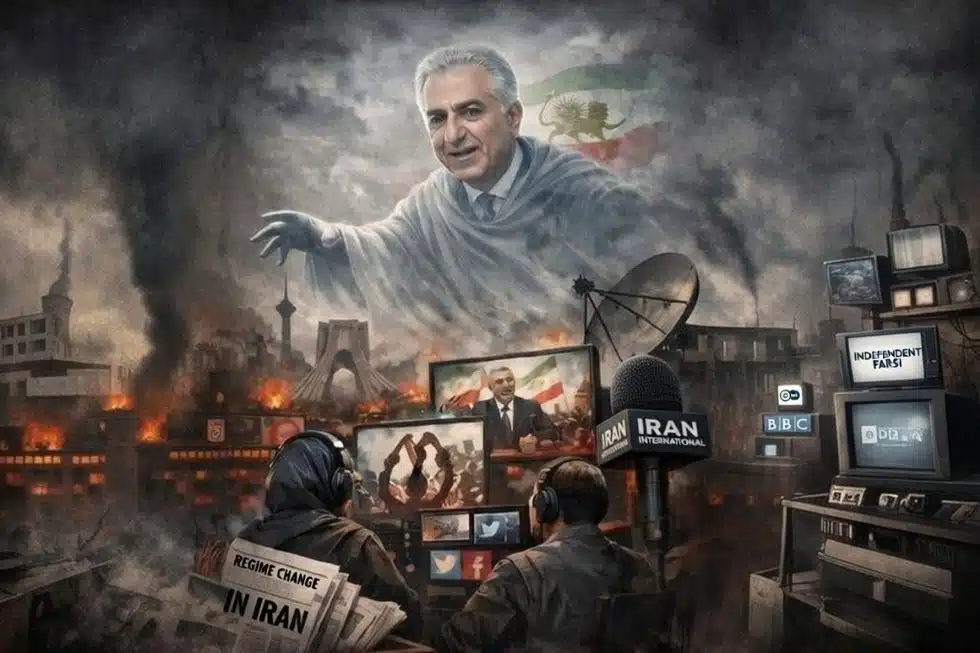
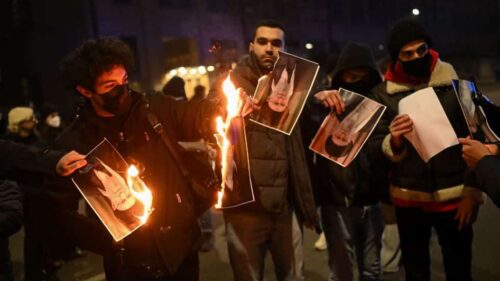
Just as the media once constructed a messianicimage of Khomeini, they are now playing a comparable role regarding Reza Pahlavi, the exiled son of the last Iranian monarch. During the uprising, media coverage implied that Pahlavi had been leading the protesters. Of course, here the question is not whether he has supporters in Iran — he does — but whether he was truly at the center of the recent protests, as claimed by the BBC, or, as Politico asserted, “Pahlavi’s name is on the lips of many protesters … even his critics.”
Even though these media may be interested in transmitting opposition voices to help topple the regime, they appear to fail to grasp the nuances of Iran’s social sensitivities. Their recent saturation coverage of Pahlavi, framing him as the “central figure” of the opposition, has coincided with the ebbing of uprisings in several Kurdish cities. This includes Sine (Sanandaj), the capital city, and Seqqiz, where the Jin, Jiyan, Azadi protests began in 2022. This fact is especially drastic in the light of the Pahlavi dynasty’s systematic violations against ethnonational rights in non-Persian regions. This history makes such portrayals not only tone-deaf but also potentially and politically erosive.
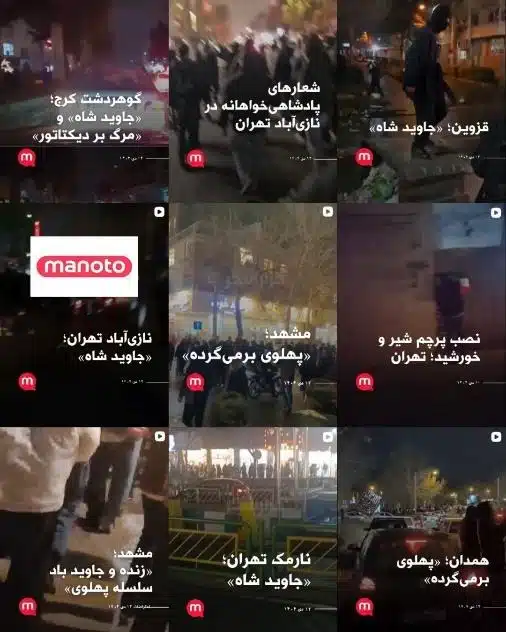
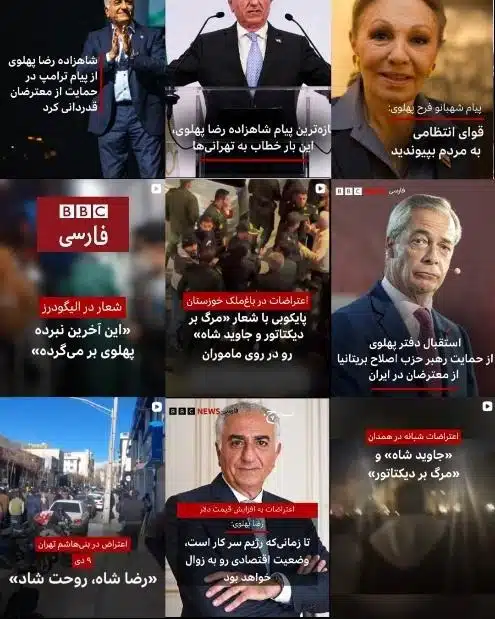
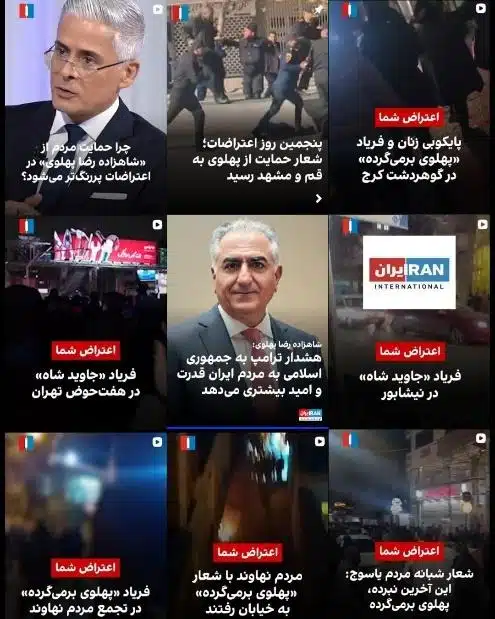
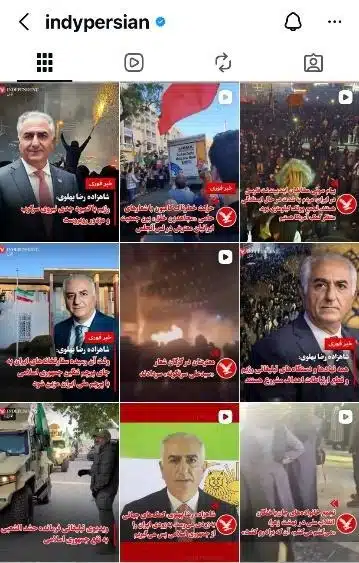
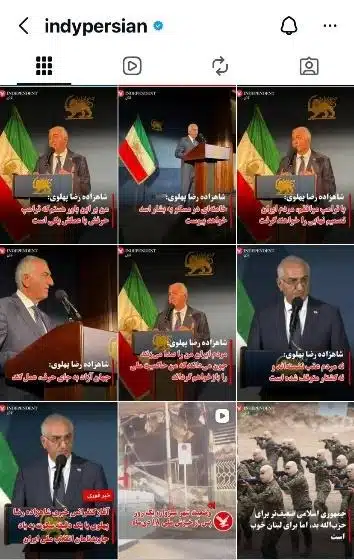
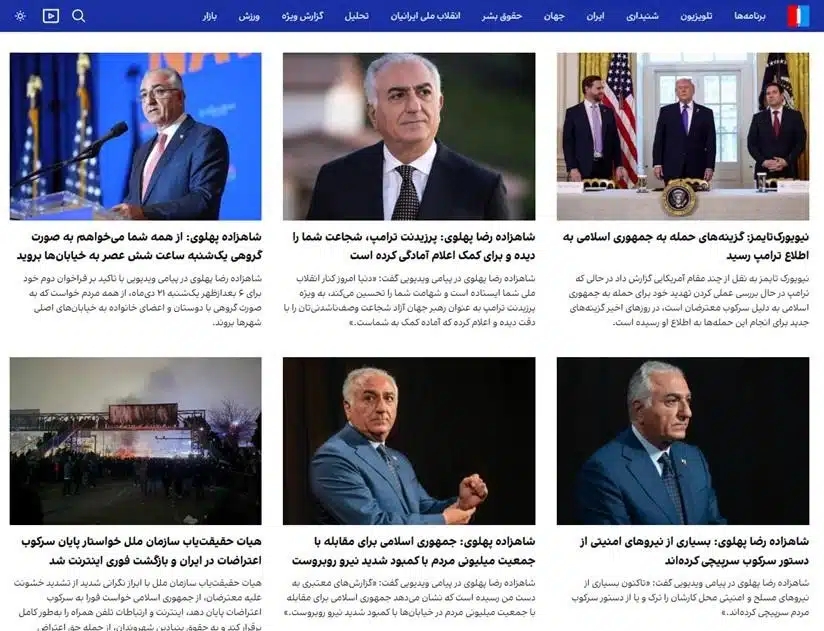
The state of the Persian opposition media is even more concerning. Within days, popular media outlets and television channels suchasIndependent Farsi, BBC Persian, Iran International and Manoto appeared to converge on a united editorial line. As their manners were no longer simply reports of the protests but rather a well-arranged montage, it would be too naive to explain it as a simple coincidence. During the protests, their editorial selection, repetition and framing increasingly replaced contextual and polyphonic analysis. The following random screenshots, taken from their social media platforms, are revealing without any caption.
Screenshots from the Instagram pages of three Iranian TV outlets — BBC Persian, Iran International and Manoto — highlight only posts featuring Pahlavi’s words and pro-Pahlavi slogans during the recent uprisings.Independent Persian media outlet’s Instagram page, which similarly emphasizes Pahlavi-related content.
#MediaCoup: how Persian media tries to legitimize Iran’s opposition
In the debate about Iran’s democratic future, battles over who speaks for the opposition are often fought as much in newsrooms as in the streets. There has been a recurring pattern in which diaspora Persian-language media elevate certain actors as the “legitimate opposition” while marginalizing others. This dynamic became highly visible in 2023 during the #MediaCoup controversy that revealed how media power can function as a form of political persuasion.
In 2023, several non-Persian and non-monarchist journalists working for opposition Persian-language media outlets in the diaspora resigned. Their resignations coincided with a campaign under the Farsi-language hashtag #MediaCoup, which criticized news blackouts and media censorship. Under this hashtag, users accused Persian media of Pahlavi favoritism, boycotting alternative voices and selectively covering others while focusing on Persian-inhabited areas.
By 2026, subsequent events reinforced these criticisms. During the recent protests, only videos of Pahlavi supporters circulated widely. The other footage showingother slogans or those clips showing Pahlavi supporters physically attacking and verbally harassing non-monarchists received little to no criticism from the media. Together, these events show a pattern of media gatekeeping that shapes which opposition is seen as acceptable, respectable and credible.
This pattern of elevating a single strongman while marginalizing other voices is not new in Iran. It has a historical lineage. During the Green Movement (2009), Mir Hossein Mousavi and Mehdi Karroubi, both now under house arrest but longtime holders of several high-ranking positions within the regime’s repressive apparatus, were portrayed by Persian diaspora media as the sole leaders of the struggle for freedom. When their highly controversial records were criticized by non-Persian communities, their voices were left unheard. As a result, non-Persian regions did not join the uprisings, and the movement was largely confined to Persian-inhabited areas.
Finally, a similar precedent appears in 1979, with the elevation of Ayatollah Khomeini to the role of the revolution’s singular voice. At that time, the Kurds rejected Khomeini’s leadership, but their dissent was again left unheard. In those days, mostly in Persian-inhabited areas, it was rumored that Khomeini’s picture would appear on the moon. The rumor spread beyond word of mouth and reached many people through BBC Persian radio. Even without fabricating a rumor, the broadcasts gave huge credibility to the story and helped elevate Khomeini’s position in Iran, while sidelining other facts.
At that time, many Iranians really expected to see Khomeini on the moon as a quasi-messianic figure. As mentioned in the beginning, this is an example of how cherry-picked facts, in some cases, can function as a form of propaganda. The BBC Persian website later wrote about this episode from the perspective of one of their journalists:
One night, everyone was saying that BBC Radio had said Khomeini’s picture had appeared on the moon. We hadn’t heard it ourselves, but everyone said they had heard it from the BBC … This very report helped spread the rumor across Iran … and the word of the BBC was authoritative for the Iranians.
Some Iranians still believe this report, along with another pivotal BBC interview with Khomeini in 1979, helped shape the course of the Islamic Revolution. This perception, among others, has led the broadcaster to be widely referred to in Iran as “Ayatollah BBC.” This can show how media credibility can also become politically productive.
The point of this section is not that the media creates revolutions. Instead, it is to show how they help legitimize a single, almost untouchable leader and cult of personality — through patterns of framing, selective amplification and moral elevation — who can influence the course of a revolution. This history provides context for understanding why the Persian #MediaCoup in Iran can be read less as a dispute over bias than as a struggle over a new form of mediated legitimacy.
This history should have made the media more attentive to the present time. Yet in 2026, as debates about Iran’s future continue, the same logic of singular legitimacy rooted in Persian supremacy remains visible. The clearest example is Pahlavi’s Emergency Period Pamphlet, a text through which he frames his political vision. Now that his specter is hunting the media, the substance of this document has received little scrutiny.
Pahlavi’s Emergency Period Pamphlet
Pahlavi released the Emergency Period Pamphlet in July, 2025, outlining his vision for post-Islamic Republic Iran. In his pamphlet, he claims to be the “leader of the national uprising” and presumes to speak for roughly 90 million people while sidelining any other alternatives, which is not in accordance with his political vision.
For example, under Clause 12.6 (page 9) of the pamphlet, his proposed post-regime-change referendum would reduce Iran’s political horizon to a binary choice between monarchy and unitary republic. However, for Kurdish political parties, federalism persists as a core and legitimate democratic objective. But Pahlavi’s unilateral framing risks excluding ethnonational demands for which, decades ago, their non-Persian leaders were imprisoned or executed under the same Pahlavi dynasty.
Another example is Clause 6, Section A (page 7), which stipulates that members of the proposed National Uprising Institution would be appointed by the leader. The pamphlet states that any change to its composition would require a majority vote of the members appointed by the leader. However, this is insufficient and would also require approval from the self-claimed leader. Consequently, the National Uprising Institution has no genuine independence from the leader. This structure creates a model of “nonbinding consultation.” It concentrates final decision-making power in the hands of a single individual. Such a concentration of power, even if framed as transient, carries a risk of reproducing authoritarian patterns.
However, his pamphlet, as well as his public statements, have many issues that need to be questioned, yet the media chooses to be silent about them.
The risk of repeating history
Global media should not serve once again as a megaphone for another Persian authoritarian. In 1979, when the Iranian people voted to approve the Iranian regime, only Kurdistan voted against it. As a result, Khomeini issued a fatwa calling for jihad and sent Iranian military and paramilitary forces to suppress Kurdistan, resulting in widespread massacres.
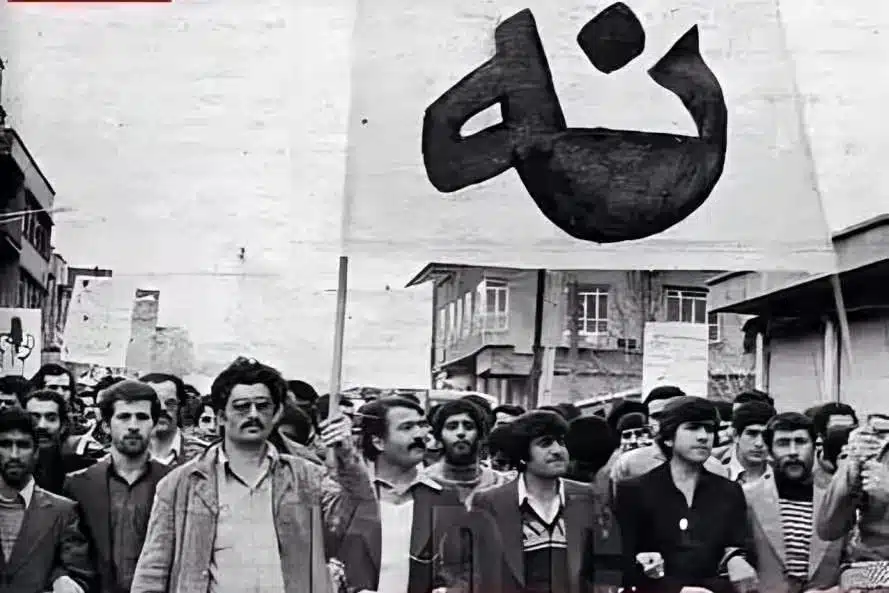
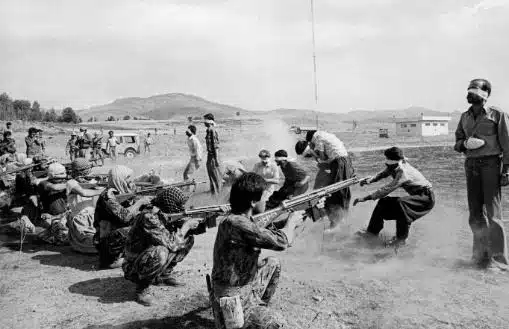
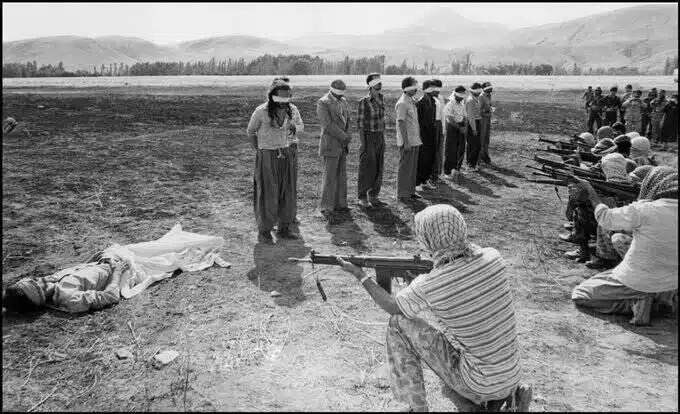
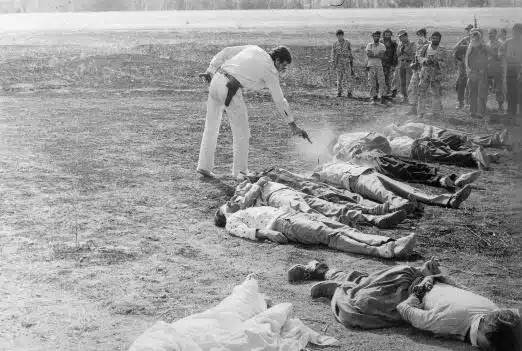
Kurdish protesters in Sine (Sanandaj) carry a large banner displaying a “No” in the Kurdish language in opposition to the Islamic Republic of Iran referendum, 29 March 1979.Kurdistan; Sine (Sanandaj) Airport; execution of Kurdish Peshmerga following the Iranian Revolution by the Iranian forces.
Today, history is about to repeat itself. The specter of Pahlavi, not on the moon but on the media, sidelines the other non-Persian alternatives. This, again, prevents a democratic future for Iran as a multinational state. As a result, in the most critical phases of the uprisings, these outlets did not convey a sense of being heard among all civilians. Moreover, many critics of the Pahlavi regime expected the media to devote time to questioning Reza Pahlavi’s position on the highly controversial legacy of the Pahlavi dynasty’s human rights violations, or to critically discuss his centralized, leader-centric program outlined in his Emergency Period Pamphlet. But the media largely overlooked this important aspect and instead amplified his voice as that of another Persian strongman. Only after the uprisings waned and his political missteps became apparent did some outlets, belatedly, begin to offer criticism.
Read more, think deeper and become smarter, perhaps even wiser, one article at a time. Sign up for our free newsletters now.
<label for=”Your email will be shared with fairobserver and subject to its Privacy Policy”>I agree to receive emails and other content from Fair Observer. I understand that I may repeal my consent at any time. You can review our Privacy Policy and Terms of Use for further information…</label>
If, in the next uprisings, another Persian strongman dominates, the demonstrations will fail again. If the voices of non-Persians are again unheard, no democratic future is possible. And if the media claim to represent “peoples,” they must represent all of them; silence in the face of exclusion is complicity.
A screenshot from the website of Iran International, the London-based Persian-language news platform.
Please read our commenting guidelines before commenting.
1. Be Respectful: Please be polite to the author. Avoid hostility. The whole point of Fair Observer is openness to different perspectives from perspectives from around the world.
2. Comment Thoughtfully: Please be relevant and constructive. We do not allow personal attacks, disinformation or trolling. We will remove hate speech or incitement.
3. Contribute Usefully: Add something of value — a point of view, an argument, a personal experience or a relevant link if you are citing statistics and key facts.
<label style=”font-size: 18px;”>
I have read and agree to the above commenting guidelines. </label>
We rely on your support for our independence, diversity and quality.
For more than 10 years, Fair Observer has been free, fair and independent. No billionaire owns us, no advertisers control us. We are a reader-supported nonprofit. Unlike many other publications, we keep our content free for readers regardless of where they live or whether they can afford to pay. We have no paywalls and no ads.
In the post-truth era of fake news, echo chambers and filter bubbles, we publish a plurality of perspectives from around the world. Anyone can publish with us, but everyone goes through a rigorous editorial process. So, you get fact-checked, well-reasoned content instead of noise.
We publish 3,000+ voices from 90+ countries. We also conduct education and training programs on subjects ranging from digital media and journalism to writing and critical thinking. This doesn’t come cheap. Servers, editors, trainers and web developers cost money. Please consider supporting us on a regular basis as a recurring donor or a sustaining member.
Will you support FO’s journalism?
We rely on your support for our independence, diversity and quality.
The IRS recognizes Fair Observer as a section 501(c)(3) registered public charity (EIN: 46-4070943), enabling you to claim a tax deduction.
Make Sense of the World
Unique Insights from 3,000+ Contributors in 90+ Countries
<label for=”Your email will be shared with fairobserver and subject to its Privacy Policy”>I agree to receive emails and other content from Fair Observer. I understand that I may repeal my consent at any time. You can review our Privacy Policy and Terms of Use for further information .</label>
Look at the world through many prisms — 3,000+ pairs of eyes from 90+ countries. We are a rare nonprofit in the world news space and you can get our newsletters for free.
<label for=”Your email will be shared with fairobserver and subject to its Privacy Policy”>I agree to receive emails and other content from Fair Observer. I understand that I may repeal my consent at any time. You can review our Privacy Policy and Terms of Use for further information…</label>
</main>
Fair Observer, 461 Harbor Blvd, Belmont, CA 94002, USA
Support independent, crowdsourced, nonprofit journalism.
Fair Observer is a 501(c)(3) independent nonprofit. We are not owned by billionaires or controlled by advertisers. We publish nearly 3,000 authors from over 90 countries after fact-checking and editing each piece. We do not have a paywall and anyone can read us for free. With your vital donations, we can continue to do our work.
Please make a recurring (or even one-time) donation today. Even $1 goes a long way because a million donors like you mean one million dollars. Thank you for keeping us independent, free and fair.
One Time Monthly Yearly
Continue
</footer>
Sign into your Fair Observer Account
<label class=”tml-label” for=”user_login”>Username or Email Address</label>
Unique Insights from 2,500+ Contributors in 90+ Countries
<label for=”Your email will be shared with fairobserver and subject to it’s Privacy Policy”>I agree to receive emails and other content from Fair Observer. I understand that I may repeal my consent at any time. You can review our Privacy Policy and Terms of Use for further information.</label>
NEWSLETTER
Make Sense of the World
Unique Insights from 2,500+ Contributors in 90+ Countries
<label for=”Your email will be shared with fairobserver and subject to it’s Privacy Policy”>I agree to receive emails and other content from Fair Observer. I understand that I may repeal my consent at any time. You can review our Privacy Policy and Terms of Use for further information.</label>
Make Sense of the World
Unique Insights from 2,500+ Contributors in 90+ Countries
<label for=”Your email will be shared with fairobserver and subject to its Privacy Policy”>I agree to receive emails and other content from Fair Observer. I understand that I may repeal my consent at any time. You can review our Privacy Policy and Terms of Use for further information .</label>
We Need Your Consent
We use cookies to give you the best possible experience. Learn more about how we use cookies or edit your cookie preferences. Privacy Policy. My Options I Accept
Privacy & Cookies Policy
Close
Edit Cookie Preferences
The Fair Observer website uses digital cookies so it can collect statistics on how many visitors come to the site, what content is viewed and for how long, and the general location of the computer network of the visitor. These statistics are collected and processed using the Google Analytics service. Fair Observer uses these aggregate statistics from website visits to help improve the content of the website and to provide regular reports to our current and future donors and funding organizations. The type of digital cookie information collected during your visit and any derived data cannot be used or combined with other information to personally identify you. Fair Observer does not use personal data collected from its website for advertising purposes or to market to you.
As a convenience to you, Fair Observer provides buttons that link to popular social media sites, called social sharing buttons, to help you share Fair Observer content and your comments and opinions about it on these social media sites. These social sharing buttons are provided by and are part of these social media sites. They may collect and use personal data as described in their respective policies. Fair Observer does not receive personal data from your use of these social sharing buttons. It is not necessary that you use these buttons to read Fair Observer content or to share on social media.
These cookies are used to enable sharing or following of content that you find interesting on our website. These settings apply to third-party social networking and other websites.
These cookies are used to enhance the performance and functionality of our website. They provide statistics on how our website is used and help us improve by measuring errors. Certain functionalities on our website may become unavailable without these cookies.