<g id=”cross”>
<line class=”cls-1″ x1=”7″ x2=”25″ y1=”7″ y2=”25″ />
<line class=”cls-1″ x1=”7″ x2=”25″ y1=”25″ y2=”7″ />
</g>
Bangladesh Heads to the Polls as Minorities Face an Uncertain Future
<circle cx=”10.5″ cy=”10.5″ r=”7.5″ />
<line x1=”21″ x2=”15.8″ y1=”21″ y2=”15.8″ />
<nav class=”fo-navigation pos-r” itemscope itemtype=”http://schema.org/SiteNavigationElement”>
Login
Sections <circle cx=”10.5″ cy=”10.5″ r=”7.5″ />
<line x1=”21″ x2=”15.8″ y1=”21″ y2=”15.8″ /> Search
<line x1=”21″ x2=”15.8″ y1=”21″ y2=”15.8″ />
Search


PUBLICATION
Support Fair Observer
We rely on your support for our independence, diversity and quality.
</nav>
<circle cx=”10.5″ cy=”10.5″ r=”7.5″ />
<line x1=”21″ x2=”15.8″ y1=”21″ y2=”15.8″ />
<line x1=”21″ x2=”15.8″ y1=”21″ y2=”15.8″ />
Search
</header>

<main id=”main” class=”site-main” role=”main”> 


Wednesday, February 11, 2026
<header class=”entry-header”>
Central & South Asia
Bangladesh Heads to the Polls as Minorities Face an Uncertain Future
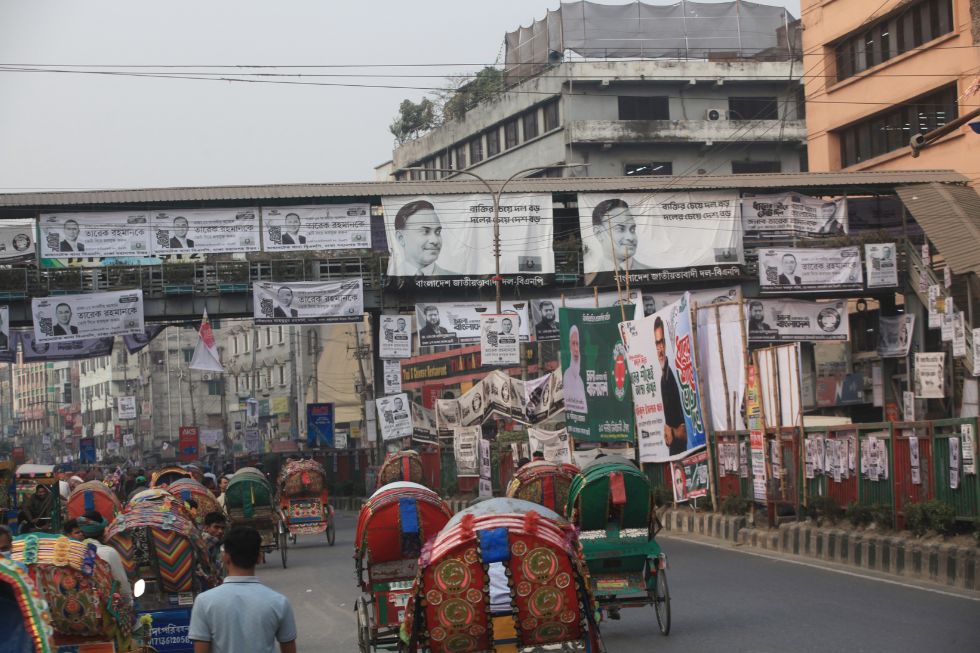
Between December 2025 and January 2026, Bangladesh witnessed renewed violence targeting religious minorities, especially Hindus, amid political unrest following Prime Minister Sheikh Hasina’s ouster. Historical ties between major parties BNP and Jamaat-e-Islami and communal violence raise concerns about systemic injustice. As Bangladesh is poised for a crucial election, past and recent violence against minorities highlights unresolved questions of protection and accountability.
By
Wednesday, February 11, 2026
</header>
Via Shutterstock.

February 11, 2026 07:05 EDT

Check out our comment feature!
Saved Successfully.
This article saved into your bookmarks. Click here to view your bookmarks.


Between December 2025 and January 2026, Bangladesh saw a renewed spate of violence against religious minorities, especially members of the Hindu community, according to police reports and documentation by human rights groups including Amnesty International and the Bangladesh Hindu Buddhist Christian Unity Council (BHBCUC). A series of killings was reported in the aftermath of the assassination of Sharif Osman Hadi, a youth leader known for promoting anti-India sentiment.
Among the reported cases is the killing of Dipu Chandra Das, a 29-year-old garment factory worker, who was lynched by a mob in the northern district of Mymensingh, following what police described as false blasphemy allegations. Local media reported he was tied to a tree and set on fire. In a separate incident in the same district, Bajendra Biswas, a 40-year-old paramilitary officer, was shot dead by unidentified assailants.
Elsewhere, Khokon Chandra Das, a 50-year-old businessman in Shariatpur district in central Bangladesh, was attacked by a group of men armed with sharp weapons. He was beaten, set on fire and died in hospital three days after the assault, according to media reports.
In Jessore district in southern Bangladesh, Rana Pratap Bairagi, a 45-year-old businessman and a newspaper editor, was fatally shot in the head, with the attackers also slitting his throat.
Other incidents include the stabbing to death of Sarat Mani Chakraborty, a 40-year-old grocery shop owner in Narsingdi district in central Bangladesh, and the beating to death of Samir Das, a 28-year-old auto-rickshaw driver in Feni district in the country’s southeast.
All the victims identified in the incidents were members of the Hindu community, Bangladesh’s largest religious minority, which comprises around 8% of the population according to the 2022 national census.
Post Hasina unrest
Bangladesh experienced a wave of communal violence following the ouster of longtime Prime Minister Sheikh Hasina on August 5, 2024, amid student-led protests that led to her resignation. Amnesty International reported that, in the immediate aftermath, houses, places of worship and business establishments belonging to religious minorities were attacked in various parts of the country.
Local media outlets documented widespread vandalism, looting and arson targeting Hindu temples, houses and businesses. Reports also emerged of beatings, sexual assaults and killings involving members of the Hindu and Christian community, with the BHBCUC warning that many families were left displaced and without livelihoods. Members of the Ahmadiyya community, a minority sect within Islam, were also subjected to attacks, according to rights organizations and media reports.
Community groups, including the BHBCUC and the Bangladesh Puja Udjapan Parishad (BPUP), recorded at least 205 incidents targeting minority communities across 52 districts in the days following the fall of Hasina’s government. Media reports from August 2024 documented damage to 228 Hindu homes, 240 Hindu-owned businesses and 15 temples. According to The Daily Star, these figures are most likely an undercount because they reflected only incidents reported to authorities or covered by the media.
The BHBCUC said that at least 2,010 incidents of communal violence were reported across the country between August 4 and 20, 2024.
In a public statement, India expressed deep concern for what it describes as the “unremitting hostility against minorities in Bangladesh, including Hindus, Buddhists and Christians at the hands of extremists”.
While the interim government led by Muhammad Yunus has described the violence as largely political, the nature of many attacks suggests a more complex picture. Numerous incidents involved the vandalism of Hindu temples, the burning of homes identified by religious symbols and lynchings following allegations of blasphemy.
The United Nations Human Rights Office (OHCHR) noted that religious identity and communal tensions, in addition to political affiliation, have played a role in the violence. According to the UN report, witnesses to some of the incidents have identified the attackers as local supporters of the Bangladesh Nationalist Party (BNP) and Jamaat-e-Islami, two major political forces in the country. In one documented case, a victim told investigators that local BNP leaders were among those involved in the attack.
Background and contested histories of the two main political parties
Jamaat-e-Islami (Jamaat) has a long and controversial history marked by religious extremism and political violence. Founded in 1941 in Lahore, British-ruled India (now in Pakistan), the party aimed to advance an explicitly Islamic social and political order across the subcontinent.
In Pakistan, Jamaat played a central role in the anti-Ahmadiyya agitation called the Lahore Riots in 1953, which resulted in widespread violence and the deaths of an estimated 2000 people, according to some historians.
Jamaat had opposed the Bangladesh Liberation War of 1971 and aligned itself with the Pakistani Army, assisting its campaign against the independence movement. Scholars and human rights organizations have documented that Jamaat-linked militias collaborated in widespread abuses during the conflict, including the selective and targeted killing of Bengali Hindus and Bengali intellectuals, irrespective of religion. These crimes formed part of a broader campaign of mass violence that many scholars and international observers have described as genocidal, in which up to three million people are estimated to have died and millions more displaced or injured.
In Pakistan, Jamaat subsequently supported General Zia Ul Haq’s Islamization program following the military overthrow of Prime Minister Zulfiqar Ali Bhutto in 1977.
Founded in 1979, the Bangladesh Nationalist Party (BNP) identifies itself as a nationalist rather than an Islamist party. However, critics have long pointed to its alliances with Islamist groups, most notably with Jamaat, which helped mainstream religious discourse in its politics. In 1977, during the presidency of Ziaur Rahman, the Party’s founder, Bangladesh’s constitution was amended to remove “secularism” as a foundational principle of the state.
Reports and judicial probing have linked supporters and leaders of the BNP-led coalition and its Jamaat allies with targeted violence against religious minorities, including killings, rape, arson and looting in the aftermath of the 2001 elections in Bangladesh.
As Bangladesh is preparing for general elections scheduled for February 12, the future of the country’s religious minorities remains uncertain.
The BNP and Jamaat have emerged as two of the principal forces seeking to shape the post-election landscape. For the first time in its history, Jamaat has nominated a candidate from the Hindu community. The BNP, meanwhile, has sought to project a secular-friendly image ahead of the elections. However, the historical record of both parties and recurring episodes of minority-targeted violence raise concerns about minority protection in Bangladesh.
We are a nonprofit, truly independent media organization committed to delivering diverse, fact-based global analysis. If you like what you are reading, sign up for our free newsletters now.
<label for=”Your email will be shared with fairobserver and subject to its Privacy Policy”>I agree to receive emails and other content from Fair Observer. I understand that I may repeal my consent at any time. You can review our Privacy Policy and Terms of Use for further information…</label>
Whether a future government led by either formation will demonstrate the political will to ensure minority protection and systemic justice in Bangladesh remains an open question.
[Eureporter first published this piece.]
[Kaitlyn Diana edited this piece.]
The views expressed in this article are the author’s own and do not necessarily reflect Fair Observer’s editorial policy.
Comment
0 Comments
Newest
Oldest
Most Voted
Most Voted
Inline Feedbacks
View all comments
Commenting Guidelines
Please read our commenting guidelines before commenting.
1. Be Respectful: Please be polite to the author. Avoid hostility. The whole point of Fair Observer is openness to different perspectives from perspectives from around the world.
2. Comment Thoughtfully: Please be relevant and constructive. We do not allow personal attacks, disinformation or trolling. We will remove hate speech or incitement.
3. Contribute Usefully: Add something of value — a point of view, an argument, a personal experience or a relevant link if you are citing statistics and key facts.
<label style=”font-size: 18px;”>
I have read and agree to the above commenting guidelines.
</label>
Please agree to the guidelines before proceeding.
I
Agree, Proceed to Login
Cancel
Related Reading
Reconciliation in a Broken State — Myanmar’s Civil War and the Illusion of Elections
Myanmar has been gripped by civil war, leading to widespread suffering, poverty and displacement since the military coup in 2021….
by
Asanga Abeyagoonasekera,
December 25, 2025
FO° Talks: Sheikh Hasina Sentenced to Death — Inside Bangladesh’s Most Explosive Political Crisis
In this episode of FO° Talks, Rohan Khattar Singh and Nijhoom Majumder examine the death sentence handed to former Bangladeshi…
by
Nijhoom Majumder & Rohan Khattar Singh,
November 29, 2025
FO° Talks: Bangladesh — Can Interim Government of Muhammad Yunus Protect Hindus?
In this episode of FO° Talks, Shahidul Alam argues that Sheikh Hasina’s downfall exposed the fragility of Bangladesh’s institutions and…
by
Shahidul Alam & Rohan Khattar Singh,
September 14, 2025
Support Fair Observer
We rely on your support for our independence, diversity and quality.
For more than 10 years, Fair Observer has been free, fair and independent. No billionaire
owns us, no advertisers control us. We are a reader-supported nonprofit. Unlike many other
publications, we keep our content free for readers regardless of where they live or whether
they can afford to pay. We have no paywalls and no ads.
In the post-truth era of fake news, echo chambers and filter bubbles, we publish a plurality
of perspectives from around the world. Anyone can publish with us, but everyone goes through
a rigorous editorial process. So, you get fact-checked, well-reasoned content instead of
noise.
We publish 3,000+ voices from 90+ countries. We also conduct education and training programs
on subjects ranging from digital media and journalism to writing and critical thinking. This
doesn’t come cheap. Servers, editors, trainers and web developers cost
money.
Please consider supporting us on a regular basis as a recurring donor or a
sustaining member.
Will you support FO’s journalism?
We rely on your support for our independence, diversity and quality.
Donation Cycle
<label for=”donation_cycle_one_time”>One Time</label>
<label for=”donation_cycle_monthly”>Monthly</label>
<label for=”donation_cycle_yearly”>Yearly</label>
Donation Amount
<label for=”amount_11″>$11</label>
<label for=”amount_111″>$111</label>
<label for=”other”>Other</label>
$
The IRS recognizes Fair Observer as a section 501(c)(3) registered public charity
(EIN: 46-4070943), enabling you to claim a tax deduction.
Make Sense of the World
Unique Insights from 3,000+ Contributors in 90+ Countries
<label
for=”Your email will be shared with fairobserver and subject to its Privacy Policy”>I
agree to receive emails and other content from Fair Observer. I understand
that I
may repeal my consent at any time. You can review our Privacy Policy
and Terms of Use
for further
information .</label>
for=”Your email will be shared with fairobserver and subject to its Privacy Policy”>I
agree to receive emails and other content from Fair Observer. I understand
that I
may repeal my consent at any time. You can review our Privacy Policy
and Terms of Use
for further
information .</label>
Read more, think deeper and become smarter, perhaps even wiser, one article at a time. Sign up for our free newsletters now.
<label for=”Your email will be shared with fairobserver and subject to its Privacy Policy”>I agree to receive emails and other content from Fair Observer. I understand that I may repeal my consent at any time. You can review our Privacy Policy and Terms of Use for further information…</label>
</main>
Fair Observer, 461 Harbor Blvd, Belmont, CA 94002, USA
<footer class=”mart70 fo-black-bg padt50 padb30″>
Sections
PUBLICATION
Support Fair Observer
We rely on your support for our independence, diversity and quality.


</footer>

<footer id=”fixed-footer” class=”support-footer”>


Support
independent, crowdsourced, nonprofit
journalism.
Fair Observer is a 501(c)(3) independent nonprofit. We are not owned by billionaires or controlled by
advertisers. We publish nearly 3,000 authors from over 90 countries after fact-checking and editing each
piece. We do not have a paywall and anyone can read us for free. With your vital donations, we can
continue
to do our work.
Please make a recurring (or even one-time) donation today. Even $1 goes a long way because
a
million donors
like you mean one million dollars. Thank you for keeping us independent, free and fair.
One Time
Monthly
Yearly
Monthly
Yearly
Continue 

</footer>

Sign into your Fair Observer Account
<label class=”tml-label” for=”user_login”>Username or Email Address</label>
<label class=”tml-label” for=”user_pass”>Password</label>
<label class=”tml-label” for=”rememberme”>Remember Me</label>
Log In
Forgot
Password
Password
Forgot Password
Enter your registered email address or username. You will receive a
link to create a new password via email.
Please enter your username or email address. You will receive an email message with instructions on how to reset your password.
<label class=”tml-label” for=”user_login”>Username or Email Address</label>
Get New Password
Or
Return to
Login
Forgot Password
We have sent a link to your registered email address to reset your password.
<circle cx=”12.5″ cy=”12″ r=”12″ fill=”#414141″ />
Back to
Login
Become a Member & Enjoy Exclusive Benefits!
<circle cx=”12.5″ cy=”12″ r=”12″ fill=”#414141″ />
Access to comments feature
<circle cx=”12.5″ cy=”12″ r=”12″ fill=”#414141″ />
Bookmark your favorite articles
<circle cx=”12.5″ cy=”12″ r=”12″ fill=”#414141″ />
Exclusive invitations to FO° Talks & FO° Live
<circle cx=”12.5″ cy=”12″ r=”12″ fill=”#414141″ />
Access to all of our e-publications
Return to
Login
Login
NEWSLETTER
Make Sense of the World
Unique Insights from 2,500+ Contributors in 90+ Countries

<label
for=”Your email will be shared with fairobserver and subject to it’s Privacy Policy”>I
agree to receive emails and other content from Fair Observer. I understand
that I may repeal my consent at any time. You can review our Privacy Policy
and Terms of Use
for further information.</label>
for=”Your email will be shared with fairobserver and subject to it’s Privacy Policy”>I
agree to receive emails and other content from Fair Observer. I understand
that I may repeal my consent at any time. You can review our Privacy Policy
and Terms of Use
for further information.</label>
NEWSLETTER
Make Sense of the World
Unique Insights from 2,500+ Contributors in 90+ Countries
<label
for=”Your email will be shared with fairobserver and subject to it’s Privacy Policy”>I
agree to receive emails and other content from Fair Observer. I understand
that I may repeal my consent at any time. You can review our Privacy Policy
and Terms of Use
for further information.</label>
for=”Your email will be shared with fairobserver and subject to it’s Privacy Policy”>I
agree to receive emails and other content from Fair Observer. I understand
that I may repeal my consent at any time. You can review our Privacy Policy
and Terms of Use
for further information.</label>

Make Sense of the World
Unique Insights from 2,500+ Contributors in 90+ Countries
<label
for=”Your email will be shared with fairobserver and subject to its Privacy Policy”>I
agree to receive emails and other content from Fair Observer. I understand that I
may repeal my consent at any time. You can review our Privacy Policy and Terms of Use for further
information .</label>
for=”Your email will be shared with fairobserver and subject to its Privacy Policy”>I
agree to receive emails and other content from Fair Observer. I understand that I
may repeal my consent at any time. You can review our Privacy Policy and Terms of Use for further
information .</label>
We Need Your Consent
We use cookies to give you the best possible experience. Learn more about how we use cookies or edit your cookie preferences. Privacy Policy. My Options I Accept
Privacy & Cookies Policy
Close
Edit Cookie Preferences
The Fair Observer website uses digital cookies so it can collect statistics on how many visitors come to the site, what content is viewed and for how long, and the general location of the computer network of the visitor. These statistics are collected and processed using the Google Analytics service. Fair Observer uses these aggregate statistics from website visits to help improve the content of the website and to provide regular reports to our current and future donors and funding organizations. The type of digital cookie information collected during your visit and any derived data cannot be used or combined with other information to personally identify you. Fair Observer does not use personal data collected from its website for advertising purposes or to market to you.
As a convenience to you, Fair Observer provides buttons that link to popular social media sites, called social sharing buttons, to help you share Fair Observer content and your comments and opinions about it on these social media sites. These social sharing buttons are provided by and are part of these social media sites. They may collect and use personal data as described in their respective policies. Fair Observer does not receive personal data from your use of these social sharing buttons. It is not necessary that you use these buttons to read Fair Observer content or to share on social media.
Necessary
<label class=”form-check-label” for=”wt-cli-checkbox-necessary”>Necessary</label>
Always Enabled
These cookies essential for the website to function.
Social Media
<label for=”wt-cli-checkbox-social_media” class=”cli-slider” data-cli-enable=”Enabled” data-cli-disable=”Disabled”>Social Media</label>
These cookies are used to enable sharing or following of content that you find interesting on our website. These settings apply to third-party social networking and other websites.
Performance & Functionality
<label for=”wt-cli-checkbox-performance” class=”cli-slider” data-cli-enable=”Enabled” data-cli-disable=”Disabled”>Performance & Functionality</label>
These cookies are used to enhance the performance and functionality of our website. They provide statistics on how our website is used and help us improve by measuring errors. Certain functionalities on our website may become unavailable without these cookies.
Analytics
<label for=”wt-cli-checkbox-analytics” class=”cli-slider” data-cli-enable=”Enabled” data-cli-disable=”Disabled”>Analytics</label>
SAVE & ACCEPT
<textarea id=’wpd-editor-source-code’></textarea>Insert
</body></html>
Total Views:
Source: World Politics - fairobserver.com