<g id=”cross”>
<line class=”cls-1″ x1=”7″ x2=”25″ y1=”7″ y2=”25″ />
<line class=”cls-1″ x1=”7″ x2=”25″ y1=”25″ y2=”7″ />
</g>
Marco Rubio Reassures Europe to Death
<circle cx=”10.5″ cy=”10.5″ r=”7.5″ />
<line x1=”21″ x2=”15.8″ y1=”21″ y2=”15.8″ />
<nav class=”fo-navigation pos-r” itemscope itemtype=”http://schema.org/SiteNavigationElement”>
Login
Sections <circle cx=”10.5″ cy=”10.5″ r=”7.5″ />
<line x1=”21″ x2=”15.8″ y1=”21″ y2=”15.8″ /> Search
<line x1=”21″ x2=”15.8″ y1=”21″ y2=”15.8″ />
Search


PUBLICATION
Support Fair Observer
We rely on your support for our independence, diversity and quality.
</nav>
<circle cx=”10.5″ cy=”10.5″ r=”7.5″ />
<line x1=”21″ x2=”15.8″ y1=”21″ y2=”15.8″ />
<line x1=”21″ x2=”15.8″ y1=”21″ y2=”15.8″ />
Search
</header>

<main id=”main” class=”site-main” role=”main”> 





Friday, February 20, 2026
<header class=”entry-header”>
The office of Devil’s Advocate is a historical reality. Created in 1587, the jurist’s task was to
poke holes in dossiers proposing the canonization of a new saint. Our easier task is to poke
holes in the dominant narratives supplied by our media.
Marco Rubio Reassures Europe to Death
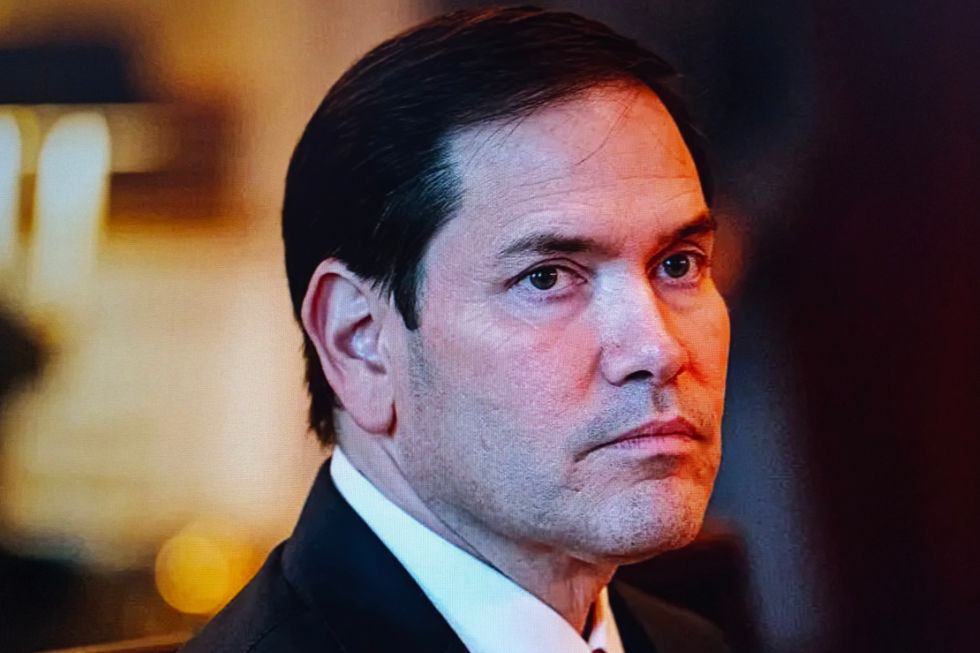
Europe craved reassurance at Munich. US Secretary of State Marco Rubio obliged by delivering hollow platitudes about shared history and Christian heritage. But behind the applause lies a continent trapped: abandoned by an erratic America, unable to break free, and led by leaders their own people no longer believe. The cracks are showing.
By
Friday, February 20, 2026
</header>
Via Shutterstock.

February 20, 2026 06:54 EDT

Check out our comment feature!
Saved Successfully.
This article saved into your bookmarks. Click here to view your bookmarks.


US Secretary of State Marco Rubio received a standing ovation at last week’s Munich Security Conference in Germany after delivering a speech the conference chair, retired German diplomat Wolfgang Ischinger, effusively described as “reassuring.” Speaking for the entire audience, he drew Rubio’s attention to “the sigh of relief” heard “through this hall.” The timing was perfect. Europe was desperately looking for reassurance from a nation whose image had turned diabolical after a special operation, the abduction of sitting Venezuelan President Nicolás Maduro in his bedroom, was followed by several weeks of what Europeans will remember as the great Greenland standoff.
Though evoked as early as his January 2025 inauguration, US President Donald Trump began 2026 by making Greenland the scene of his latest geopolitical psychodrama. He confirmed a personal ambition many had written off as simply wacky. The master of the Oval Office threatened to militarily capture a vast piece of European territory, apparently to satisfy his appetite for Lebensraum (living space).
Or should we call it Wirtschaftsraum (economic space), because most people don’t see Greenland as a space for living? Unlike Gaza or even North Korea, it seems unlikely that the great New York real estate mogul addicted to orange makeup has a plan for building another of his stunning beach resorts on Greenland’s arctic shores. Looking back, it’s relatively easy to understand why Adolf Hitler felt somewhat confined between Germany’s post-World War I borders. But can a credible case be made that the United States lacks either living or economic space?
None of the Europeans in the hall in Munich failed to understand the reason for Ischinger’s feeling of reassurance. At the same conference in 2025, newly installed US Vice President JD Vance delivered a speech that shocked and humiliated the audience. It played out as a frontal assault on Europe’s social, political and economic culture.
The dominant mood in the room was apprehension. After the Greenland episode, many Europeans had decided that the Trump administration had become dominated by what California Congressman Ro Khanna has called “the Epstein class.” The New York Times columnist Ezra Klein glossed this epithet as Khanna’s term for “the rich and powerful people who act and think like they’re above the law and, and perhaps above morality.” In other words, a den of demons singing to the same hymnal as sex trafficker Jeffrey Epstein.
The Europeans were thus in dire need of the very relief and reassurance Ischinger acknowledged. Rubio obliged them by repeatedly reminding his audience that Europe and the US were yoked “together” — a word that appeared 28 times in his speech — by a “shared history, Christian faith, culture, heritage, language, ancestry, and the sacrifices our forefathers made together for the common civilization to which we have fallen heir.” (Impertinent question for the Epstein class: Do heirs always fall?)
Rubio’s superficially reassuring clichés
If each of the items in Rubio’s list of factors of togetherness had anything like the force he attributes to them, his argument might sound not just reassuring but even convincing. Alas, no one needed to be convinced, it was enough to be “reassured.” At one point, when the US Secretary of State rhetorically asserted that “we will always be a child of Europe,” the audience broke into applause. For a brief moment, they may have felt comforted by the idea that Rubio had put them in the role of “Daddy,” a term NATO chief Mark Rutte had previously applied to Trump.
But do any of Rubio’s claims about a shared cultural and political identity stand up, even to superficial scrutiny? He invokes a sense of “shared history,” but how much of that history has been truly shared? When you think about it, what does the sharing of history mean? The US shared much of its history with native American tribes and with African slave traders. But has that translated into a sense of mutual purpose among the participants? Much of the history “shared” by the US and Europe — but also among the European nations themselves — has been dominated by war, rivalry, suspicion and competition for empire. Shared conflict creates familiarity, but it rarely produces unbreakable bonds or the sense of being united in a common vision of the future.
Throughout the speech, Rubio stresses the religious bond. But is it logical to claim that the constitutional separation of church and state in the US combined with what everyone recognizes as the radical and practically total secularization of nearly all European nations can signify a sharing of “Christian faith” across the Atlantic ocean? Yes, you can find churches that built over many centuries, but if only a smattering of the faithful visit them for anything other than touristic reasons, and if their faith turns out to manifest itself as little more than a compulsive repetition of inherited habits, can any rational observer take the existence of a transatlantic civilization united by the Christian faith seriously?
Just like Vance a year ago, Rubio berates the practice of welcoming immigrants, suspected of diluting the purity of the “civilization.” What he’s hinting at here and elsewhere in his speech is what he perceives as the racial identity associated with European roots: whiteness. Rubio cites his own case: the man everyone identifies as the scion of a Cuban family, who can prove his legitimacy by tracing his ancestry back to two European sources Piedmont-Sardinia (Italy) and Saville (Spain).
Is Europe a thing?
Then there’s his evocation of “culture, heritage, language, ancestry.” What does that mean in today’s European context? Even after constituting itself initially as a “Common Market” and then as the “European Union,” the concept of Europe remains that of a collection of geographically contiguous nations. It represents a bewildering diversity of elements, so much so that the “Union” is perceived effectively and embarrassingly for its own citizens as little more than a sprawling and generally annoying bureaucracy.
Is the idea of defense the only key to creating a sense of European unity? That seems to reflect the dominant thinking of the current generation of leaders. The Russia–Ukraine conflict has revealed that the only identifiable force preventing the Union from falling into political incoherence is its nations’ historical dependence on the US nuclear umbrella and the dollar. The wizards of Europe created the euro in the hope of rivaling the dollar, but that experiment has failed. To quote former Greek Finance Minister Yanis Varoufakis: Europe is “a continent united by different languages” and “divided by a common currency.”
Rubio’s mission was to convince his audience that the European relationship with the US is reassuringly solid. Ischinger appears convinced, but are the rest of his colleagues in the room? Trump 2.0’s frankly aggressive policies and unpredictable actions across the globe have more than raised eyebrows. European leaders increasingly allude to what should appear obvious: that the vaunted Union has lost its footing. It is held together by the fragile ropes of its increasingly bloated and undemocratic bureaucracy. From a geopolitical point of view, the 27-state confederation based in Brussels, Belgium, functions primarily as a motley collection of US vassal states. It’s the strings that tie the nations to Washington that keep the idea of Europe alive.
That may explain why the idea of “strategic autonomy,” initially formulated by General Charles de Gaulle, has once again come to the fore. France’s lame duck President Emmanual Macron first evoked the ambition of achieving Europe’s strategic autonomy after only a few months in office back in 2017. He occasionally returns to the concept, though framing it as an aspiration rather than a viable program. But the concept is desperately needed, even if no one seems capable of implementing it. At the same Munich conference, German Chancellor Friedrich Merz warned that Washington’s “claim to leadership is disputed, perhaps squandered.” Who can replace the leader?
Unless we conclude that Europe’s current “leaders” (who don’t even lead their own nations) are as brainless in reality as the rhetoric they feel continually obliged to spout in public, reaffirming their liberal “values” and commitment to noble causes, it’s doubtful that many of them would echo Ischinger’s feeling of being “reassured” by Rubio’s concentrated but slightly disguised assault on their political culture.
Two incompatible systems at the core of a single civilization?
Rubio’s tone was tepid in comparison to Vance’s, but in some ways his speech was more aggressive. On two occasions, he excoriated a bugbear he calls “massive welfare states,” as if to say to the Europeans: “How foolish of you to impose universal healthcare on a population that doesn’t deserve it?”
Personal insecurity is the psychological pillar of the US economy. It explains American greatness just as the welfare state explains Europe’s inconsequentiality. Most Americans take that as common sense, but even the current roster of inept European leaders understand that the price of stability everywhere in Europe is the maintenance of the web of safeguards the European nations have provided for a population otherwise exposed to domination and exploitation by the Epstein class that rules the US.
Europe is currently locked into a lose-lose scenario that was created by US President Joe Biden’s administration and sealed by UK Prime Minister Boris Johnson’s impromptu visit to the Ukrainian capital of Kyiv in the spring of 2022. That was the decisive moment when BoJo gave instructions to a captive Ukrainian regime to cancel an initialed peace agreement and prolong a war it could never win. Ukrainian President Volodymyr Zelenskyy no doubt assumed that with the might of NATO behind him, victory was assured. What he was prevented from understanding is that Washington felt no urgency about their mission. What they wanted was regime change in Russia, even if it required years of combat and millions of casualties. Biden made it clear when he repeatedly insisted that it could last “as long as it takes.”
The nasty surprise for the Europeans came last year when, having wholeheartedly acted as loyal vassals to Washington, their “benign” overlord, Biden, was replaced by the “malignant” Trump, who promised to end the war within 24 hours, essentially by recognizing the reality on the ground: Ukraine’s military defeat. To prove they weren’t the vassals of a diabolical transatlantic leader, they had to demonstrate to one another that they remained faithful to the agenda of their former angelic overlord, Biden. That inevitably aggravated the sentiment not just of having lost their compass, but also of being nobody’s masters, not even of their own populations.
In such circumstances, should we be surprised that the favorability ratings of France’s Macron stand at 16%, Germany’s Merz at 21% and UK’s Prime Minister Keir Starmer at 23%? Should we similarly be surprised that despite a concerted effort to inspire fear of the Russian bear invading Europe — a message enthusiastically endorsed and amplified by Europe’s mainstream media — support for increased defense spending in France has fallen from 40% in 2025 to 28% and in Germany from 37% to 24%?
Ischinger may feel reassured, but that doesn’t change the simple fact that European leaders are in a bind. They have lost all credibility with their own electorates. They have been pushed by interests beyond their national borders to commitments that make little sense. They remain stuck in a viral, often hysterical hatred and fear of an imaginary enemy that obliges them to prolong their commitment to a war that has already undermined their own economies and destroyed Ukraine, the object they were recruited to rescue. At the same time, their populations have come to perceive the US — the commanding presence in NATO — as a dangerous adversary.
Ischinger’s first question to Rubio was about US commitment to Ukraine. Rubio predictably waffled a meaningless, “reassuring” response. Europe now finds itself in the most awkward situation, abandoned by the US while still taking orders from Washington about who they should hate and refuse to do business with: Russia and China. Talk about Scylla and Charybdis or, more colloquially, a rock and a hard place.
And speaking of rocks, now they’re being invited to feel reassured by the comforting fact that Rubio only throws rhetorical rocks and not physical bombs at them.
We’re independent, nonprofit and powered by 3,000+ voices from around the world — not billionaires or governments. Enjoy real journalism, sign up for our free newsletters.
<label for=”Your email will be shared with fairobserver and subject to its Privacy Policy”>I agree to receive emails and other content from Fair Observer. I understand that I may repeal my consent at any time. You can review our Privacy Policy and Terms of Use for further information…</label>
*[The Devil’s Advocatepursues the tradition Fair Observer began in 2017 with the launch of our “Devil’s Dictionary.” It does so with a slight change of focus, moving from language itself — political and journalistic rhetoric — to the substantial issues in the news. Read more ofthe Fair Observer Devil’s Dictionary. The news we consume deserves to be seen from an outsider’s point of view. And who could be more outside official discourse than Old Nick himself?]
[Lee Thompson-Kolar edited this piece.]
The views expressed in this article are the author’s own and do not necessarily reflect Fair Observer’s editorial policy.
Comment
0 Comments
Newest
Oldest
Most Voted
Most Voted
Inline Feedbacks
View all comments
Commenting Guidelines
Please read our commenting guidelines before commenting.
1. Be Respectful: Please be polite to the author. Avoid hostility. The whole point of Fair Observer is openness to different perspectives from perspectives from around the world.
2. Comment Thoughtfully: Please be relevant and constructive. We do not allow personal attacks, disinformation or trolling. We will remove hate speech or incitement.
3. Contribute Usefully: Add something of value — a point of view, an argument, a personal experience or a relevant link if you are citing statistics and key facts.
<label style=”font-size: 18px;”>
I have read and agree to the above commenting guidelines.
</label>
Please agree to the guidelines before proceeding.
I
Agree, Proceed to Login
Cancel
Related Reading
Europe Endorses Assisted Dying: Its Own Suicide
European leaders are now invoking “existential threats” from Russia to justify military spending, a trend Shakespeare seems to have adumbrated…
by
Peter Isackson,
November 28, 2025
Europe’s Scripted March to War
From Washington’s cherry tree to today’s war rooms, lying about what you did became democracy’s unforgivable sin while the deeds…
by
Peter Isackson,
October 24, 2025
The Devil’s Advocate: Europe’s Accelerating Descent into Hell
When we learned of “the end of history,” a little over three decades ago, our geopolitical meteorologists forecasted sunny skies…
by
Peter Isackson,
September 5, 2025
Support Fair Observer
We rely on your support for our independence, diversity and quality.
For more than 10 years, Fair Observer has been free, fair and independent. No billionaire
owns us, no advertisers control us. We are a reader-supported nonprofit. Unlike many other
publications, we keep our content free for readers regardless of where they live or whether
they can afford to pay. We have no paywalls and no ads.
In the post-truth era of fake news, echo chambers and filter bubbles, we publish a plurality
of perspectives from around the world. Anyone can publish with us, but everyone goes through
a rigorous editorial process. So, you get fact-checked, well-reasoned content instead of
noise.
We publish 3,000+ voices from 90+ countries. We also conduct education and training programs
on subjects ranging from digital media and journalism to writing and critical thinking. This
doesn’t come cheap. Servers, editors, trainers and web developers cost
money.
Please consider supporting us on a regular basis as a recurring donor or a
sustaining member.
Will you support FO’s journalism?
We rely on your support for our independence, diversity and quality.
Donation Cycle
<label for=”donation_cycle_one_time”>One Time</label>
<label for=”donation_cycle_monthly”>Monthly</label>
<label for=”donation_cycle_yearly”>Yearly</label>
Donation Amount
<label for=”amount_11″>$11</label>
<label for=”amount_111″>$111</label>
<label for=”other”>Other</label>
$
The IRS recognizes Fair Observer as a section 501(c)(3) registered public charity
(EIN: 46-4070943), enabling you to claim a tax deduction.
Make Sense of the World
Unique Insights from 3,000+ Contributors in 90+ Countries
<label
for=”Your email will be shared with fairobserver and subject to its Privacy Policy”>I
agree to receive emails and other content from Fair Observer. I understand
that I
may repeal my consent at any time. You can review our Privacy Policy
and Terms of Use
for further
information .</label>
for=”Your email will be shared with fairobserver and subject to its Privacy Policy”>I
agree to receive emails and other content from Fair Observer. I understand
that I
may repeal my consent at any time. You can review our Privacy Policy
and Terms of Use
for further
information .</label>
We’re independent, nonprofit and powered by 3,000+ voices from around the world — not billionaires or governments. Enjoy real journalism, sign up for our free newsletters.
<label for=”Your email will be shared with fairobserver and subject to its Privacy Policy”>I agree to receive emails and other content from Fair Observer. I understand that I may repeal my consent at any time. You can review our Privacy Policy and Terms of Use for further information…</label>
</main>
Fair Observer, 461 Harbor Blvd, Belmont, CA 94002, USA
<footer class=”mart70 fo-black-bg padt50 padb30″>
Sections
PUBLICATION
Support Fair Observer
We rely on your support for our independence, diversity and quality.


</footer>

<footer id=”fixed-footer” class=”support-footer”>


Support
independent, crowdsourced, nonprofit
journalism.
Fair Observer is a 501(c)(3) independent nonprofit. We are not owned by billionaires or controlled by
advertisers. We publish nearly 3,000 authors from over 90 countries after fact-checking and editing each
piece. We do not have a paywall and anyone can read us for free. With your vital donations, we can
continue
to do our work.
Please make a recurring (or even one-time) donation today. Even $1 goes a long way because
a
million donors
like you mean one million dollars. Thank you for keeping us independent, free and fair.
One Time
Monthly
Yearly
Monthly
Yearly
Continue 

</footer>

Sign into your Fair Observer Account
<label class=”tml-label” for=”user_login”>Username or Email Address</label>
<label class=”tml-label” for=”user_pass”>Password</label>
<label class=”tml-label” for=”rememberme”>Remember Me</label>
Log In
Forgot
Password
Password
Forgot Password
Enter your registered email address or username. You will receive a
link to create a new password via email.
Please enter your username or email address. You will receive an email message with instructions on how to reset your password.
<label class=”tml-label” for=”user_login”>Username or Email Address</label>
Get New Password
Or
Return to
Login
Forgot Password
We have sent a link to your registered email address to reset your password.
<circle cx=”12.5″ cy=”12″ r=”12″ fill=”#414141″ />
Back to
Login
Become a Member & Enjoy Exclusive Benefits!
<circle cx=”12.5″ cy=”12″ r=”12″ fill=”#414141″ />
Access to comments feature
<circle cx=”12.5″ cy=”12″ r=”12″ fill=”#414141″ />
Bookmark your favorite articles
<circle cx=”12.5″ cy=”12″ r=”12″ fill=”#414141″ />
Exclusive invitations to FO° Talks & FO° Live
<circle cx=”12.5″ cy=”12″ r=”12″ fill=”#414141″ />
Access to all of our e-publications
Return to
Login
Login
NEWSLETTER
Make Sense of the World
Unique Insights from 2,500+ Contributors in 90+ Countries

<label
for=”Your email will be shared with fairobserver and subject to it’s Privacy Policy”>I
agree to receive emails and other content from Fair Observer. I understand
that I may repeal my consent at any time. You can review our Privacy Policy
and Terms of Use
for further information.</label>
for=”Your email will be shared with fairobserver and subject to it’s Privacy Policy”>I
agree to receive emails and other content from Fair Observer. I understand
that I may repeal my consent at any time. You can review our Privacy Policy
and Terms of Use
for further information.</label>
NEWSLETTER
Make Sense of the World
Unique Insights from 2,500+ Contributors in 90+ Countries
<label
for=”Your email will be shared with fairobserver and subject to it’s Privacy Policy”>I
agree to receive emails and other content from Fair Observer. I understand
that I may repeal my consent at any time. You can review our Privacy Policy
and Terms of Use
for further information.</label>
for=”Your email will be shared with fairobserver and subject to it’s Privacy Policy”>I
agree to receive emails and other content from Fair Observer. I understand
that I may repeal my consent at any time. You can review our Privacy Policy
and Terms of Use
for further information.</label>

Make Sense of the World
Unique Insights from 2,500+ Contributors in 90+ Countries
<label
for=”Your email will be shared with fairobserver and subject to its Privacy Policy”>I
agree to receive emails and other content from Fair Observer. I understand that I
may repeal my consent at any time. You can review our Privacy Policy and Terms of Use for further
information .</label>
for=”Your email will be shared with fairobserver and subject to its Privacy Policy”>I
agree to receive emails and other content from Fair Observer. I understand that I
may repeal my consent at any time. You can review our Privacy Policy and Terms of Use for further
information .</label>
We Need Your Consent
We use cookies to give you the best possible experience. Learn more about how we use cookies or edit your cookie preferences. Privacy Policy. My Options I Accept
Privacy & Cookies Policy
Close
Edit Cookie Preferences
The Fair Observer website uses digital cookies so it can collect statistics on how many visitors come to the site, what content is viewed and for how long, and the general location of the computer network of the visitor. These statistics are collected and processed using the Google Analytics service. Fair Observer uses these aggregate statistics from website visits to help improve the content of the website and to provide regular reports to our current and future donors and funding organizations. The type of digital cookie information collected during your visit and any derived data cannot be used or combined with other information to personally identify you. Fair Observer does not use personal data collected from its website for advertising purposes or to market to you.
As a convenience to you, Fair Observer provides buttons that link to popular social media sites, called social sharing buttons, to help you share Fair Observer content and your comments and opinions about it on these social media sites. These social sharing buttons are provided by and are part of these social media sites. They may collect and use personal data as described in their respective policies. Fair Observer does not receive personal data from your use of these social sharing buttons. It is not necessary that you use these buttons to read Fair Observer content or to share on social media.
Necessary
<label class=”form-check-label” for=”wt-cli-checkbox-necessary”>Necessary</label>
Always Enabled
These cookies essential for the website to function.
Social Media
<label for=”wt-cli-checkbox-social_media” class=”cli-slider” data-cli-enable=”Enabled” data-cli-disable=”Disabled”>Social Media</label>
These cookies are used to enable sharing or following of content that you find interesting on our website. These settings apply to third-party social networking and other websites.
Performance & Functionality
<label for=”wt-cli-checkbox-performance” class=”cli-slider” data-cli-enable=”Enabled” data-cli-disable=”Disabled”>Performance & Functionality</label>
These cookies are used to enhance the performance and functionality of our website. They provide statistics on how our website is used and help us improve by measuring errors. Certain functionalities on our website may become unavailable without these cookies.
Analytics
<label for=”wt-cli-checkbox-analytics” class=”cli-slider” data-cli-enable=”Enabled” data-cli-disable=”Disabled”>Analytics</label>
SAVE & ACCEPT
<textarea id=’wpd-editor-source-code’></textarea>Insert
</body></html>
Total Views:
Source: World Politics - fairobserver.com