<g id=”cross”>
<line class=”cls-1″ x1=”7″ x2=”25″ y1=”7″ y2=”25″ />
<line class=”cls-1″ x1=”7″ x2=”25″ y1=”25″ y2=”7″ />
</g>
“America First” Means Re-Engaging with Afghanistan
<circle cx=”10.5″ cy=”10.5″ r=”7.5″ />
<line x1=”21″ x2=”15.8″ y1=”21″ y2=”15.8″ />
<nav class=”fo-navigation pos-r” itemscope itemtype=”http://schema.org/Navigation”>
Login
Sections <circle cx=”10.5″ cy=”10.5″ r=”7.5″ />
<line x1=”21″ x2=”15.8″ y1=”21″ y2=”15.8″ />
Search
<circle cx=”10.5″ cy=”10.5″ r=”7.5″ />
<line x1=”21″ x2=”15.8″ y1=”21″ y2=”15.8″ />
Search


PUBLICATION
Support Fair Observer
We rely on your support for our independence, diversity and quality.
</nav>
</header>

<main id=”main” class=”site-main” role=”main”> 


Saturday, December 20, 2025
<header class=”entry-header”>
“America First” Means Re-Engaging with Afghanistan
Washington turned its back on Kabul, allowing Russia and China to move into the resulting vacuum and assert their influence in the region. Terrorist groups in Afghanistan are gaining strength, while the Taliban supports some militants and fights against others. The US must re-engage with Afghanistan, as officials face increasing threats and moral responsibilities, and Afghan partners seek protection and resettlement.
By
Saturday, December 20, 2025
</header>
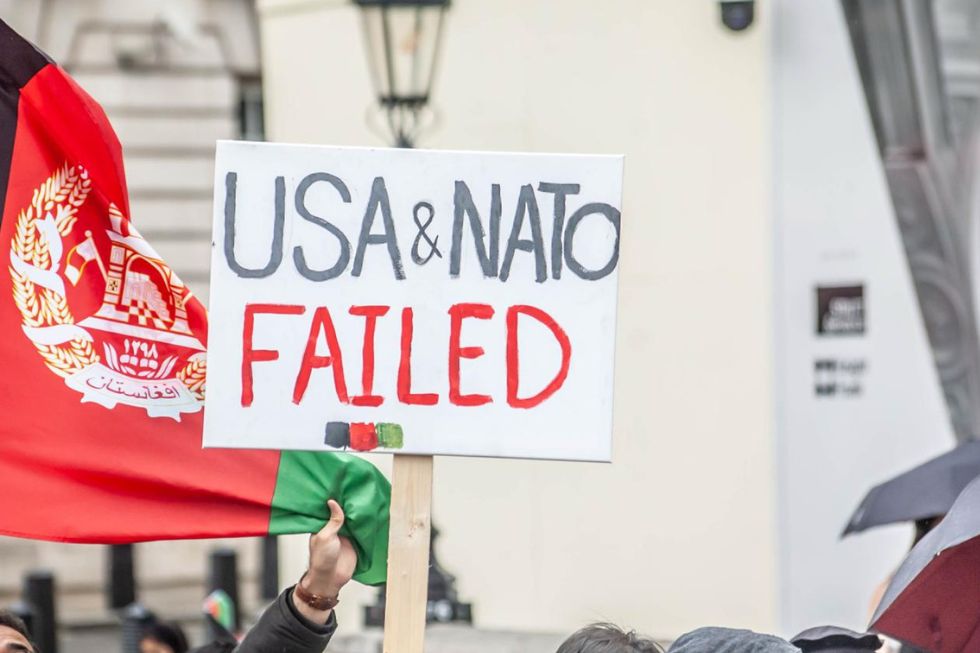
Via Shutterstock.

December 20, 2025 05:57 EDT

Check out our comment feature!
Saved Successfully.
This article saved into your bookmarks. Click here to view your bookmarks.


As Washington looks away from Kabul, Moscow and Beijing are leaning in. Beijing has maintained dialogue — without formal recognition — with the new Afghan government to sustain its investments and border security. Russia, on the other hand, was the first nation to formally recognize the Taliban’s government, promising incoming investment and additional avenues for cooperation.
Alongside external relations building, the Taliban are also contesting with attacks and militant activity from nonstate actors (NSAs) like ISIS-Khorasan (IS-K) and Tehriki-Taliban Pakistan (TTP), which number in the thousands and continue to recruit via online campaigns. Their efforts have contributed to Afghanistan’s 78% increase in NSA attacks from 2024 to 2025. When American troops withdrew in August 2021, the US didn’t just leave Afghanistan — it left behind a vacuum now being filled by powers with starkly different values and ambitions.
Why the US must re-engage
The US must re-engage with Afghanistan for three key reasons. First, complete disengagement has allowed China and Russia to rapidly expand their influence in a strategically important country that connects Central and South Asia to the Middle East. Second, turning a blind eye to NSA activity in Afghanistan is allowing groups like IS-K, who have a history of attacks against the US and the West, to grow their power and online influence unchecked. Finally, the US has a moral obligation to support the Afghan military contractors and other allies left dangerously behind, whom it had previously promised safe passage.
Russia, which formally recognized the Taliban in July 2025, said that while its recognition will not involve a military presence, it will yield economic and development results “soon.” As the sole country to recognize the government, Russia may receive preferential treatment when applying for energy and development projects, including for roads, mining and hydro dam construction. This relationship may provide Moscow with potential new energy markets, from which it is suffering due to international sanctions in response to its military actions in Ukraine.
While less overt, China has also warmed its relations with Afghanistan’s Taliban. China has now received the new Afghan Ambassador to China, allowing it to lend support to existing projects like China Metallurgical Industry’s (MCC’s) Mes Aynak Mine and engage in humanitarian diplomacy, such as its support for those affected by the floods in Herat and the earthquake in Kunar.
China’s reasoning for continuing its relationship in Afghanistan is twofold. First, it wants to maintain border security regarding extremist Uyghurs from the Xinjiang province who found sympathy with IS-K’s cause. Subsequently, such extremists have used the Wakhan border as a means to reach Afghanistan from China to train with the groups. Upon joining, some militants have spread Uyghur-language propaganda that threatens China with attacks, prompting Beijing to maintain its relationships with willing partners and build military bases along the border, such as the one in Tajikistan.
Secondly, China has existing and new investments within the country that need to continue churning profits, including the Mes Aynak Mine and the Amu Darya oil extraction agreement. If China disengaged with the Taliban, other investors would surely scoop up the remnants and claim the profits as their own, robbing China of future opportunities.
Though both Russia and China have applauded the Taliban’s efforts to combat and stifle extremist terrorism activity from within the country, data tells a different story. In January 2025, the UN Security Council identified IS-K, operating mainly in Afghanistan, as the most dangerous affiliate of the Islamic State.
While IS-K’s increasingly deadly attacks have been decreasing in number amidst a reported “funding crisis,” groups such as TTP are alive and well, with rising attack numbers and support from the Afghan Taliban. According to the National Terrorism Index, TTP was ranked as the fastest-growing group in 2024 with a 90% increase in attributed deaths, doubling its numbers from the previous year.
Furthermore, Central Asia jihadist groups, such as Jamaat Ansarrullah (JA), aka Tajiki Taliban, are opening camps to train and recruit in Afghanistan alongside TTP, using the same terrain whose skies were once dominated by US drones. Ironically, the new camps opened by TTP and JA are tacitly supported by the Afghan Taliban, with the government providing “logistical and operational space and financial support” according to the UN. Despite evidence that the Afghan Taliban is supporting TTP and JA, both Russia and China continue to support its counterterrorism narrative.
Finally, the US has a profound moral responsibility to support the Afghan people, especially those who fought alongside our military. Afghans eligible for special immigrant visas (SIVs) — 50,000 of whom are still awaiting approval — risked their and their families’ lives to advance the US’ mission in Afghanistan for over two decades, only to be abandoned and left in danger in their own country or in legal limbo in neighboring nations.
The US invested over $2 trillion in Afghanistan — not only in military operations but also in building institutions, schools and infrastructure meant to foster stability and democracy. This immense investment was not merely financial — it represented a promise to the Afghan people that America would stand by them in their pursuit of peace and self-determination. To withdraw entirely after such a long and costly engagement is to neglect that promise and undermine the moral foundations of US foreign policy. Moreover, the alliances and partnerships forged during 20 years of collaboration cannot simply be discarded; they are the result of shared sacrifice and mutual trust.
Re-engaging with Afghanistan is not just a matter of strategic interest but of ethical duty. America’s credibility as a global leader depends on its willingness to uphold its commitments and to act with compassion and integrity toward those who stood beside it in times of war.
How can the US engage with Afghanistan without recognizing the Taliban?
The most common and legitimate critique of re-engagement with Afghanistan is the issue of recognizing the Taliban as the legitimate government of Afghanistan. While that is off the table for most policymakers, there are various ways in which the US, via the US Mission to the UN, the Department of State and the Department of War, can and must engage with international organizations, other nations and Afghan citizens.
Firstly, the US Mission to the UN can and should support the UN Human Rights Council’s resolution, introduced by the European Union, to establish an investigative body monitoring human rights abuses in Afghanistan and gather information on possible perpetrators to bring justice to the victims. The body is set to mirror the UN’s International, Impartial and Independent Mechanism (IIIM) on crimes committed in Syria by the Arab Republic post-2011.
The US can support the new unit by efficiently responding to requests for evidence in its possession and assisting with providing relevant information to investigations. Because the US had such an extensive presence and intelligence awareness in Afghanistan, its military can likely assist with investigations.
Additionally, if legal frameworks do not yet exist to support such collaboration, the US should work to adopt relevant frameworks with assistance from the new UN investigative unit. The US’ engagement with the unit will reinstate trust in its commitment to international law, human rights and multilateral cooperation, all of which are currently in question.
Furthermore, while the US cannot directly engage in counterterrorism efforts with the Taliban against IS-K and similar groups, it can coordinate with local partners, such as Tajikistan and Pakistan. Tajikistan, which shares a 843-mile border with Afghanistan, has largely resisted cooperation with the Taliban and increased its investment in border security after the instability from August 2021.
The US Department of War, whether independently or through NATO, should engage with Tajikistan and Pakistan to support their counterterrorism efforts and engage in capacity building and intelligence sharing to deplete the capabilities of groups like IS-K, TTP and others. If the US allows Afghanistan to once again become a breeding ground for terror, how long before the threats come knocking — again — at America’s door?
Finally, while the US may not be able to directly invest in Afghanistan, nor engage diplomatically with Taliban officials to compete with China and Russia, nor conduct on-the-ground counterterrorism operations, it can support the Afghan people within the US and in the diaspora.
The Department of State should continue to rapidly process SIVs by re-opening the Coordinator for Afghan Relocation Efforts (CARE) center to support the immigration of former Afghan military contractors who are stuck in hiding. Unfortunately, the Trump Administration closed CARE in July 2025, despite 300,000 pending cases, further depleting hope and allies’ trust in our security promises.
In addition to reopening the CARE center, Congress should pass the long-stalled bipartisan Afghan Adjustment Act (S.2327), which would address the immigration issues many Afghans in the US are currently facing. Promises made should be promises kept, and returning to our original promise to provide these non-citizen patriots with safe passage to the U.S. would offer a moral lifeline to the administration.
We are a rare nonprofit in the world news space. Most other organizations are owned by billionaires or governments. We are bottom-up, not top-down and bring you perspectives from around the world. So, sign up now for our free newsletters to hear from our 3,000+ voices from 90+ countries.
<label for=”Your email will be shared with fairobserver and subject to its Privacy Policy”>I agree to receive emails and other content from Fair Observer. I understand that I may repeal my consent at any time. You can review our Privacy Policy and Terms of Use for further information…</label>
By stepping back from Afghanistan, the US surrendered both the moral high ground and strategic leverage it once held to its geopolitical rivals. Today, terrorist groups exploit the power vacuum, while competitors like China and Russia shape the future of a region that America spent decades and trillions of dollars trying to stabilize. The time has come to ask not whether the US should re-engage — but how soon it must engage.
[Kaitlyn Diana edited this piece.]
The views expressed in this article are the author’s own and do not necessarily reflect Fair Observer’s editorial policy.
Comment
0 Comments
Newest
Oldest
Most Voted
Most Voted
Inline Feedbacks
View all comments
Commenting Guidelines
Please read our commenting guidelines before commenting.
1. Be Respectful: Please be polite to the author. Avoid hostility. The whole point of Fair Observer is openness to different perspectives from perspectives from around the world.
2. Comment Thoughtfully: Please be relevant and constructive. We do not allow personal attacks, disinformation or trolling. We will remove hate speech or incitement.
3. Contribute Usefully: Add something of value — a point of view, an argument, a personal experience or a relevant link if you are citing statistics and key facts.
<label style=”font-size: 18px;”>
I have read and agree to the above commenting guidelines.
</label>
Please agree to the guidelines before proceeding.
I
Agree, Proceed to Login
Cancel
Related Reading
Reclaiming Bagram: America’s Strategic Dilemma in Afghanistan
Washington faces renewed debate over control of Bagram Air Base as power vacuums and Taliban weakness reshape Afghanistan’s future. US…
by
Saboor Sakhizada,
October 29, 2025
FO° Talks: Trump Wants Bagram Back — Decoding The Power Game Between the US, Taliban and China
In this episode of FO° Talks, Rohan Khattar Singh and Ashraf Haidari discuss US President Donald Trump’s renewed push to…
by
Ashraf Haidari & Rohan Khattar Singh,
October 28, 2025
FO° Talks: America Is to Blame for Taliban’s Returning to Power
In this episode of FO° Talks, Rohan Khattar Singh interviews Italian photojournalist Lorenzo Tugnoli about his book, It Can Never…
by
Lorenzo Tugnoli & Rohan Khattar Singh,
September 24, 2025
The United States Must Reclaim Afghanistan to Protect Its Interests
The Taliban took control of Afghanistan in August 2021 after the collapse of the elected government and the withdrawal of…
by
Ashraf Haidari,
July 17, 2025
Support Fair Observer
We rely on your support for our independence, diversity and quality.
For more than 10 years, Fair Observer has been free, fair and independent. No billionaire
owns us, no advertisers control us. We are a reader-supported nonprofit. Unlike many other
publications, we keep our content free for readers regardless of where they live or whether
they can afford to pay. We have no paywalls and no ads.
In the post-truth era of fake news, echo chambers and filter bubbles, we publish a plurality
of perspectives from around the world. Anyone can publish with us, but everyone goes through
a rigorous editorial process. So, you get fact-checked, well-reasoned content instead of
noise.
We publish 3,000+ voices from 90+ countries. We also conduct education and training programs
on subjects ranging from digital media and journalism to writing and critical thinking. This
doesn’t come cheap. Servers, editors, trainers and web developers cost
money.
Please consider supporting us on a regular basis as a recurring donor or a
sustaining member.
Will you support FO’s journalism?
We rely on your support for our independence, diversity and quality.
Donation Cycle
<label for=”donation_cycle_one_time”>One Time</label>
<label for=”donation_cycle_monthly”>Monthly</label>
<label for=”donation_cycle_yearly”>Yearly</label>
Donation Amount
<label for=”amount_11″>$11</label>
<label for=”amount_111″>$111</label>
<label for=”other”>Other</label>
$
The IRS recognizes Fair Observer as a section 501(c)(3) registered public charity
(EIN: 46-4070943), enabling you to claim a tax deduction.
Make Sense of the World
Unique Insights from 3,000+ Contributors in 90+ Countries
<label
for=”Your email will be shared with fairobserver and subject to its Privacy Policy”>I
agree to receive emails and other content from Fair Observer. I understand
that I
may repeal my consent at any time. You can review our Privacy Policy
and Terms of Use
for further
information .</label>
for=”Your email will be shared with fairobserver and subject to its Privacy Policy”>I
agree to receive emails and other content from Fair Observer. I understand
that I
may repeal my consent at any time. You can review our Privacy Policy
and Terms of Use
for further
information .</label>
We’re independent, nonprofit and powered by 3,000+ voices from around the world — not billionaires or governments. Enjoy real journalism, sign up for our free newsletters.
<label for=”Your email will be shared with fairobserver and subject to its Privacy Policy”>I agree to receive emails and other content from Fair Observer. I understand that I may repeal my consent at any time. You can review our Privacy Policy and Terms of Use for further information…</label>
</main>
Fair Observer, 461 Harbor Blvd, Belmont, CA 94002, USA
<footer class=”mart70 fo-black-bg padt50 padb30″>
Sections
PUBLICATION
Support Fair Observer
We rely on your support for our independence, diversity and quality.


</footer>

<footer id=”fixed-footer” class=”support-footer”>


Support
independent, crowdsourced, nonprofit
journalism.
Fair Observer is a 501(c)(3) independent nonprofit. We are not owned by billionaires or controlled by
advertisers. We publish nearly 3,000 authors from over 90 countries after fact-checking and editing each
piece. We do not have a paywall and anyone can read us for free. With your vital donations, we can
continue
to do our work.
Please make a recurring (or even one-time) donation today. Even $1 goes a long way because
a
million donors
like you mean one million dollars. Thank you for keeping us independent, free and fair.
One Time
Monthly
Yearly
Monthly
Yearly
Continue 

</footer>

Sign into your Fair Observer Account
<label class=”tml-label” for=”user_login”>Username or Email Address</label>
<label class=”tml-label” for=”user_pass”>Password</label>
<label class=”tml-label” for=”rememberme”>Remember Me</label>
Log In
Forgot
Password
Forgot Password
Enter your registered email address or username. You will receive a
link to create a new password via email.
Please enter your username or email address. You will receive an email message with instructions on how to reset your password.
<label class=”tml-label” for=”user_login”>Username or Email Address</label>
Get New Password
Or
Return to
Login
Forgot Password
We have sent a link to your registered email address to reset your password.
<circle cx=”12.5″ cy=”12″ r=”12″ fill=”#414141″ />
Back to
Login
Become a Member & Enjoy Exclusive Benefits!
<circle cx=”12.5″ cy=”12″ r=”12″ fill=”#414141″ />
Access to comments feature
<circle cx=”12.5″ cy=”12″ r=”12″ fill=”#414141″ />
Bookmark your favorite articles
<circle cx=”12.5″ cy=”12″ r=”12″ fill=”#414141″ />
Exclusive invitations to FO° Talks & FO° Live
<circle cx=”12.5″ cy=”12″ r=”12″ fill=”#414141″ />
Access to all of our e-publications
Return to
Login
Login
NEWSLETTER
Make Sense of the World
Unique Insights from 2,500+ Contributors in 90+ Countries

<label
for=”Your email will be shared with fairobserver and subject to it’s Privacy Policy”>I
agree to receive emails and other content from Fair Observer. I understand
that I may repeal my consent at any time. You can review our Privacy Policy
and Terms of Use
for further information.</label>
for=”Your email will be shared with fairobserver and subject to it’s Privacy Policy”>I
agree to receive emails and other content from Fair Observer. I understand
that I may repeal my consent at any time. You can review our Privacy Policy
and Terms of Use
for further information.</label>
NEWSLETTER
Make Sense of the World
Unique Insights from 2,500+ Contributors in 90+ Countries
<label
for=”Your email will be shared with fairobserver and subject to it’s Privacy Policy”>I
agree to receive emails and other content from Fair Observer. I understand
that I may repeal my consent at any time. You can review our Privacy Policy
and Terms of Use
for further information.</label>
for=”Your email will be shared with fairobserver and subject to it’s Privacy Policy”>I
agree to receive emails and other content from Fair Observer. I understand
that I may repeal my consent at any time. You can review our Privacy Policy
and Terms of Use
for further information.</label>

Make Sense of the World
Unique Insights from 2,500+ Contributors in 90+ Countries
<label
for=”Your email will be shared with fairobserver and subject to its Privacy Policy”>I
agree to receive emails and other content from Fair Observer. I understand that I
may repeal my consent at any time. You can review our Privacy Policy and Terms of Use for further
information .</label>
for=”Your email will be shared with fairobserver and subject to its Privacy Policy”>I
agree to receive emails and other content from Fair Observer. I understand that I
may repeal my consent at any time. You can review our Privacy Policy and Terms of Use for further
information .</label>
We Need Your Consent
We use cookies to give you the best possible experience. Learn more about how we use cookies or edit your cookie preferences. Privacy Policy. My Options I Accept
Privacy & Cookies Policy
Close
Edit Cookie Preferences
The Fair Observer website uses digital cookies so it can collect statistics on how many visitors come to the site, what content is viewed and for how long, and the general location of the computer network of the visitor. These statistics are collected and processed using the Google Analytics service. Fair Observer uses these aggregate statistics from website visits to help improve the content of the website and to provide regular reports to our current and future donors and funding organizations. The type of digital cookie information collected during your visit and any derived data cannot be used or combined with other information to personally identify you. Fair Observer does not use personal data collected from its website for advertising purposes or to market to you.
As a convenience to you, Fair Observer provides buttons that link to popular social media sites, called social sharing buttons, to help you share Fair Observer content and your comments and opinions about it on these social media sites. These social sharing buttons are provided by and are part of these social media sites. They may collect and use personal data as described in their respective policies. Fair Observer does not receive personal data from your use of these social sharing buttons. It is not necessary that you use these buttons to read Fair Observer content or to share on social media.
Necessary
<label class=”form-check-label” for=”wt-cli-checkbox-necessary”>Necessary</label>
Always Enabled
These cookies essential for the website to function.
Social Media
<label for=”wt-cli-checkbox-social_media” class=”cli-slider” data-cli-enable=”Enabled” data-cli-disable=”Disabled”>Social Media</label>
These cookies are used to enable sharing or following of content that you find interesting on our website. These settings apply to third-party social networking and other websites.
Performance & Functionality
<label for=”wt-cli-checkbox-performance” class=”cli-slider” data-cli-enable=”Enabled” data-cli-disable=”Disabled”>Performance & Functionality</label>
These cookies are used to enhance the performance and functionality of our website. They provide statistics on how our website is used and help us improve by measuring errors. Certain functionalities on our website may become unavailable without these cookies.
Analytics
<label for=”wt-cli-checkbox-analytics” class=”cli-slider” data-cli-enable=”Enabled” data-cli-disable=”Disabled”>Analytics</label>
SAVE & ACCEPT
<textarea id=’wpd-editor-source-code’></textarea>Insert
</body>
</html>
Total Views:
Source: World Politics - fairobserver.com