<g id=”cross”>
<line class=”cls-1″ x1=”7″ x2=”25″ y1=”7″ y2=”25″ />
<line class=”cls-1″ x1=”7″ x2=”25″ y1=”25″ y2=”7″ />
</g>
Reconciliation in a Broken State — Myanmar’s Civil War and the Illusion of Elections
<circle cx=”10.5″ cy=”10.5″ r=”7.5″ />
<line x1=”21″ x2=”15.8″ y1=”21″ y2=”15.8″ />
<nav class=”fo-navigation pos-r” itemscope itemtype=”http://schema.org/Navigation”>
Login
Sections <circle cx=”10.5″ cy=”10.5″ r=”7.5″ />
<line x1=”21″ x2=”15.8″ y1=”21″ y2=”15.8″ />
Search
<circle cx=”10.5″ cy=”10.5″ r=”7.5″ />
<line x1=”21″ x2=”15.8″ y1=”21″ y2=”15.8″ />
Search


PUBLICATION
Support Fair Observer
We rely on your support for our independence, diversity and quality.
</nav>
</header>

<main id=”main” class=”site-main” role=”main”> 




Thursday, December 25, 2025
<header class=”entry-header”>
Reconciliation in a Broken State — Myanmar’s Civil War and the Illusion of Elections
Myanmar has been gripped by civil war, leading to widespread suffering, poverty and displacement since the military coup in 2021. The upcoming elections promised by the generals ruling the country serve to maintain the junta’s power rather than reflect the will of the people. This instability not only affects Myanmar but also has far-reaching regional and global consequences.
By
Thursday, December 25, 2025
</header>

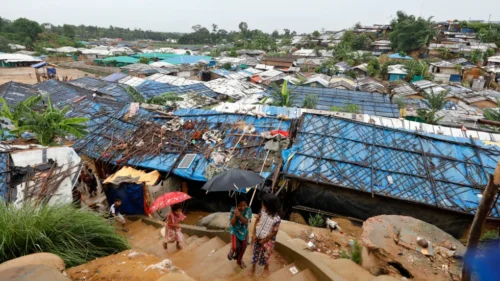
Via Shutterstock.

December 25, 2025 06:26 EDT

Check out our comment feature!
Saved Successfully.
This article saved into your bookmarks. Click here to view your bookmarks.


In Myanmar, life has frozen. You do not move forward there; you remain suspended — between gunfire and hunger, between promises and graves. This paralysis has a name: civil war, sustained by the absence of democracy and the endurance of fear.
Across Myanmar’s hills and plains, life is now measured by absence. Since the 2021 coup, more than 6,800 people have been killed and over 3.5 million displaced. Nearly half the population has fallen into poverty. According to the United Nations, nearly 22 million people require humanitarian assistance. Hunger and disease are no longer byproducts of war; they are its instruments.
As if human cruelty were insufficient, nature delivered its own verdict. In March 2025, a powerful earthquake struck central Myanmar, killing thousands and leaving tens of thousands without shelter. The disaster exposed what politics had already destroyed: a hollow state incapable of protecting its people.
In the aftermath of such devastation, the ongoing violence only deepens the tragedy the nation faces. Another hospital burns. Another report is filed, marking the sixty-seventh attack on a healthcare facility. Thirty-three dead. Twenty wounded. The numbers arrive already fatigued, stripped of urgency by repetition. The head of the World Health Organization says he is appalled. He must say this. The world nods, as it must. Indignation has become ritual — performed, recorded, forgotten. In a country long isolated, atrocity has become routine, and routine has become silence.
The illusion of order
This paralysis did not emerge by accident. It was engineered.
Civilian supremacy has been deferred since 2008, when the constitution guaranteed the military 25% of parliamentary seats — enough to veto any reform. Elections are not a step forward; they are a mechanism to preserve that design and block any genuine federal future.
When the generals seized power, they did not merely overturn the 2020 election; they replaced legitimacy with procedure. They appointed an election commission of former generals and prepared a vote meant not to reflect the people, but to exhaust them.
To recover the appearance of order, the generals promise an election on December 28. An election that the United Nations calls “cosmetic.” The big question is whether the world will pretend otherwise. It will take place under state-controlled media and laws so severe that dissent no longer risks prison alone, but erasure. Even then, thousands remain incarcerated for resistance. President Win Myint is still behind bars. Former State Counsellor of Myanmar Aung San Suu Kyi remains imprisoned, her party dissolved, her voice extinguished. Power, when it fears the people, does not persuade. It confines.
The cost of moral symbols
There is a private irony in this repression. Two leaders I once met — Imran Khan and Suu Kyi — now share the same fate: confinement imposed by regimes that claim stability. I remember my 30-minute interview with Suu Kyi in 2012. She was razor-focused, her eyes fixed on mine, listening with a meditation-like intensity. She was intelligent, already familiar with my country’s history, noting that her Oxford classmate was the sister of Sri Lanka’s former president Chandrika Bandaranaike, and shared reflections on Sri Lankan politics.
She asked pointed questions about our three-decade civil war. Then she asked, “How old were you when your father was killed?” I replied, “16.” She said, “I was only 2. See, we have something in common. Both our parents were killed.” She paused and then asked, “So, have you forgiven the killers? Isn’t that reconciliation?” She spoke quietly of patience and moral clarity, yet warned that reconciliation in Myanmar is uniquely difficult, especially among its fractured ethnic groups.
History answered otherwise, and her later silence during the Rohingya atrocities revealed a harsher truth: even moral symbols fracture when trapped inside the machinery of the state.
A crisis without borders
Myanmar’s democratic failure does not stop at its borders. It spills outward — into Thailand through narcotics and scam networks, into Bangladesh through the displacement of more than a million Rohingya and across the region through an instability no wall can contain.
Above this suffering, the great powers calculate. Roads, pipelines and corridors thread through the Kachin and Shan States as part of the China–Myanmar Economic Corridor (CMEC). Geography, for Beijing, is destiny: access to the Indian Ocean and control over rare-earth minerals essential to modern technology. Much of these deposits lie in areas controlled by resistance groups such as the Kachin Independence Organization. I trace this strategic geography in my forthcoming book, Winds of Change. For China, they are a necessity. For Washington, they are supply chains. India, too, explores quiet ties with the Kachin Independence Army. Even principles bend when rare-earth minerals promise power and profit.
What peace would actually require
Yet calculation alone cannot end a civil war of this depth. A sustainable peace in Myanmar demands more than condemnation or convenience; it requires a disciplined, four-pronged effort. First, inclusive political dialogue is essential: any settlement must bring together the military, representative civilian leadership such as the National Unity Government, ethnic armed organizations and civil society. Dialogue must move beyond the Association of Southeast Asian Nations’ (ASEAN) limited consensus toward a genuine federal arrangement, anchored in constitutional guarantees and a credible framework for transitional justice.
Second, international pressure and accountability must shift the junta’s calculus. Targeted sanctions on military revenue, arms embargoes, protection for political prisoners and sustained humanitarian corridors are instruments of restraint. Accountability for war crimes is not a moral luxury; it is a condition for peace.
Third, regional mediation must be strengthened. ASEAN, supported by India, China and Japan, can facilitate ceasefires, transitional talks and confidence-building measures — if sovereignty is no longer used as a shield against human suffering.
Fourth, grassroots reconciliation and economic stabilization must anchor peace where it matters most: addressing ethnic grievances, restoring basic services, enabling the return of displaced families and rebuilding livelihoods. Federalism, tailored to local realities, remains the only architecture capable of holding this fractured country together.
The United States speaks of human rights. It sanctions, freezes funds and finances aid. Yet words without leverage resemble lamps in a storm — visible, but cold. A regime that controls only fragments of its territory and depends increasingly on Beijing is not a partner; it is a liability. Pragmatism, whether under a Trump administration or any other, may offer clarity — but only if paired with engagement.
Gregory B. Poling of the Center for Strategic and International Studies (CSIS) argues that Myanmar’s best future lies in a truly federal resistance capable of toppling the military regime or forcing it to the negotiating table. To reach that future, the United States must engage rather than isolate, countering the junta’s drift toward Russia and China.
The people of Myanmar are not variables in a strategic equation. They are bodies broken by bombs, families uprooted by fear, survivors of earthquakes and artillery alike. Any policy that discounts their suffering is not realism; it is cruelty disguised as strategy.
You can read the CIA Factbook and listen to MI6 people for your analysis, or you could read perspectives from our 3,000+ authors from 90+ countries and make sense of the world. Sign up for our free newsletters now.
<label for=”Your email will be shared with fairobserver and subject to its Privacy Policy”>I agree to receive emails and other content from Fair Observer. I understand that I may repeal my consent at any time. You can review our Privacy Policy and Terms of Use for further information…</label>
In the ruined towns and shattered valleys of Myanmar, one question persists — quiet and unforgiving: will the world act as guardian or spectator? Peace cannot be declared in isolation. It must be built through restraint, solidarity and the refusal to exchange human suffering for advantage. If the great powers fail this test, Myanmar will stand as a monument — not to ambition, but to the world’s choice to look away.
[Kaitlyn Diana edited this piece.]
The views expressed in this article are the author’s own and do not necessarily reflect Fair Observer’s editorial policy.
Comment
0 Comments
Newest
Oldest
Most Voted
Most Voted
Inline Feedbacks
View all comments
Commenting Guidelines
Please read our commenting guidelines before commenting.
1. Be Respectful: Please be polite to the author. Avoid hostility. The whole point of Fair Observer is openness to different perspectives from perspectives from around the world.
2. Comment Thoughtfully: Please be relevant and constructive. We do not allow personal attacks, disinformation or trolling. We will remove hate speech or incitement.
3. Contribute Usefully: Add something of value — a point of view, an argument, a personal experience or a relevant link if you are citing statistics and key facts.
<label style=”font-size: 18px;”>
I have read and agree to the above commenting guidelines.
</label>
Please agree to the guidelines before proceeding.
I
Agree, Proceed to Login
Cancel
Related Reading
FO° Talks: Is Myanmar’s Junta Using Elections to Consolidate Power?
In this episode of FO° Talks, Rohan Khattar Singh and Daniel Sullivan examine Myanmar’s December 28 election and why it…
by
Daniel Sullivan & Rohan Khattar Singh,
December 23, 2025
The Rohingyas’ Plight Continues Though the World Has Forgotten
In 2017, Myanmar exiled over a million of its chiefly Muslim Rohingya minority. Bangladesh is struggling to support the exiles,…
by
Sadia Korobi,
September 2, 2024
ASEAN’s Myanmar Strategy, Slow But Steady
Despite repeated urgency for stronger action, ASEAN recognizes that coercive strategies are not effective in seeking a final resolution in…
by
Tzyy Wei Siu,
December 21, 2021
Support Fair Observer
We rely on your support for our independence, diversity and quality.
For more than 10 years, Fair Observer has been free, fair and independent. No billionaire
owns us, no advertisers control us. We are a reader-supported nonprofit. Unlike many other
publications, we keep our content free for readers regardless of where they live or whether
they can afford to pay. We have no paywalls and no ads.
In the post-truth era of fake news, echo chambers and filter bubbles, we publish a plurality
of perspectives from around the world. Anyone can publish with us, but everyone goes through
a rigorous editorial process. So, you get fact-checked, well-reasoned content instead of
noise.
We publish 3,000+ voices from 90+ countries. We also conduct education and training programs
on subjects ranging from digital media and journalism to writing and critical thinking. This
doesn’t come cheap. Servers, editors, trainers and web developers cost
money.
Please consider supporting us on a regular basis as a recurring donor or a
sustaining member.
Will you support FO’s journalism?
We rely on your support for our independence, diversity and quality.
Donation Cycle
<label for=”donation_cycle_one_time”>One Time</label>
<label for=”donation_cycle_monthly”>Monthly</label>
<label for=”donation_cycle_yearly”>Yearly</label>
Donation Amount
<label for=”amount_11″>$11</label>
<label for=”amount_111″>$111</label>
<label for=”other”>Other</label>
$
The IRS recognizes Fair Observer as a section 501(c)(3) registered public charity
(EIN: 46-4070943), enabling you to claim a tax deduction.
Make Sense of the World
Unique Insights from 3,000+ Contributors in 90+ Countries
<label
for=”Your email will be shared with fairobserver and subject to its Privacy Policy”>I
agree to receive emails and other content from Fair Observer. I understand
that I
may repeal my consent at any time. You can review our Privacy Policy
and Terms of Use
for further
information .</label>
for=”Your email will be shared with fairobserver and subject to its Privacy Policy”>I
agree to receive emails and other content from Fair Observer. I understand
that I
may repeal my consent at any time. You can review our Privacy Policy
and Terms of Use
for further
information .</label>
Look at the world through many prisms — 3,000+ pairs of eyes from 90+ countries. We are a rare nonprofit in the world news space and you can get our newsletters for free.
<label for=”Your email will be shared with fairobserver and subject to its Privacy Policy”>I agree to receive emails and other content from Fair Observer. I understand that I may repeal my consent at any time. You can review our Privacy Policy and Terms of Use for further information…</label>
</main>
Fair Observer, 461 Harbor Blvd, Belmont, CA 94002, USA
<footer class=”mart70 fo-black-bg padt50 padb30″>
Sections
PUBLICATION
Support Fair Observer
We rely on your support for our independence, diversity and quality.


</footer>

<footer id=”fixed-footer” class=”support-footer”>


Support
independent, crowdsourced, nonprofit
journalism.
Fair Observer is a 501(c)(3) independent nonprofit. We are not owned by billionaires or controlled by
advertisers. We publish nearly 3,000 authors from over 90 countries after fact-checking and editing each
piece. We do not have a paywall and anyone can read us for free. With your vital donations, we can
continue
to do our work.
Please make a recurring (or even one-time) donation today. Even $1 goes a long way because
a
million donors
like you mean one million dollars. Thank you for keeping us independent, free and fair.
One Time
Monthly
Yearly
Monthly
Yearly
Continue 

</footer>

Sign into your Fair Observer Account
<label class=”tml-label” for=”user_login”>Username or Email Address</label>
<label class=”tml-label” for=”user_pass”>Password</label>
<label class=”tml-label” for=”rememberme”>Remember Me</label>
Log In
Forgot
Password
Forgot Password
Enter your registered email address or username. You will receive a
link to create a new password via email.
Please enter your username or email address. You will receive an email message with instructions on how to reset your password.
<label class=”tml-label” for=”user_login”>Username or Email Address</label>
Get New Password
Or
Return to
Login
Forgot Password
We have sent a link to your registered email address to reset your password.
<circle cx=”12.5″ cy=”12″ r=”12″ fill=”#414141″ />
Back to
Login
Become a Member & Enjoy Exclusive Benefits!
<circle cx=”12.5″ cy=”12″ r=”12″ fill=”#414141″ />
Access to comments feature
<circle cx=”12.5″ cy=”12″ r=”12″ fill=”#414141″ />
Bookmark your favorite articles
<circle cx=”12.5″ cy=”12″ r=”12″ fill=”#414141″ />
Exclusive invitations to FO° Talks & FO° Live
<circle cx=”12.5″ cy=”12″ r=”12″ fill=”#414141″ />
Access to all of our e-publications
Return to
Login
Login
NEWSLETTER
Make Sense of the World
Unique Insights from 2,500+ Contributors in 90+ Countries

<label
for=”Your email will be shared with fairobserver and subject to it’s Privacy Policy”>I
agree to receive emails and other content from Fair Observer. I understand
that I may repeal my consent at any time. You can review our Privacy Policy
and Terms of Use
for further information.</label>
for=”Your email will be shared with fairobserver and subject to it’s Privacy Policy”>I
agree to receive emails and other content from Fair Observer. I understand
that I may repeal my consent at any time. You can review our Privacy Policy
and Terms of Use
for further information.</label>
NEWSLETTER
Make Sense of the World
Unique Insights from 2,500+ Contributors in 90+ Countries
<label
for=”Your email will be shared with fairobserver and subject to it’s Privacy Policy”>I
agree to receive emails and other content from Fair Observer. I understand
that I may repeal my consent at any time. You can review our Privacy Policy
and Terms of Use
for further information.</label>
for=”Your email will be shared with fairobserver and subject to it’s Privacy Policy”>I
agree to receive emails and other content from Fair Observer. I understand
that I may repeal my consent at any time. You can review our Privacy Policy
and Terms of Use
for further information.</label>

Make Sense of the World
Unique Insights from 2,500+ Contributors in 90+ Countries
<label
for=”Your email will be shared with fairobserver and subject to its Privacy Policy”>I
agree to receive emails and other content from Fair Observer. I understand that I
may repeal my consent at any time. You can review our Privacy Policy and Terms of Use for further
information .</label>
for=”Your email will be shared with fairobserver and subject to its Privacy Policy”>I
agree to receive emails and other content from Fair Observer. I understand that I
may repeal my consent at any time. You can review our Privacy Policy and Terms of Use for further
information .</label>
We Need Your Consent
We use cookies to give you the best possible experience. Learn more about how we use cookies or edit your cookie preferences. Privacy Policy. My Options I Accept
Privacy & Cookies Policy
Close
Edit Cookie Preferences
The Fair Observer website uses digital cookies so it can collect statistics on how many visitors come to the site, what content is viewed and for how long, and the general location of the computer network of the visitor. These statistics are collected and processed using the Google Analytics service. Fair Observer uses these aggregate statistics from website visits to help improve the content of the website and to provide regular reports to our current and future donors and funding organizations. The type of digital cookie information collected during your visit and any derived data cannot be used or combined with other information to personally identify you. Fair Observer does not use personal data collected from its website for advertising purposes or to market to you.
As a convenience to you, Fair Observer provides buttons that link to popular social media sites, called social sharing buttons, to help you share Fair Observer content and your comments and opinions about it on these social media sites. These social sharing buttons are provided by and are part of these social media sites. They may collect and use personal data as described in their respective policies. Fair Observer does not receive personal data from your use of these social sharing buttons. It is not necessary that you use these buttons to read Fair Observer content or to share on social media.
Necessary
<label class=”form-check-label” for=”wt-cli-checkbox-necessary”>Necessary</label>
Always Enabled
These cookies essential for the website to function.
Social Media
<label for=”wt-cli-checkbox-social_media” class=”cli-slider” data-cli-enable=”Enabled” data-cli-disable=”Disabled”>Social Media</label>
These cookies are used to enable sharing or following of content that you find interesting on our website. These settings apply to third-party social networking and other websites.
Performance & Functionality
<label for=”wt-cli-checkbox-performance” class=”cli-slider” data-cli-enable=”Enabled” data-cli-disable=”Disabled”>Performance & Functionality</label>
These cookies are used to enhance the performance and functionality of our website. They provide statistics on how our website is used and help us improve by measuring errors. Certain functionalities on our website may become unavailable without these cookies.
Analytics
<label for=”wt-cli-checkbox-analytics” class=”cli-slider” data-cli-enable=”Enabled” data-cli-disable=”Disabled”>Analytics</label>
SAVE & ACCEPT
<textarea id=’wpd-editor-source-code’></textarea>Insert
</body>
</html>
Total Views:
Source: World Politics - fairobserver.com