<g id=”cross”>
<line class=”cls-1″ x1=”7″ x2=”25″ y1=”7″ y2=”25″ />
<line class=”cls-1″ x1=”7″ x2=”25″ y1=”25″ y2=”7″ />
</g>
The Captured Republic: Pakistan’s Military and the Illusion of Islamic Destiny
<circle cx=”10.5″ cy=”10.5″ r=”7.5″ />
<line x1=”21″ x2=”15.8″ y1=”21″ y2=”15.8″ />
<nav class=”fo-navigation pos-r” itemscope itemtype=”http://schema.org/Navigation”>
Login
Sections <circle cx=”10.5″ cy=”10.5″ r=”7.5″ />
<line x1=”21″ x2=”15.8″ y1=”21″ y2=”15.8″ />
Search
<circle cx=”10.5″ cy=”10.5″ r=”7.5″ />
<line x1=”21″ x2=”15.8″ y1=”21″ y2=”15.8″ />
Search


PUBLICATION
Support Fair Observer
We rely on your support for our independence, diversity and quality.
</nav>
</header>

<main id=”main” class=”site-main” role=”main”> 



Tuesday, December 02, 2025
<header class=”entry-header”>
The Captured Republic: Pakistan’s Military and the Illusion of Islamic Destiny
Pakistan’s army blends power and faith as it tightens its hold over the state. The military has been expanding its ideological reach at home and deepening its ties with Saudi Arabia and Turkey to play a broader Islamic role. By 2035, Pakistan’s army could serve as both the nation’s defense force and a radicalized corporate militia, spelling trouble for India and the region.
By
Tuesday, December 02, 2025
</header>
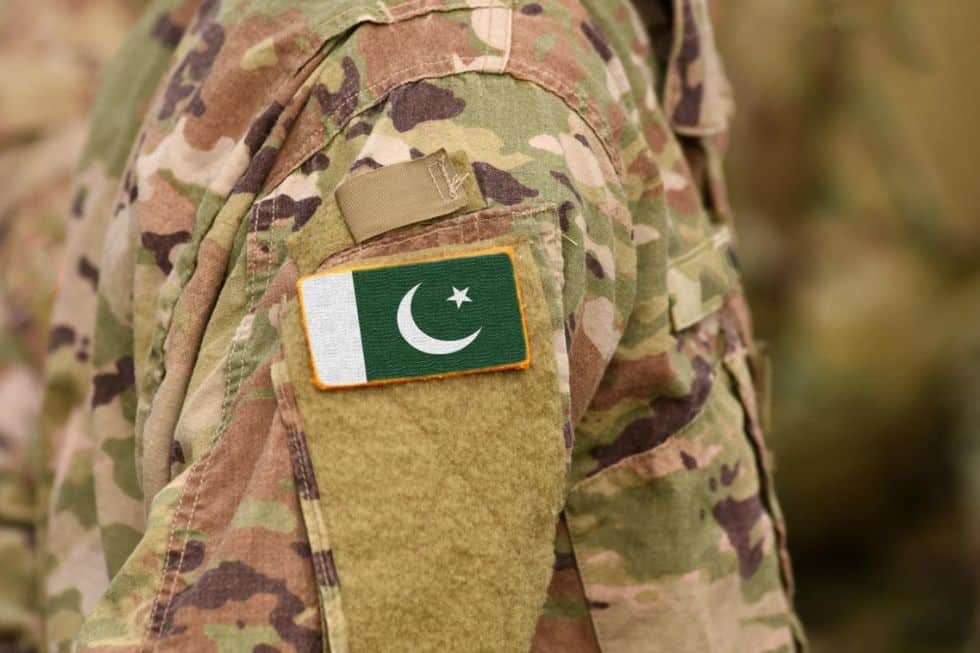
Via Shutterstock.
December 02, 2025 07:11 EDT

Check out our comment feature!
Saved Successfully.
This article saved into your bookmarks. Click here to view your bookmarks.


During my years in uniform, I learned that an army’s strength lies not in the weapons it carries, but in the restraint with which it wields them. Pakistan’s tragedy is that its army never learned this truth.
From its inception, Pakistan’s army has been both sword and sultan, claiming the right to rule under the pretext of protecting a fragile faith. What began as a professional institution in 1947 has now become a theocratic corporation, governing politics, economy, ideology and even religion. It is no longer the guardian of the republic; it is the republic itself.
Having watched this transformation over decades through wars, crises and dialogs, I have observed Pakistan’s army work on its ideological project. By 2035, we can rest assured that the army will continue to dominate Pakistan. By then, this army will not be a rational institution serving a nation but a radicalized oligarchy that believes it is serving god.
In 1947, Pakistan’s army was the guardian of a newly created Islamic republic. Over the decades, the army has transformed into the most dominant political, ideological and economic force within Pakistan. The Pakistan paradox is simple: the army professes to be the custodian of national defense while, in reality, it is the captor of the Pakistani state.
Today, the army controls everything in Pakistan, from guns and nuclear weapons to governance and national narrative.
Historical evolution and institutional DNA
Pakistan’s army was born out of fear, fear of India, fear of disintegration and fear of irrelevance. In 1947, as Partition tore the subcontinent apart, the new nation of Pakistan emerged without institutions, industry or administrative depth.
Its army, composed largely of Muslim officers of the old British Indian Army, inherited not a state but a siege. Unlike India, which quickly stabilized under a democratic framework, Pakistan’s generals found themselves surrounded by uncertainty and hostility, real or imagined. From the very beginning, they were taught that India sought to undo Pakistan’s existence.
This siege mentality fused nationalism with theology. Every officer was taught that Pakistan was not merely a new state, but an Islamic mission born in opposition to Hindu India. When General Ayub Khan seized power in 1958, it was justified not as a coup but as salvation. The army declared itself the most patriotic and competent guardian of the nation.
The collapse of East Pakistan in 1971 did not humble this institution; it hardened it. Instead of introspection, it chose indignation. Civilians were blamed, politicians were vilified and the army emerged from defeat even more entrenched in power.
The DNA of the Pakistan Army is deeply influenced by the circumstances of Pakistan’s creation in 1947. Unlike India’s army, which inherited a stable administrative and political framework, Pakistan’s army was traumatized by insecurity, partition violence and the perception of an existential threat from India.
The early leadership, drawn almost entirely from the Muslim officers of the British Indian Army, internalized a siege mentality that fused nationalism with religion. From the very beginning, the army projected itself as the ultimate guardian of both Pakistan’s territorial and ideological frontiers.
The first major shift came after the failure of the civilian elite in governance during the 1950s, allowing General Ayub Khan to seize power in 1958. This marked the beginning of the military’s self-perception as the only competent and patriotic institution in Pakistan. Ayub’s era institutionalized military dominance in the domestic bureaucracy, foreign policy and the economy. The 1971 debacle — the dismemberment of Pakistan — intensified the army’s insecurities but did not erode its dominance. Instead, it reinforced the military’s conviction that politicians and civilians were inherently incapable of safeguarding the state’s interests.
General Zia-ul-Haq’s coup in 1977 marked the next decisive transformation of the army. From now on, Islamization became the name of the game. Luckily, the Cold War was in full swing and the Soviets had invaded Afghanistan. Flush with American support and Saudi money for the Afghan mujahideen, Zia infused religious doctrine into the military ethos, merging professional military education with Islamic indoctrination. From now on, jihad became an instrument of foreign policy and Islamism an ideological glue to unify the fractious Pakistani polity.
Present composition and ideological drift
Years of Islamist indoctrination have created a new officer class. These officers have been shaped by decades of exposure to jihadist narratives and anti-India diatribe within the National Defence University and Command and Staff College curricula. Studies have noted a measurable increase in religiosity among mid-ranking officers and a tendency to conflate faith with patriotism.
The army’s radicalization is not overtly visible in uniform. However, it manifests subtly through the army’s choice of narratives, public statements and policy preferences. The military establishment continues to project India as an existential threat while covertly nurturing Islamist groups as “strategic assets” in Kashmir and Afghanistan. Despite occasional purges of extremist officers, the institution’s tolerance for religious militancy remains structural. This ideological environment blurs the line between professional soldiering and ideological warfare.
The influence of the Tablighi Jamaat, Jamaat-e-Islami and Barelvi movements within cantonments is well documented. Retired generals have publicly defended the Taliban and Osama bin Laden as “martyrs,” reflecting how deep the radical narrative runs through the officer corps.
Economic empire and the military-industrial complex
Parallel to its ideological control, Pakistan’s army has constructed an enormous economic empire that sustains its autonomy and patronage networks. The “Milbus,” or military business complex, encompasses vast holdings in agriculture, industry, construction and banking. Pakistani journalist and scholar Ayesha Siddiqa estimates that Milbus controls assets worth over $20 billion. Foundations such as the Fauji Foundation, Army Welfare Trust and Shaheen Foundation operate like conglomerates, generating profits that feed directly into the military welfare system, bypassing civilian oversight.
This economic empire serves multiple strategic purposes. First, it ensures institutional cohesion through material incentives, making loyalty to the military hierarchy financially rewarding. Second, it entrenches the army’s political control, as retired officers populate corporate boards, bureaucracies and even diplomatic positions. Third, it immunizes the army from fiscal accountability, enabling it to extract a disproportionate share of the national budget while retaining off-book sources of revenue.
By 2035, unless checked by systemic reform, this militarized economy will further weaken Pakistan’s civilian institutions. The army’s corporate empire will evolve into a state within a state, controlling both coercive power and economic capital, a combination that effectively subordinates the civilian state apparatus to military supremacy.
The nexus of Islamism, nationalism and military identity
One of the most dangerous developments in Pakistan’s strategic culture has been the fusion of Islamism with militarized nationalism. The army presents itself as the “Fortress of Islam,” positioning its military campaigns, particularly against India and in Afghanistan, as religiously sanctioned struggles.
A selective reading of history reinforces this self-image: the narrative of a hostile Hindu India, the betrayal of Muslims by the West and the divine destiny of Pakistan as the leader of the Islamic world holds sway over the public imagination. Within this framework, the army perceives jihadist groups not as existential threats but as tools of strategic depth. This “jihadist calculus” led to the nurturing of organizations like Lashkar-e-Taiba, Jaish-e-Mohammad and the Haqqani Network, which have been deployed as proxies while the army maintained plausible deniability.
The army has long been portraying its campaigns not as conventional conflicts but as divinely sanctioned missions in defense of the faith. This narrative has proved potent in mobilizing domestic legitimacy and regional influence, giving the army a moral veneer for what are essentially geopolitical pursuits.
The ideological contamination is circular; the army radicalizes society, and the radicalized society, in turn, legitimizes the army’s dominance. In effect, Pakistan has become a praetorian-theocratic hybrid, where the military’s authority is sustained by religious legitimacy.
From defender of borders to defender of faith, a praetorian-theocratic hybrid
The origins of this ideological transformation lie in the trauma of Partition and the theological justification for Pakistan’s creation. In 1947, Pakistan was dominated by Punjab and Bengal, which suffered the most during Partition. The Muslim League propagated the two-nation theory, claiming Hindus and Muslims were two separate nations. Right from the outset, the Pakistani elites gave the slogan: Islam is in danger. Over the decades, Pakistan’s army appropriated this slogan to build a doctrine where national security became synonymous with the survival of Islam itself.
The 1947–48, 1965 and 1971 wars with India were framed not merely as territorial disputes but as existential battles between Islam and Hinduism, good and evil, belief and idolatry. As stated earlier, this militarized religiosity deepened after Zia’s coup in 1977. Now, the army adopted Islamic mottos, military manuals invoked Quranic injunctions and officers were encouraged to see themselves as mujahideen in uniform.
The Afghan Jihad of the 1980s turbocharged jihadist organizations. Now, they were no longer threats but strategic assets. Groups like Lashkar-e-Taiba, Jaish-e-Mohammad and the Haqqani Network became instruments of what analysts have termed the jihadist calculus, the use of religiously motivated proxies to secure strategic depth in Afghanistan, bleed India in Kashmir and expand Pakistan’s influence across the Muslim world. The army supported a façade of plausible deniability even as these groups were nurtured, funded and protected.
As Pakistani journalist Ahmed Rashid notes, “Pakistan created the Taliban, and the Taliban, in turn, created a Pakistan that could never return to secular politics.” The result has been an irreversible ideological contamination: the army radicalized society, and the radicalized society, in turn, sanctified the army’s political supremacy.
Today, Pakistan stands as a praetorian-theocratic hybrid, a state where the army and Islam sustain each other. The army no longer derives authority from its capacity to defend borders, but from its self-declared role as the defender of the faith. The state’s legitimacy has thus migrated from the constitution to the Quran, and from the ballot box to the barracks.
This ideological weaponization of religion has not remained confined to domestic politics. It has acquired an increasingly international dimension. Pakistan seeks to align its army with the broader Islamic world, not as a partner, but as a potential vanguard of pan-Islamic defence.
Pakistan’s expanding Islamic military ambitions and flirtations with neo-Ottomans
Saudi Arabia has long been Pakistan’s principal ideological and financial sponsor. The relationship, cemented during the Afghan Jihad, rests on three pillars: religious affinity, economic dependency and security collaboration. Riyadh’s oil wealth and Pakistan’s military manpower formed a symbiotic equation; the Saudis funded Pakistan’s economy, while Pakistan provided trained soldiers and nuclear assurance.
Pakistan’s participation in the Saudi-led Islamic Military Counter Terrorism Coalition (IMCTC), set up in 2015, is emblematic of this relationship. The appointment of Raheel Sharif, a retired army chief, as the first commander of the IMCTC is a signal of Pakistan’s aspiration to command, or at least represent, the collective military strength of the Muslim world.
Behind the rhetoric of counterterrorism, however, the IMCTC’s structure and orientation reveal deeper ambitions to project a Sunni military bloc under Saudi influence, with Pakistan’s army as its professional backbone. This alignment has allowed Pakistan to receive Saudi loans, deferred oil payments and defense contracts, effectively intertwining religion, geopolitics and economic survival.
Türkiye’s resurgence under President Recep Tayyip Erdoğan has given Pakistan another ideological and strategic partner. Erdoğan’s vision of neo-Ottoman revivalism resonates with Pakistan’s own quest for Islamic leadership. Both countries see themselves as wronged by the West, both use religion to legitimize power and both promote militarized nationalism wrapped in Islamic symbolism.
Defense collaboration between Ankara and Islamabad has grown rapidly. Pakistan has acquired Turkish-made drones, attack helicopters and naval systems, while Turkish defense industries are helping modernize Pakistan’s armament production. Religious overtones of Muslim brotherhood accompany joint military exercises such as Ataturk XI. In 2024, Pakistan’s military media even described its cooperation with Türkiye as part of “the unity of the Muslim world in the face of global injustice.”
For Pakistan, Türkiye represents not only a technological partner but an ideological mirror, a fellow Muslim state reclaiming strength through faith and arms. Together, their rhetoric hints at a larger ambition: to reforge a collective Islamic identity that challenges Western dominance and Indian ascendancy alike.
Central and West Asian outreach and the “Army for Islam” fallacy
Beyond Saudi Arabia and Türkiye, Pakistan has expanded its engagement with the Islamic states of Central Asia, Uzbekistan, Kazakhstan, Turkmenistan and Azerbaijan, under the banner of regional Islamic solidarity. The rationale is dual: economic integration via connectivity corridors and strategic alignment through shared religious identity.
Islamabad’s active promotion of defense pacts and training programs with these countries — many of which are secular in governance but Muslim in demography — reflects an attempt to craft a broader Islamic security architecture. Pakistan’s military academies regularly host officers from these states, while its defense exports, especially small arms and training aircraft, are promoted as symbols of Muslim technological capability.
Even more telling is Pakistan’s rhetorical positioning within the Organisation of Islamic Cooperation (OIC). It has increasingly attempted to project itself as the military conscience of the Muslim world, the only nuclear-armed Islamic power capable of defending the ummah (“Muslim community”) against external aggression.
The idea that Pakistan’s army could evolve into the “Army for Islam” is not new. It has been implicit since Zia’s era, but recent events have made it dangerously explicit. The army’s rhetoric often emphasizes the “defense of Muslim causes”, be it Palestine, Kashmir or Afghanistan.
Pakistan’s participation in the IMCTC, its military training of Gulf forces and its cultivation of ideological partners across West and Central Asia have combined to create the perception of a pan-Islamic military role. Within Pakistan’s strategic community, this notion is presented as both a moral duty and a leadership opportunity.
Domestically, it strengthens the army’s grip on national identity. Internationally, it promises prestige and influence in the Muslim world. But beneath the surface lies a dangerous delusion, that a state born of faith can impose its religious identity upon its foreign policy without consequence.
In practice, Pakistan’s attempt to become the army for Islam could fragment the Islamic world rather than unite it. Its Sunni bias alienates Iran; its dependence on Saudi funding limits autonomy and its association with jihadist proxies tarnishes its credibility. Moreover, the weaponization of Islam in foreign policy fuels sectarianism at home, undermining Pakistan’s internal cohesion and economic stability.
The strategic consequences of Pakistan’s fusion of Islamism with militarism are profound and far-reaching. By intertwining faith with force, Pakistan has become a source of regional destabilization, exporting instability across South Asia, the Gulf and Central Asia, regions already fractured by sectarian and ideological divides.
Its reliance on Islamic patronage, particularly from Saudi Arabia and other Gulf monarchies, has discouraged meaningful economic reform and entrenched a cycle of dependency that undermines sovereignty. At the same time, the army’s self-conception as the defender of Islam has ideologically trapped the state, preventing reconciliation with India and alienating secular or moderate Muslim allies who view Pakistan’s militant religiosity with suspicion. This ideological rigidity has eroded Pakistan’s strategic autonomy, gradually reducing it to a client power within the competing spheres of influence of Saudi Arabia and Türkiye.
Most dangerously, the deliberate conflation of jihadism with state policy has deepened international distrust of Pakistan, reinforcing its image as a sanctuary for extremism rather than a responsible regional actor. In seeking glory as the “Army of Islam,” Pakistan risks losing the very foundation of its stability, its credibility, its independence and its place in the community of nations.
The transformation of Pakistan’s army from a national defense force to an ideological vanguard represents one of the most significant and dangerous shifts in South Asian strategic history. What began as a doctrine of national survival has evolved into a theology of militarism, where faith and firepower are inseparable.
We are a nonprofit, truly independent media organization committed to delivering diverse, fact-based global analysis. If you like what you are reading, sign up for our free newsletters now.
<label for=”Your email will be shared with fairobserver and subject to its Privacy Policy”>I agree to receive emails and other content from Fair Observer. I understand that I may repeal my consent at any time. You can review our Privacy Policy and Terms of Use for further information…</label>
Yet this ambition is as unstable as it is audacious. It rests on the illusion that Islam can be unified through military means and that Pakistan’s fractured polity can sustain such a mission. The fusion of Islamism, nationalism and military identity has trapped Pakistan in a self-perpetuating cycle, a state where soldiers preach, clerics strategize and jihad becomes policy. The danger is not only to Pakistan’s neighbors but to the entire Islamic world, which risks being drawn into the orbit of a militarized faith that confuses piety with power.
[Shokin Chauhan published a version of this piece on Substack.]
[Kaitlyn Diana edited this piece.]
The views expressed in this article are the author’s own and do not necessarily reflect Fair Observer’s editorial policy.
Comment
0 Comments
Newest
Oldest
Most Voted
Most Voted
Inline Feedbacks
View all comments
Commenting Guidelines
Please read our commenting guidelines before commenting.
1. Be Respectful: Please be polite to the author. Avoid hostility. The whole point of Fair Observer is openness to different perspectives from perspectives from around the world.
2. Comment Thoughtfully: Please be relevant and constructive. We do not allow personal attacks, disinformation or trolling. We will remove hate speech or incitement.
3. Contribute Usefully: Add something of value — a point of view, an argument, a personal experience or a relevant link if you are citing statistics and key facts.
<label style=”font-size: 18px;”>
I have read and agree to the above commenting guidelines.
</label>
Please agree to the guidelines before proceeding.
I
Agree, Proceed to Login
Cancel
Related Reading
Cracks in the China–Pakistan Partnership: Revealing the Illusion
The China–Pakistan relationship appears strong but is deeply rooted in dependency, with China prioritizing its strategic interests. China treats Pakistan…
by
Shokin Chauhan,
October 1, 2025
FO° Talks: Pakistan Develops Closer Ties with US and China After May’s Clashes with India
In this episode of FO° Talks, Rohan Khattar Singh and retired Lieutenant General Cherish Mathson analyze India’s military posture after…
by
Cherish Mathson & Rohan Khattar Singh,
October 1, 2025
Making Sense of the Latest India–Pakistan Tensions
Fair Observer Editor-in-Chief Atul Singh and retired CIA Officer Glenn Carle discuss the latest escalation in the India–Pakistan conflict following…
by
Glenn Carle & Atul Singh,
June 5, 2025
Support Fair Observer
We rely on your support for our independence, diversity and quality.
For more than 10 years, Fair Observer has been free, fair and independent. No billionaire
owns us, no advertisers control us. We are a reader-supported nonprofit. Unlike many other
publications, we keep our content free for readers regardless of where they live or whether
they can afford to pay. We have no paywalls and no ads.
In the post-truth era of fake news, echo chambers and filter bubbles, we publish a plurality
of perspectives from around the world. Anyone can publish with us, but everyone goes through
a rigorous editorial process. So, you get fact-checked, well-reasoned content instead of
noise.
We publish 3,000+ voices from 90+ countries. We also conduct education and training programs
on subjects ranging from digital media and journalism to writing and critical thinking. This
doesn’t come cheap. Servers, editors, trainers and web developers cost
money.
Please consider supporting us on a regular basis as a recurring donor or a
sustaining member.
Will you support FO’s journalism?
We rely on your support for our independence, diversity and quality.
Donation Cycle
<label for=”donation_cycle_one_time”>One Time</label>
<label for=”donation_cycle_monthly”>Monthly</label>
<label for=”donation_cycle_yearly”>Yearly</label>
Donation Amount
<label for=”amount_11″>$11</label>
<label for=”amount_111″>$111</label>
<label for=”other”>Other</label>
$
The IRS recognizes Fair Observer as a section 501(c)(3) registered public charity
(EIN: 46-4070943), enabling you to claim a tax deduction.
Make Sense of the World
Unique Insights from 3,000+ Contributors in 90+ Countries
<label
for=”Your email will be shared with fairobserver and subject to its Privacy Policy”>I
agree to receive emails and other content from Fair Observer. I understand
that I
may repeal my consent at any time. You can review our Privacy Policy
and Terms of Use
for further
information .</label>
for=”Your email will be shared with fairobserver and subject to its Privacy Policy”>I
agree to receive emails and other content from Fair Observer. I understand
that I
may repeal my consent at any time. You can review our Privacy Policy
and Terms of Use
for further
information .</label>
We are a nonprofit, truly independent media organization committed to delivering diverse, fact-based global analysis. If you like what you are reading, sign up for our free newsletters now.
<label for=”Your email will be shared with fairobserver and subject to its Privacy Policy”>I agree to receive emails and other content from Fair Observer. I understand that I may repeal my consent at any time. You can review our Privacy Policy and Terms of Use for further information…</label>
</main>
Fair Observer, 461 Harbor Blvd, Belmont, CA 94002, USA
<footer class=”mart70 fo-black-bg padt50 padb30″>
Sections
PUBLICATION
Support Fair Observer
We rely on your support for our independence, diversity and quality.


</footer>

<footer id=”fixed-footer” class=”support-footer”>


Support
independent, crowdsourced, nonprofit
journalism.
Fair Observer is a 501(c)(3) independent nonprofit. We are not owned by billionaires or controlled by
advertisers. We publish nearly 3,000 authors from over 90 countries after fact-checking and editing each
piece. We do not have a paywall and anyone can read us for free. With your vital donations, we can
continue
to do our work.
Please make a recurring (or even one-time) donation today. Even $1 goes a long way because
a
million donors
like you mean one million dollars. Thank you for keeping us independent, free and fair.
One Time
Monthly
Yearly
Monthly
Yearly
Continue 

</footer>

Sign into your Fair Observer Account
<label class=”tml-label” for=”user_login”>Username or Email Address</label>
<label class=”tml-label” for=”user_pass”>Password</label>
<label class=”tml-label” for=”rememberme”>Remember Me</label>
Log In
Forgot
Password
Forgot Password
Enter your registered email address or username. You will receive a
link to create a new password via email.
Please enter your username or email address. You will receive an email message with instructions on how to reset your password.
<label class=”tml-label” for=”user_login”>Username or Email Address</label>
Get New Password
Or
Return to
Login
Forgot Password
We have sent a link to your registered email address to reset your password.
<circle cx=”12.5″ cy=”12″ r=”12″ fill=”#414141″ />
Back to
Login
Become a Member & Enjoy Exclusive Benefits!
<circle cx=”12.5″ cy=”12″ r=”12″ fill=”#414141″ />
Access to comments feature
<circle cx=”12.5″ cy=”12″ r=”12″ fill=”#414141″ />
Bookmark your favorite articles
<circle cx=”12.5″ cy=”12″ r=”12″ fill=”#414141″ />
Exclusive invitations to FO° Talks & FO° Live
<circle cx=”12.5″ cy=”12″ r=”12″ fill=”#414141″ />
Access to all of our e-publications
Return to
Login
Login
NEWSLETTER
Make Sense of the World
Unique Insights from 2,500+ Contributors in 90+ Countries

<label
for=”Your email will be shared with fairobserver and subject to it’s Privacy Policy”>I
agree to receive emails and other content from Fair Observer. I understand
that I may repeal my consent at any time. You can review our Privacy Policy
and Terms of Use
for further information.</label>
for=”Your email will be shared with fairobserver and subject to it’s Privacy Policy”>I
agree to receive emails and other content from Fair Observer. I understand
that I may repeal my consent at any time. You can review our Privacy Policy
and Terms of Use
for further information.</label>
NEWSLETTER
Make Sense of the World
Unique Insights from 2,500+ Contributors in 90+ Countries
<label
for=”Your email will be shared with fairobserver and subject to it’s Privacy Policy”>I
agree to receive emails and other content from Fair Observer. I understand
that I may repeal my consent at any time. You can review our Privacy Policy
and Terms of Use
for further information.</label>
for=”Your email will be shared with fairobserver and subject to it’s Privacy Policy”>I
agree to receive emails and other content from Fair Observer. I understand
that I may repeal my consent at any time. You can review our Privacy Policy
and Terms of Use
for further information.</label>

Make Sense of the World
Unique Insights from 2,500+ Contributors in 90+ Countries
<label
for=”Your email will be shared with fairobserver and subject to its Privacy Policy”>I
agree to receive emails and other content from Fair Observer. I understand that I
may repeal my consent at any time. You can review our Privacy Policy and Terms of Use for further
information .</label>
for=”Your email will be shared with fairobserver and subject to its Privacy Policy”>I
agree to receive emails and other content from Fair Observer. I understand that I
may repeal my consent at any time. You can review our Privacy Policy and Terms of Use for further
information .</label>
We Need Your Consent
We use cookies to give you the best possible experience. Learn more about how we use cookies or edit your cookie preferences. Privacy Policy. My Options I Accept
Privacy & Cookies Policy
Close
Edit Cookie Preferences
The Fair Observer website uses digital cookies so it can collect statistics on how many visitors come to the site, what content is viewed and for how long, and the general location of the computer network of the visitor. These statistics are collected and processed using the Google Analytics service. Fair Observer uses these aggregate statistics from website visits to help improve the content of the website and to provide regular reports to our current and future donors and funding organizations. The type of digital cookie information collected during your visit and any derived data cannot be used or combined with other information to personally identify you. Fair Observer does not use personal data collected from its website for advertising purposes or to market to you.
As a convenience to you, Fair Observer provides buttons that link to popular social media sites, called social sharing buttons, to help you share Fair Observer content and your comments and opinions about it on these social media sites. These social sharing buttons are provided by and are part of these social media sites. They may collect and use personal data as described in their respective policies. Fair Observer does not receive personal data from your use of these social sharing buttons. It is not necessary that you use these buttons to read Fair Observer content or to share on social media.
Necessary
<label class=”form-check-label” for=”wt-cli-checkbox-necessary”>Necessary</label>
Always Enabled
These cookies essential for the website to function.
Social Media
<label for=”wt-cli-checkbox-social_media” class=”cli-slider” data-cli-enable=”Enabled” data-cli-disable=”Disabled”>Social Media</label>
These cookies are used to enable sharing or following of content that you find interesting on our website. These settings apply to third-party social networking and other websites.
Performance & Functionality
<label for=”wt-cli-checkbox-performance” class=”cli-slider” data-cli-enable=”Enabled” data-cli-disable=”Disabled”>Performance & Functionality</label>
These cookies are used to enhance the performance and functionality of our website. They provide statistics on how our website is used and help us improve by measuring errors. Certain functionalities on our website may become unavailable without these cookies.
Analytics
<label for=”wt-cli-checkbox-analytics” class=”cli-slider” data-cli-enable=”Enabled” data-cli-disable=”Disabled”>Analytics</label>
SAVE & ACCEPT
<textarea id=’wpd-editor-source-code’></textarea>Insert
</body>
</html>
Total Views:
Source: World Politics - fairobserver.com