<g id=”cross”>
<line class=”cls-1″ x1=”7″ x2=”25″ y1=”7″ y2=”25″ />
<line class=”cls-1″ x1=”7″ x2=”25″ y1=”25″ y2=”7″ />
</g>
Climate Protest in the Age of Unrest
<circle cx=”10.5″ cy=”10.5″ r=”7.5″ />
<line x1=”21″ x2=”15.8″ y1=”21″ y2=”15.8″ />
<nav class=”fo-navigation pos-r” itemscope itemtype=”http://schema.org/Navigation”>
Login
Sections <circle cx=”10.5″ cy=”10.5″ r=”7.5″ />
<line x1=”21″ x2=”15.8″ y1=”21″ y2=”15.8″ />
Search
<circle cx=”10.5″ cy=”10.5″ r=”7.5″ />
<line x1=”21″ x2=”15.8″ y1=”21″ y2=”15.8″ />
Search


PUBLICATION
Support Fair Observer
We rely on your support for our independence, diversity and quality.
</nav>
</header>

<main id=”main” class=”site-main” role=”main”> 



Friday, January 02, 2026
<header class=”entry-header”>
Climate Protest in the Age of Unrest
A global wave of Generation Z–led protests has erupted with remarkable speed and success, toppling governments and forcing reforms across developing and fragile democracies. Unlike earlier youth movements, these uprisings focus on corruption, authoritarianism and economic stagnation rather than climate change. By rebuilding accountability and the rule of law, they may still shape the future of climate action.
By
Friday, January 02, 2026
</header>

Via Shutterstock.

January 02, 2026 06:44 EDT

Check out our comment feature!
Saved Successfully.
This article saved into your bookmarks. Click here to view your bookmarks.


There are three remarkable shared characteristics about the wave of Generation Z (Gen Z) protests that have swept around the world in the last 18 months: the speed and scale with which they took off, their astonishing success and, lastly, the mix of motivations that lit the spark of protest and those that are missing from many of the protestors’ demands. Those missing motivations may hold clues about the future of effective climate activism.
Bangladesh’s Student-People’s Uprising, which ended with the toppling of Sheikh Hasina’s 15-year increasingly authoritarian premiership, was the first of this Gen Z Protests wave. What started as dissent against quota-based recruitment to government jobs quickly grew into a massive pro-democracy and anti-corruption movement, in which 1,400 protestors were killed, and the incumbent fled across the border to India and has since been sentenced to death.
In the last 18 months, similar Gen Z protests have emerged in more than 20 countries worldwide, from Mozambique to Mongolia, Paraguay to the Philippines. There are ongoing protests in 11 countries.
From local sparks to a global Gen Z uprising
The triggers for resistance are often incidental and varied in different contexts. In Serbia, the collapse of a rooftop in the Novi Sad railway station, where 16 people were killed, led to a spontaneous eruption of protests among the student community against government corruption and negligence. In Madagascar, a peaceful September protest against the persistent failures of state-owned companies’ provision of power and water in the capital evolved into widespread unrest spearheaded by a Gen Z online movement, and a military coup has since replaced the President.
But there are common threads between these disparate protest movements: the erosion of democratic rights, rising authoritarianism, corruption and economic stagnation. Each protest has learned the lesson of the last, taking cultural cues from online culture and other protests to create independent movements, each with a recognizable Gen Z signature.
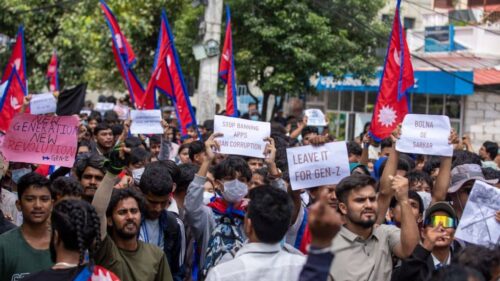
Gone are the “There is no Planet B” placards of 2020’s Fridays for the Future campaigns, which blossomed globally but were most prominent in the capital cities of Europe, Australia and North America. Now, protestors are taking inspiration from online meme culture. “Ok boomer, time’s up” became a rallying cry for the successful protests in Nepal this past September. A skull-and-crossbones flag from the Manga One Piece has become a symbol of protest across countries, and Pikachu is no longer a beloved Pokémon but a firebrand provocateur.
The protests themselves are an expression of a generation that has grown up in a global social media age, who pride themselves on absurd humor and nihilism, and ironically, are willing to die for it.
And while their methods and motivations might be unconventional, with Nepal’s election held via the app Discord providing the best case in point, Gen Z protestors have been remarkably successful. Governments have been overthrown in Sri Lanka, Bangladesh, Nepal and Madagascar. Major policy changes have been achieved in Timor-Leste and Kenya.
Not since the Arab Spring of 2011 and 2012, when pro-democracy protests deposed rulers in Tunisia, Libya, Egypt and Yemen, has a protest movement caused so much political upheaval in such a short time.
Climate change and global protests
There were many contributing factors to the political instability that rocked the Arab Region over a decade ago. But the effects of climate change, especially when combined with bread and butter issues like affordability, corruption and authoritarian overreach, are an explosive cocktail. Indeed, widespread droughts wiped out around 85% of livestock across eastern Syria in 2011, while severe weather-induced breadbasket failures in 2010 saw price spikes on key foods cascade across the region.
With protests ongoing around the world, it would be difficult to attribute all current Gen Z protests to a single climate event. In fact, climate change has been noticeably absent as a rallying call for the movements altogether.
At a cursory glance, that might be surprising. It was only six years ago that more than seven million protesters took to the streets around the world for the Global Climate Strike. The phrase “Gen Z Protest” has its origins in a 2019 article by the French Market Research firm Ipsos, which looked at climate action and intergenerational conflict. Since then, climate activism hasn’t gone away, but it has undergone a reckoning. The last major global climate strike took place in 2021 ahead of the 26th UN Climate Conference (COP26) in Glasgow.
For a while, the COP process provided a lightning rod for protest. But the hosting of three subsequent COPs in Egypt, the United Arab Emirates (UAE) and Azerbaijan significantly curtailed the space for such campaigns.
One noticeable outcome of COP30 being hosted in democratic Brazil has been a welcome return of newsworthy peaceful protests. This was best exemplified when 90 protestors from indigenous communities blocked the negotiators’ entrance to object to resource extractivism in the Amazon.
Why climate change is missing — and why that matters
A decade on from the landmark Paris Agreement, there has been little progress in annual greenhouse gas emissions. However, there have also been wins along the way. China continues to hurtle forward in its staggering rollout of renewable energy. Recently, the European Union announced that it was on track for its 2030 emissions reduction target.
However, anthropogenic greenhouse gas emissions are still higher than they have ever been. Even the Secretary-General of the United Nations has warned that exceeding the 1.5 °C warming target, even temporarily, is inevitable.
During that period, activism and protest movements have had to adapt to a more turbulent and impoverished world, rocked by the economic and social shocks of the COVID-19 pandemic, geopolitical tensions, major military conflicts and the advent of artificial intelligence. The World Bank estimates that global growth in this decade will be the slowest since the 1960s.
Key figures in the climate movement, while not abandoning their roots, have since chosen to devote their energy to pressing humanitarian disasters. In September, Greta Thunberg and 170 other pro-Palestinian protestors were detained by Israeli forces as they sailed an aid flotilla to Gaza.
The flare-ups of protest led by Gen Z are a response to a fragmented and dangerous world order. It is not surprising, then, that the center of gravity of this new wave of protests lies in developing economies and fragile democracies, and that its chief protagonists are local activists focused on bread-and-butter issues.
Climate change will exacerbate the conditions for political instability. The World Economic Forum estimates that for every degree of warming, 12% of global GDP is lost. The world is currently on course for 2.7 °C warming by 2100.
The nature of that instability could derail climate action and see a slide towards authoritarianism. This is already happening in the United States, where a surge in climate migrants crossing the US-Mexican border has been used to justify the Trump administration’s homeland security policies. The Gen Z protests might demonstrate an antidote to this in the long run, ironically, precisely because they do not tackle climate change head-on.
Accountability and the rule of law are prerequisites for international climate action. Corruption and inequality are blockers to addressing both rapid mitigation and adaptation, the latter being a significant challenge in the developing world.
We are a rare nonprofit in the world news space. Most other organizations are owned by billionaires or governments. We are bottom-up, not top-down and bring you perspectives from around the world. So, sign up now for our free newsletters to hear from our 3,000+ voices from 90+ countries.
<label for=”Your email will be shared with fairobserver and subject to its Privacy Policy”>I agree to receive emails and other content from Fair Observer. I understand that I may repeal my consent at any time. You can review our Privacy Policy and Terms of Use for further information…</label>
In this day and age, some of the most effective climate change activism might not be about environmental collapse, but rather about reinvigorating the democratic contract between governments and their people.
[Kaitlyn Diana edited this piece.]
The views expressed in this article are the author’s own and do not necessarily reflect Fair Observer’s editorial policy.
Comment
0 Comments
Newest
Oldest
Most Voted
Most Voted
Inline Feedbacks
View all comments
Commenting Guidelines
Please read our commenting guidelines before commenting.
1. Be Respectful: Please be polite to the author. Avoid hostility. The whole point of Fair Observer is openness to different perspectives from perspectives from around the world.
2. Comment Thoughtfully: Please be relevant and constructive. We do not allow personal attacks, disinformation or trolling. We will remove hate speech or incitement.
3. Contribute Usefully: Add something of value — a point of view, an argument, a personal experience or a relevant link if you are citing statistics and key facts.
<label style=”font-size: 18px;”>
I have read and agree to the above commenting guidelines.
</label>
Please agree to the guidelines before proceeding.
I
Agree, Proceed to Login
Cancel
Related Reading
The Unseriousness of Young Revolutionaries
Young protesters across the world use humor, memes and pop culture to confront failing governments and rigid institutions. Their decentralized…
by
Tara Yarwais,
November 8, 2025
The Amazon Under Threat: The Urgency of COP30 in Brazil
Brazil faces a test of leadership as it hosts COP30 in Belém amid a worsening climate emergency and global denialism….
by
Luiz Cesar Pimentel,
November 5, 2025
Communal Resilience as a Young Person in an Increasingly Volatile US
In the US, many members of Generation Z (Gen Z) believe that democracy is at risk from threats that Gen…
by
Simone Colburn,
October 21, 2025
Support Fair Observer
We rely on your support for our independence, diversity and quality.
For more than 10 years, Fair Observer has been free, fair and independent. No billionaire
owns us, no advertisers control us. We are a reader-supported nonprofit. Unlike many other
publications, we keep our content free for readers regardless of where they live or whether
they can afford to pay. We have no paywalls and no ads.
In the post-truth era of fake news, echo chambers and filter bubbles, we publish a plurality
of perspectives from around the world. Anyone can publish with us, but everyone goes through
a rigorous editorial process. So, you get fact-checked, well-reasoned content instead of
noise.
We publish 3,000+ voices from 90+ countries. We also conduct education and training programs
on subjects ranging from digital media and journalism to writing and critical thinking. This
doesn’t come cheap. Servers, editors, trainers and web developers cost
money.
Please consider supporting us on a regular basis as a recurring donor or a
sustaining member.
Will you support FO’s journalism?
We rely on your support for our independence, diversity and quality.
Donation Cycle
<label for=”donation_cycle_one_time”>One Time</label>
<label for=”donation_cycle_monthly”>Monthly</label>
<label for=”donation_cycle_yearly”>Yearly</label>
Donation Amount
<label for=”amount_11″>$11</label>
<label for=”amount_111″>$111</label>
<label for=”other”>Other</label>
$
The IRS recognizes Fair Observer as a section 501(c)(3) registered public charity
(EIN: 46-4070943), enabling you to claim a tax deduction.
Make Sense of the World
Unique Insights from 3,000+ Contributors in 90+ Countries
<label
for=”Your email will be shared with fairobserver and subject to its Privacy Policy”>I
agree to receive emails and other content from Fair Observer. I understand
that I
may repeal my consent at any time. You can review our Privacy Policy
and Terms of Use
for further
information .</label>
for=”Your email will be shared with fairobserver and subject to its Privacy Policy”>I
agree to receive emails and other content from Fair Observer. I understand
that I
may repeal my consent at any time. You can review our Privacy Policy
and Terms of Use
for further
information .</label>
No owners, no ads, just global voices and first class editors. We’re a nonprofit that puts real journalism first. Join us — subscribe to our free newsletters — now.
<label for=”Your email will be shared with fairobserver and subject to its Privacy Policy”>I agree to receive emails and other content from Fair Observer. I understand that I may repeal my consent at any time. You can review our Privacy Policy and Terms of Use for further information…</label>
</main>
Fair Observer, 461 Harbor Blvd, Belmont, CA 94002, USA
<footer class=”mart70 fo-black-bg padt50 padb30″>
Sections
PUBLICATION
Support Fair Observer
We rely on your support for our independence, diversity and quality.


</footer>

<footer id=”fixed-footer” class=”support-footer”>


Support
independent, crowdsourced, nonprofit
journalism.
Fair Observer is a 501(c)(3) independent nonprofit. We are not owned by billionaires or controlled by
advertisers. We publish nearly 3,000 authors from over 90 countries after fact-checking and editing each
piece. We do not have a paywall and anyone can read us for free. With your vital donations, we can
continue
to do our work.
Please make a recurring (or even one-time) donation today. Even $1 goes a long way because
a
million donors
like you mean one million dollars. Thank you for keeping us independent, free and fair.
One Time
Monthly
Yearly
Monthly
Yearly
Continue 

</footer>

Sign into your Fair Observer Account
<label class=”tml-label” for=”user_login”>Username or Email Address</label>
<label class=”tml-label” for=”user_pass”>Password</label>
<label class=”tml-label” for=”rememberme”>Remember Me</label>
Log In
Forgot
Password
Forgot Password
Enter your registered email address or username. You will receive a
link to create a new password via email.
Please enter your username or email address. You will receive an email message with instructions on how to reset your password.
<label class=”tml-label” for=”user_login”>Username or Email Address</label>
Get New Password
Or
Return to
Login
Forgot Password
We have sent a link to your registered email address to reset your password.
<circle cx=”12.5″ cy=”12″ r=”12″ fill=”#414141″ />
Back to
Login
Become a Member & Enjoy Exclusive Benefits!
<circle cx=”12.5″ cy=”12″ r=”12″ fill=”#414141″ />
Access to comments feature
<circle cx=”12.5″ cy=”12″ r=”12″ fill=”#414141″ />
Bookmark your favorite articles
<circle cx=”12.5″ cy=”12″ r=”12″ fill=”#414141″ />
Exclusive invitations to FO° Talks & FO° Live
<circle cx=”12.5″ cy=”12″ r=”12″ fill=”#414141″ />
Access to all of our e-publications
Return to
Login
Login
NEWSLETTER
Make Sense of the World
Unique Insights from 2,500+ Contributors in 90+ Countries

<label
for=”Your email will be shared with fairobserver and subject to it’s Privacy Policy”>I
agree to receive emails and other content from Fair Observer. I understand
that I may repeal my consent at any time. You can review our Privacy Policy
and Terms of Use
for further information.</label>
for=”Your email will be shared with fairobserver and subject to it’s Privacy Policy”>I
agree to receive emails and other content from Fair Observer. I understand
that I may repeal my consent at any time. You can review our Privacy Policy
and Terms of Use
for further information.</label>
NEWSLETTER
Make Sense of the World
Unique Insights from 2,500+ Contributors in 90+ Countries
<label
for=”Your email will be shared with fairobserver and subject to it’s Privacy Policy”>I
agree to receive emails and other content from Fair Observer. I understand
that I may repeal my consent at any time. You can review our Privacy Policy
and Terms of Use
for further information.</label>
for=”Your email will be shared with fairobserver and subject to it’s Privacy Policy”>I
agree to receive emails and other content from Fair Observer. I understand
that I may repeal my consent at any time. You can review our Privacy Policy
and Terms of Use
for further information.</label>

Make Sense of the World
Unique Insights from 2,500+ Contributors in 90+ Countries
<label
for=”Your email will be shared with fairobserver and subject to its Privacy Policy”>I
agree to receive emails and other content from Fair Observer. I understand that I
may repeal my consent at any time. You can review our Privacy Policy and Terms of Use for further
information .</label>
for=”Your email will be shared with fairobserver and subject to its Privacy Policy”>I
agree to receive emails and other content from Fair Observer. I understand that I
may repeal my consent at any time. You can review our Privacy Policy and Terms of Use for further
information .</label>
We Need Your Consent
We use cookies to give you the best possible experience. Learn more about how we use cookies or edit your cookie preferences. Privacy Policy. My Options I Accept
Privacy & Cookies Policy
Close
Edit Cookie Preferences
The Fair Observer website uses digital cookies so it can collect statistics on how many visitors come to the site, what content is viewed and for how long, and the general location of the computer network of the visitor. These statistics are collected and processed using the Google Analytics service. Fair Observer uses these aggregate statistics from website visits to help improve the content of the website and to provide regular reports to our current and future donors and funding organizations. The type of digital cookie information collected during your visit and any derived data cannot be used or combined with other information to personally identify you. Fair Observer does not use personal data collected from its website for advertising purposes or to market to you.
As a convenience to you, Fair Observer provides buttons that link to popular social media sites, called social sharing buttons, to help you share Fair Observer content and your comments and opinions about it on these social media sites. These social sharing buttons are provided by and are part of these social media sites. They may collect and use personal data as described in their respective policies. Fair Observer does not receive personal data from your use of these social sharing buttons. It is not necessary that you use these buttons to read Fair Observer content or to share on social media.
Necessary
<label class=”form-check-label” for=”wt-cli-checkbox-necessary”>Necessary</label>
Always Enabled
These cookies essential for the website to function.
Social Media
<label for=”wt-cli-checkbox-social_media” class=”cli-slider” data-cli-enable=”Enabled” data-cli-disable=”Disabled”>Social Media</label>
These cookies are used to enable sharing or following of content that you find interesting on our website. These settings apply to third-party social networking and other websites.
Performance & Functionality
<label for=”wt-cli-checkbox-performance” class=”cli-slider” data-cli-enable=”Enabled” data-cli-disable=”Disabled”>Performance & Functionality</label>
These cookies are used to enhance the performance and functionality of our website. They provide statistics on how our website is used and help us improve by measuring errors. Certain functionalities on our website may become unavailable without these cookies.
Analytics
<label for=”wt-cli-checkbox-analytics” class=”cli-slider” data-cli-enable=”Enabled” data-cli-disable=”Disabled”>Analytics</label>
SAVE & ACCEPT
<textarea id=’wpd-editor-source-code’></textarea>Insert
</body>
</html>
Total Views:
Source: World Politics - fairobserver.com