<g id=”cross”>
<line class=”cls-1″ x1=”7″ x2=”25″ y1=”7″ y2=”25″ />
<line class=”cls-1″ x1=”7″ x2=”25″ y1=”25″ y2=”7″ />
</g>
How Chemical Weapons Allegations Could Change Sudan’s War Stances and the World’s Response
<circle cx=”10.5″ cy=”10.5″ r=”7.5″ />
<line x1=”21″ x2=”15.8″ y1=”21″ y2=”15.8″ />
<nav class=”fo-navigation pos-r” itemscope itemtype=”http://schema.org/SiteNavigationElement”>
Login
Sections <circle cx=”10.5″ cy=”10.5″ r=”7.5″ />
<line x1=”21″ x2=”15.8″ y1=”21″ y2=”15.8″ /> Search
<line x1=”21″ x2=”15.8″ y1=”21″ y2=”15.8″ />
Search


PUBLICATION
Support Fair Observer
We rely on your support for our independence, diversity and quality.
</nav>
<circle cx=”10.5″ cy=”10.5″ r=”7.5″ />
<line x1=”21″ x2=”15.8″ y1=”21″ y2=”15.8″ />
<line x1=”21″ x2=”15.8″ y1=”21″ y2=”15.8″ />
Search
</header>

<main id=”main” class=”site-main” role=”main”> 



Tuesday, January 27, 2026
<header class=”entry-header”>
Africa
How Chemical Weapons Allegations Could Change Sudan’s War Stances and the World’s Response
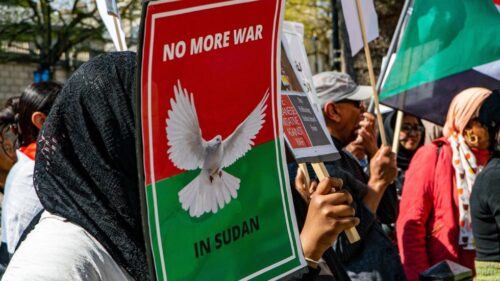
Sudan’s civil conflict has escalated with allegations that its national army used banned chemical weapons, specifically chlorine gas. This accusation challenges international law and complicates diplomatic efforts by increasing political costs and isolating Sudan’s military leadership. The situation threatens peace negotiations, raising urgent questions about the global community’s commitment to enforcing wartime red lines.
By
Tuesday, January 27, 2026
</header>
Via Shutterstock.

January 27, 2026 07:01 EDT

Check out our comment feature!
Saved Successfully.
This article saved into your bookmarks. Click here to view your bookmarks.


For more than two years, the Sudanese civil conflict has been characterized by mass displacement, ethnic cleansing, starvation and the near collapse of the state itself. No side emerges with clean hands. Yet recently discovered evidence threatens to change the conflict’s international trajectory.
Allegations of chemical weapons use: crossing a red line
Evidence reviewed by independent experts suggests that Sudan’s national army, the Sudanese Armed Forces (SAF), may have used chemical agents, specifically chlorine gas, during the fighting. If confirmed, this would not simply add another war crime to the list. It would cross one of the firmest red lines in modern warfare and push Sudan’s war from a humanitarian crisis into a direct challenge to one of international law’s most guarded taboos.
Chemical weapons usage is banned almost universally, and Sudan itself is a signatory to the Chemical Weapons Convention (CWC) treaty. If a national army is found to have violated it, the issue moves beyond the battlefield and enters the realm of broken international obligations. For diplomats in Washington, Brussels and elsewhere, that distinction matters as it raises the political cost of engagement and narrows the room for compromise.
The evidence that has emerged so far, including imagery, open-source videos and expert chemical assessments, is not yet a formal legal ruling. That responsibility lies with international verification bodies, such as the Organisation for the Prohibition of Chemical Weapons (OPCW). Diplomacy, however, operates on a different threshold, and in political terms the bar has already been crossed.
What complicates the situation even further is who is accused of these atrocities. These are, after all, not members of some militia groups or rogue commanders operating at the margins, but forces that present themselves as Sudan’s legitimate national army. This contradicts the narrative that many governments had actually been relying on: that the SAF, however brutal it is, still represented the last institutional backbone of the Sudanese state.
Diverging international responses
The United States had been the most forceful in its response so far. After an initial cautious response, Washington has increasingly placed these allegations as part of a broader pattern of behavior that makes the SAF’s political rehabilitation impossible without accountability.
Concerns that Islamist militias may have access to chemical weapons heightened the perceived stakes. In new sanctions imposed earlier this year, the US government explicitly referenced chemical weapons and indicated the intent to cross a line that had been historically treated with care: accusing a government of using banned weapons without waiting for full multilateral consensus.
In contrast, the European Union’s response has been more temperate. So far, Brussels has folded the allegations into wider condemnations of atrocities and humanitarian law violations, showcasing the EU’s strong institutional preference for legal process and multilateral verification. OPCW verification indeed remains a crucial factor for most European member states, especially Germany. However, European restraints do not mean being unaware: even unproven claims of chemical weapons usage disrupt the political math and raise the diplomatic price of engagement.
Diplomatic isolation and the future of peace efforts
Beyond the transatlantic divide, the charges also contribute to greater diplomatic isolation of the SAF at a moment when it has been constantly seeking recognition as Sudan’s legitimate authority. The allegations make it harder for African, Arab and European states to justify cooperation, whether military, intelligence or even humanitarian. Isolation deepens precisely when legitimacy matters most.
Peace efforts are also at risk. Chemical weapons accusations reduce political space and shift attention from conflict resolution to accountability. Talks may slow, and diplomatic channels may narrow, yet for many, that is the point. Allowing negotiations to proceed as if nothing happened would send a dangerous signal: the use of mass-atrocity weapons cannot simply be set aside in the name of expediency.
We are a rare nonprofit in the world news space. Most other organizations are owned by billionaires or governments. We are bottom-up, not top-down and bring you perspectives from around the world. So, sign up now for our free newsletters to hear from our 3,000+ voices from 90+ countries.
<label for=”Your email will be shared with fairobserver and subject to its Privacy Policy”>I agree to receive emails and other content from Fair Observer. I understand that I may repeal my consent at any time. You can review our Privacy Policy and Terms of Use for further information…</label>
The war in Sudan has already tested the international community’s tolerance for human suffering. Chemical weapons, on the other hand, test the underlying question of whether international red lines still mean anything at all. If the allegations are confirmed, the question will no longer be what happened on the battlefield, but whether the international community is prepared to act on the norms it claims to defend.
[Kaitlyn Diana edited this piece.]
The views expressed in this article are the author’s own and do not necessarily reflect Fair Observer’s editorial policy.
Comment
0 Comments
Newest
Oldest
Most Voted
Most Voted
Inline Feedbacks
View all comments
Commenting Guidelines
Please read our commenting guidelines before commenting.
1. Be Respectful: Please be polite to the author. Avoid hostility. The whole point of Fair Observer is openness to different perspectives from perspectives from around the world.
2. Comment Thoughtfully: Please be relevant and constructive. We do not allow personal attacks, disinformation or trolling. We will remove hate speech or incitement.
3. Contribute Usefully: Add something of value — a point of view, an argument, a personal experience or a relevant link if you are citing statistics and key facts.
<label style=”font-size: 18px;”>
I have read and agree to the above commenting guidelines.
</label>
Please agree to the guidelines before proceeding.
I
Agree, Proceed to Login
Cancel
Related Reading
FO° Talks: Sudan’s Civil War Explained — RSF vs SAF, Darfur Crisis and Red Sea Geopolitics
In this episode of FO° Talks, Rohan Khattar Singh and Fernando Carvajal examine how Sudan’s civil war grew into a…
by
Fernando Carvajal & Rohan Khattar Singh,
November 23, 2025
The World Must Act to Save Darfur’s Innocents From Further Massacre
Sudan’s crisis deepens as the Rapid Support Forces (RSF) battle the Sudanese Armed Forces (SAF) for dominance across Darfur. The…
by
Gerald Walker,
November 15, 2025
The Cost of Silence: Why Global Inaction Is Betraying the People of Sudan
After three years of civil war in Sudan between the Sudanese Armed Forces and the Rapid Support Forces military groups,…
by
Fernando Carvajal,
July 28, 2025
Support Fair Observer
We rely on your support for our independence, diversity and quality.
For more than 10 years, Fair Observer has been free, fair and independent. No billionaire
owns us, no advertisers control us. We are a reader-supported nonprofit. Unlike many other
publications, we keep our content free for readers regardless of where they live or whether
they can afford to pay. We have no paywalls and no ads.
In the post-truth era of fake news, echo chambers and filter bubbles, we publish a plurality
of perspectives from around the world. Anyone can publish with us, but everyone goes through
a rigorous editorial process. So, you get fact-checked, well-reasoned content instead of
noise.
We publish 3,000+ voices from 90+ countries. We also conduct education and training programs
on subjects ranging from digital media and journalism to writing and critical thinking. This
doesn’t come cheap. Servers, editors, trainers and web developers cost
money.
Please consider supporting us on a regular basis as a recurring donor or a
sustaining member.
Will you support FO’s journalism?
We rely on your support for our independence, diversity and quality.
Donation Cycle
<label for=”donation_cycle_one_time”>One Time</label>
<label for=”donation_cycle_monthly”>Monthly</label>
<label for=”donation_cycle_yearly”>Yearly</label>
Donation Amount
<label for=”amount_11″>$11</label>
<label for=”amount_111″>$111</label>
<label for=”other”>Other</label>
$
The IRS recognizes Fair Observer as a section 501(c)(3) registered public charity
(EIN: 46-4070943), enabling you to claim a tax deduction.
Make Sense of the World
Unique Insights from 3,000+ Contributors in 90+ Countries
<label
for=”Your email will be shared with fairobserver and subject to its Privacy Policy”>I
agree to receive emails and other content from Fair Observer. I understand
that I
may repeal my consent at any time. You can review our Privacy Policy
and Terms of Use
for further
information .</label>
for=”Your email will be shared with fairobserver and subject to its Privacy Policy”>I
agree to receive emails and other content from Fair Observer. I understand
that I
may repeal my consent at any time. You can review our Privacy Policy
and Terms of Use
for further
information .</label>
We are a nonprofit, truly independent media organization committed to delivering diverse, fact-based global analysis. If you like what you are reading, sign up for our free newsletters now.
<label for=”Your email will be shared with fairobserver and subject to its Privacy Policy”>I agree to receive emails and other content from Fair Observer. I understand that I may repeal my consent at any time. You can review our Privacy Policy and Terms of Use for further information…</label>
</main>
Fair Observer, 461 Harbor Blvd, Belmont, CA 94002, USA
<footer class=”mart70 fo-black-bg padt50 padb30″>
Sections
PUBLICATION
Support Fair Observer
We rely on your support for our independence, diversity and quality.


</footer>

<footer id=”fixed-footer” class=”support-footer”>


Support
independent, crowdsourced, nonprofit
journalism.
Fair Observer is a 501(c)(3) independent nonprofit. We are not owned by billionaires or controlled by
advertisers. We publish nearly 3,000 authors from over 90 countries after fact-checking and editing each
piece. We do not have a paywall and anyone can read us for free. With your vital donations, we can
continue
to do our work.
Please make a recurring (or even one-time) donation today. Even $1 goes a long way because
a
million donors
like you mean one million dollars. Thank you for keeping us independent, free and fair.
One Time
Monthly
Yearly
Monthly
Yearly
Continue 

</footer>

Sign into your Fair Observer Account
<label class=”tml-label” for=”user_login”>Username or Email Address</label>
<label class=”tml-label” for=”user_pass”>Password</label>
<label class=”tml-label” for=”rememberme”>Remember Me</label>
Log In
Forgot
Password
Password
Forgot Password
Enter your registered email address or username. You will receive a
link to create a new password via email.
Please enter your username or email address. You will receive an email message with instructions on how to reset your password.
<label class=”tml-label” for=”user_login”>Username or Email Address</label>
Get New Password
Or
Return to
Login
Forgot Password
We have sent a link to your registered email address to reset your password.
<circle cx=”12.5″ cy=”12″ r=”12″ fill=”#414141″ />
Back to
Login
Become a Member & Enjoy Exclusive Benefits!
<circle cx=”12.5″ cy=”12″ r=”12″ fill=”#414141″ />
Access to comments feature
<circle cx=”12.5″ cy=”12″ r=”12″ fill=”#414141″ />
Bookmark your favorite articles
<circle cx=”12.5″ cy=”12″ r=”12″ fill=”#414141″ />
Exclusive invitations to FO° Talks & FO° Live
<circle cx=”12.5″ cy=”12″ r=”12″ fill=”#414141″ />
Access to all of our e-publications
Return to
Login
Login
NEWSLETTER
Make Sense of the World
Unique Insights from 2,500+ Contributors in 90+ Countries

<label
for=”Your email will be shared with fairobserver and subject to it’s Privacy Policy”>I
agree to receive emails and other content from Fair Observer. I understand
that I may repeal my consent at any time. You can review our Privacy Policy
and Terms of Use
for further information.</label>
for=”Your email will be shared with fairobserver and subject to it’s Privacy Policy”>I
agree to receive emails and other content from Fair Observer. I understand
that I may repeal my consent at any time. You can review our Privacy Policy
and Terms of Use
for further information.</label>
NEWSLETTER
Make Sense of the World
Unique Insights from 2,500+ Contributors in 90+ Countries
<label
for=”Your email will be shared with fairobserver and subject to it’s Privacy Policy”>I
agree to receive emails and other content from Fair Observer. I understand
that I may repeal my consent at any time. You can review our Privacy Policy
and Terms of Use
for further information.</label>
for=”Your email will be shared with fairobserver and subject to it’s Privacy Policy”>I
agree to receive emails and other content from Fair Observer. I understand
that I may repeal my consent at any time. You can review our Privacy Policy
and Terms of Use
for further information.</label>

Make Sense of the World
Unique Insights from 2,500+ Contributors in 90+ Countries
<label
for=”Your email will be shared with fairobserver and subject to its Privacy Policy”>I
agree to receive emails and other content from Fair Observer. I understand that I
may repeal my consent at any time. You can review our Privacy Policy and Terms of Use for further
information .</label>
for=”Your email will be shared with fairobserver and subject to its Privacy Policy”>I
agree to receive emails and other content from Fair Observer. I understand that I
may repeal my consent at any time. You can review our Privacy Policy and Terms of Use for further
information .</label>
We Need Your Consent
We use cookies to give you the best possible experience. Learn more about how we use cookies or edit your cookie preferences. Privacy Policy. My Options I Accept
Privacy & Cookies Policy
Close
Edit Cookie Preferences
The Fair Observer website uses digital cookies so it can collect statistics on how many visitors come to the site, what content is viewed and for how long, and the general location of the computer network of the visitor. These statistics are collected and processed using the Google Analytics service. Fair Observer uses these aggregate statistics from website visits to help improve the content of the website and to provide regular reports to our current and future donors and funding organizations. The type of digital cookie information collected during your visit and any derived data cannot be used or combined with other information to personally identify you. Fair Observer does not use personal data collected from its website for advertising purposes or to market to you.
As a convenience to you, Fair Observer provides buttons that link to popular social media sites, called social sharing buttons, to help you share Fair Observer content and your comments and opinions about it on these social media sites. These social sharing buttons are provided by and are part of these social media sites. They may collect and use personal data as described in their respective policies. Fair Observer does not receive personal data from your use of these social sharing buttons. It is not necessary that you use these buttons to read Fair Observer content or to share on social media.
Necessary
<label class=”form-check-label” for=”wt-cli-checkbox-necessary”>Necessary</label>
Always Enabled
These cookies essential for the website to function.
Social Media
<label for=”wt-cli-checkbox-social_media” class=”cli-slider” data-cli-enable=”Enabled” data-cli-disable=”Disabled”>Social Media</label>
These cookies are used to enable sharing or following of content that you find interesting on our website. These settings apply to third-party social networking and other websites.
Performance & Functionality
<label for=”wt-cli-checkbox-performance” class=”cli-slider” data-cli-enable=”Enabled” data-cli-disable=”Disabled”>Performance & Functionality</label>
These cookies are used to enhance the performance and functionality of our website. They provide statistics on how our website is used and help us improve by measuring errors. Certain functionalities on our website may become unavailable without these cookies.
Analytics
<label for=”wt-cli-checkbox-analytics” class=”cli-slider” data-cli-enable=”Enabled” data-cli-disable=”Disabled”>Analytics</label>
SAVE & ACCEPT
<textarea id=’wpd-editor-source-code’></textarea>Insert
</body></html>
Total Views:
Source: World Politics - fairobserver.com